(Courtesy: SciFi Wire)
Tag: 28 Days Later
-
More vague “news” on ’28 Months Later’
 I ran across this /Film post today regarding a sequel to “28 Weeks Later” (which, to my mind, was a very successful sequel to the bloody awesome “28 Days Later”). I don’t generally get into the web-journo thing of clawing over ourselves to convey nothing “scoops” from this junket or that, but seeing as the /Film post (stemming originally from scifi.com) brought such painfully vague information to light (though I guess the possibility of Danny Boyle directing is interesting), I figured I’d add my bit of earth-shattering information, taken from my interview with Boyle last week:
Well there is a plan. A little idea. Well it’s a big idea, and it’s a bit different so it won’t be more of the same. Not really.
Feel free to giggle at the absurdity of it all. I didn’t even bother following it up because he clearly wanted it somewhat muted, but I can’t say I’m not curious about what “a bit different” means. I love this franchise, and the closing moments of “28 Weeks Later” were friggin’ awesome, so bring this one on any day.
-
Anthony Dod Mantle — it is time
 I don’t generally throw myself full force behind a contender with the kind of FYC spirit I’m about to project. We all have our favorites and we all hope this person or that will finally get the recognition deserved, but it’s a different thing to full on advocate. But today, I just can’t help myself.
Watching “Slumdog Millionaire” a second time Friday night as part of the AFI Danny Boyle tribute, I was taken once again by the urgent nature of the film’s visual style. It’s a direct reflection of Boyle’s energetic attitude toward life and the cinema, of course. But it’s also the result of wonderful creativity from cinematographer Anthony Dod Mantle.
Boyle says he first took notice of Mantle’s work on the Dogme classic “Festen.” The two first collaborated on television’s “Strumpet” before moving into daring digital territory with the modern zombie classic “28 Days Later,” and then Mantle moved back to his Dogme roots, taking on projects for Thomas Vinterberg and Lars von Trier with a little Boyle thrown in between (2004’s “Millions”).
I never much responded to the supposed revelation that was Dogme, so Mantle first caught my eye with “28 Days Later” and especially with Kevin Macdonald’s “The Last King of Scotland,” where I suddenly felt the earth move under the weight of a new talent’s insistence on a refreshingly vigorous intimacy with his photography.
Much like Harris Savides, Cesar Charlone or Rodrigo Prieto, Mantle is finding himself moving in and out of the independent market with eye-popping work that can go unnoticed in the wake of the postcard photography that tends to be singled out during the awards season. But his work is alive, crackling with immediacy and actively creative in the service of story, never more so than in “Slumdog Millionaire,” Boyle’s latest vibrant contribution to the silver screen.
The time has come for Mantle to be recognized for the innovation he lends not only this film, but the trade itself. I fully expect “Slumdog” to find a home in numerous categories, but if I could insist consideration of just one aspect of its elaborate below-the-line construction, it would be for Mantle’s contribution. What fierce life he has captured here.
-
Danny Boyle: 8 things I’ve learned from my career in features
 Filmmaker Danny Boyle is set to be feted this evening by the American Film Institute, but with just eight feature films under his belt, the dynamic director of such milestones as “Trainspotting,” “28 Days Later” and this year’s festival favorite “Slumdog Millionaire” is hardly due for a career retrospective. He’s still going strong, excited by each new project and willing to take his time on whatever strikes his fancy along the way. But as “Slumdog” begins to stand out as, perhaps, Boyle’s greatest cinematic accomplishment to date, the director shares with us what he’s learned along the way, film-by-film.
“SHALLOW GRAVE” (1995)
“I was very lucky to get a really tight, 90-minute, taut script. Because you kind of don’t know what you’re doing on your first movie and there’s something wonderful about that. You can never get back to that innocence. It’s a good thing to start with a thriller, because you’re not going to have a lot of money and thrillers don’t depend on a lot of money. I say sort of semi-controversially or provocatively, your first film is your best film, always, because it has that innocence about it, about not knowing what you’re doing.”“TRAINSPOTTING” (1996)
“Take risks is the one I got from that. Really take risks. I haven’t always clung to it but I certainly always return to it. And I love that. That’s what people go to the movies for. They don’t go to see what’s acceptable. That’s television. John [Hodge] adapted it in a way — it was impossible to adapt, so he didn’t try. He sort of was inspired by it and went off. And I love that in adaptations. It’s really irreverent to the skill.” -
THE LISTS: In Contention’s top 20 horror films of all time
 Yes, how trite. Another list of the “best” horror films of all time. But this really is the most subjective of genres, is it not? What is scary to us all has slipped out of the realm of the universal and become much more of a personal thing.
Certain films are inarguable, as our list certainly reflects here and there. But across the landscape of horror filmmaking, you find perhaps the broadest range of creativity in the medium. So it goes without saying that a list such as this ought to be varied.
Unlike the other lists we’ve featured here at In Contention, our rundown of the 20 best horror films of all time did not spring from the mind of this writer or that, but is instead representative of the collective. We’ve polled each of our six contributors to ascertain their high marks in the genre and, through a complicated process of tabulation that involved thorough computation, lots of late nights and perhaps an abacus as well, the list was whittled down to the 20 films you see here.
There are mainstays aplenty, but we think you’ll be surprised by a few of the entries. Each of us hold very different opinions, as should be expected when you get a southerner L.A. transplant, an Arkansas law professor, two Toronto natives 20 years apart in age, a north easterner who recently made the trek out west and a humble Brit.
We hope you enjoy the list.
-
REVIEW: “Miami Vice” (**1/2)
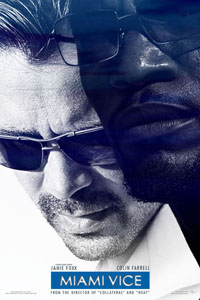 Michael Mann’s “Miami Vice” is a terribly anxious piece of filmmaking. By its own erratic and rote design, the film marks, at once, a substantial step down for the writer/director, and merely a lateral move in the realm of stylistic representation.
Boasting a curious mish-mash of caricatures and equally original representations, it is certainly the most uneven work he has offered to date, and most assuredly the worst film he has produced since the horror of 1983’s “The Keep.” Then again, the “worst” of Michael Mann would usually be a point of envy for most of today’s working filmmakers.
Based on the Anthony Yerkovich-created television series of the same name, “Miami Vice” is a meditation on deception and trust. The film wears its themes on its sleeve, though forgivably so, as, if anything is spread evenly and accomplished absolutely throughout, it is that very concept.
But Mann’s film has an eagerness to it, a misplaced ardency, that leaves the impression of a movie with something to prove. Its chest seems puffed outward from the moment the Universal Pictures logo disappears (immediately bursting into the sounds of Jay Z and Linkin Park at a Miami nightclub), to the slow fade of the closing title screen (a tonally ironic deep, cool blue).
In the adaptation, Colin Farrell and Jamie Foxx fill the classic roles of Sonny Crockett and Ricardo Tubbs respectively. As partners, this aspect of the story provides at least a basis for further exploring the notions of trust and deceit at the film’s core. When Tubbs says to Crockett “I would never doubt you,” it represents the reality of their lives, the only tangible aspect of their profession. It is a point, however, glossed over somewhat and certainly not capitalized upon as it could have been.
A thorough examination of their relationship is not needed, but an understanding of consequence of that relationship is certainly a must, and it is really nowhere to be found, even within the confines of subtext (something at which Mann has proven himself an expert time and again).
The nuts-and-bolts plot of the film plays itself out seemingly as an expansion of one of the series’ various faceless scenarios. After a former informant compromises an FBI undercover operation, Crockett and Tubbs, being a part of the Miami-Dade Police Force and existing outside the confines of any possible leak, are recruited by the Bureau to investigate further – and deep undercover.
 There is then an assortment of expected character types, from the introverted, consistently pondering drug kingpin (Lois Tosar), to the weasel-ish middle man who smells something fishy (a rather diabolically entertaining John Ortiz), to, of course, the tough-as-nails businesswoman-slash-kingpin girlfriend (Gong Li). This triumvirate of typicality is painfully derivative from the get-go, but we’ve seen Mann take the cliché and turn it into stylistic substance before in “Collateral,” so assuredly one could expect as much once more. Sadly, no such turn of events is in store.
The film is truly owned by Colin Farrell, regardless of whose name appears first on the poster and which Oscar-winning actor whined for more prominent status on the film’s payroll. Farrell in fact acts Foxx off the screen for the most part, though Tubbs is admittedly an awkwardly designed character.
He boasts a quasi-romance that is ill-defined with fellow teammate Trudy Joplin (Naomie Harris), and he turns to comedic sensibilities a bit too often in his “undercover” guise, so much so that, were I Crockett, I’d demand a less obvious partner for fear of being gutted by a suspicious drug lord. No matter how rewarding the one-liners might be on one hand, on the other, they simply represent one more wrinkled aspect of the piece that could have used some ironing.
Farrell, however, lives and breathes inside Crockett in perhaps his best performance yet – though his accent does slip at times from the Bronx to the south, oddly enough. He gives us the complexities of the character that are not found on the page (unlike Foxx), and even when the forced romance with Gong Li’s Isabella rears its trying head, we believe the loneliness and the despair that drives Crockett to seek out that connection.
At the very same time, we can sense him reciting the words of Neil McCauley in his head: “Don’t let yourself get attached to anything you are not willing to walk out on in thirty seconds flat if you feel the heat around the corner.” Even still, it is a different idea at work here, one about longing and necessity more so than discipline and detachment.
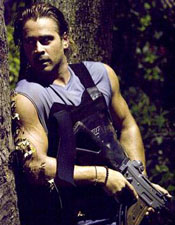 Li, however, seems forever uncomfortable in a position we are meant to believe is some saving grace for her. She shares the solitude of Crockett, the loneliness. That is their common denominator, and the single thread with which we are to buy this romance. But she does not sell that notion in the slightest. She seems almost lost in her character’s dialogue and motives. Who is this woman? Beyond a random anecdote about her mother – a lone wolf in her own right, it seems – from whence does Isabella come? We do not know.
Nor do we know much about Crockett. However, even when he is given the interesting task of peering longingly out of a window in the film’s first act, we know there is something there. But even then, why? What – even possibly – haunts this man? Did his career create a rift between himself and another lover? Various other lovers? Does he pursue a life of lies and deception undercover to escape the realities of his own anonymity? What are the realities of his anonymity?
These themes never even threaten exploration, and the sound of air rapidly filling the space vacated by such dearly departed intricacies of character is all we can hear indeed.
Elsewhere in the cast, John Ortiz weaves a truly villainous serpent, fit with hypnotic syntax and devilish grins. Though his character is painfully ordinary, Ortiz makes him eminently watchable – as does Tom Towles as a despicable and somewhat terrifying man who chews gum as if it were his sole purpose on earth. Furthermore, Barry Shabaka Henley, always a delight, provides a steadfast Lieutenant, a serious and driven man to trust. Even when his dialogue seems forced, we still believe every syllable.
The rest of the cast is somewhat anonymous by Michael Mann’s standards. Here is a director who has always been adept at filling the frame with a variety of characters, but however minute their bearing on the story, there was always dimension to be found.
Domenick Lombardozzi (you’ll recognize him from a cameo performance in this season of “Entourage”), Elizabeth Rodriguez (“ER”), Harris (“28 Days Later”), Tosar (“Los Lunes al Sol”) and Ciarán Hinds (“Munich”) fill their positions by the book. However, the loss of substance in the peripheral cast is felt most painfully in the fact that Justin Theroux (“Mulholland Drive”) is just there, taking up space.
Theroux is one of the most striking and interesting actors of the underrated lot today –- potential movie star material. A Michael Mann film should be his playground, yet there he is, forever an afterthought.
All of that said, John Hawkes’s oh-so-brief work in the film’s opening scenes soaks up the role of Alonzo for all it is worth. It is rare to understand a character so thoroughly in such a brief amount of time, and with such a consistency of emotion and complexity. You’ll recognize Hawkes from last year’s “Me and You and Everyone We Know” and television’s “Deadwood.”
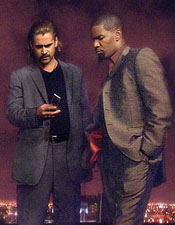 All this talk of the varied cast (however clichéd) has left me little time to fully discuss the technical aspects of the film, all a step down from the vibrant “Collateral,” yet still a move in the right direction for digital cinema.
Dion Beebe’s lensing still lacks the thematic composition of Mann’s work with Dante Spinotti in years past, and even of Emmanuel Lubezki on the underrated “Ali.” However, the juxtaposition of the imagery by way of William Goldenberg’s and Paul Rubell’s film editing keeps the pacing relentless and creative, as always.
Additionally, it seems as if Mann has found a new musical muse in Audioslave, the remnants of a singerless Rage Against the Machine with Soundgarden’s Chris Cornell at the mic. Mann has always been a fan of Moby (and seemingly still is, given the inclusion of “Anthem” and “One of These Mornings”), but this is the second time Audioslave has been featured so prominently in one of his films (following the potent usage of “Shadow on the Sun” in “Collateral”). The band contributes two new and appealing songs to the film’s soundtrack, but sadly, said soundtrack feels like a mix CD, a new track every other minute.
Mann is a master of aural atmospherics, and the sparse score even recalls the majesty of Elliot Goldenthal’s work on “Heat” at times. However, such things seem entirely rushed and thoughtless in his latest effort.
The question with which one is left after viewing “Miami Vice” is “Why did Michael Mann want to make this film?” Was it the desire to dig into the theme of lies through the world of undercover policing, as has been reported? Likely. But if so, where is the passion we’ve come to expect of his work when he is so focused, so driven? Where is the touch of humanity that seems almost organic? Why does this script feel as if Syd Field deserves a credit? Why such typicality?
These all become rhetorical questions in the final analysis, but as filmgoers, we will be quite the lucky when Mann decides to leave the desire for romp behind and tackles much more personal and engaging fare once again.
“Miami Vice” is anything but personal. It is a – sometimes – gratuitously violent (Verhoeven-level), generally by the numbers actioner with elements of depth and promises of texture that are more often teased than explored. It is vacant and even elementary on as many levels as it hopes to be poignant and thematically authoritative, and though it concludes with the emotional tinge that recalls Michael Mann cinema, it fails to reach the bar he has set for himself.
It is a high bar indeed. Perhaps he is doomed to chase it forever.