In Contention

Tag: A History of Violence

  • TORONTO: Ed Harris on ‘Appaloosa,’ acting and film crticism

    Ed HarrisWalking into to interview with any actor/director can be a tad intimidating, even after 20 years of doing it.  They have a tendency to be…difficult.  But 30 minutes into my interview with Ed Harris, he pays me a compliment that could keep wind in my sails for the duration of the fest: “Thank you for your integrity, intelligence and dedication to your job.  This has been a pleasure.”  He smiled as we shook hands and he walked me to the door

    Harris has been an actor I have admired since first seeing him as squeaky clean John Glenn in “The Right Stuff” back in 1983, which he followed with a chilling turn as a mercenary in “Under Fire,” his bright blue eyes windows into hell’s furnace. His career has moved along an interesting trajectory, shifting between supporting roles and leads with ease, often dominating whatever film he takes on with powerhouse acting.

    Oddly enough, he did not receive his first Oscar nomination until 1995 when he gave a sterling performance as Gene Kranz in “Apollo 13,” followed by another brilliant turn in “The Truman Show” as a God-like TV producer. He nurtured his dream project, “Pollock,” through its funding, before taking up the reins as director and grabbing another Oscar nod in front of the camera. And in 2002 he was nominated for a fourth time for his AIDS-afflicted writer in “The Hours,” a critically acclaimed ensemble piece from director Stephen Daldry.

    It is doubtful that “Appaloosa” will see any Oscar attention.  Though it is beautifully shot and the art direction is sublime, the film was something of a letdown, despite strong work from Harris and co-stars Viggo Mortensen and Jeremy Irons.

    “I gave the book to Viggo here at this festival in 2005,” Harris said, “when we were here for ‘A History of Violence.’ There was no one else I really wanted to do the film with, and I certainly never considered anyone else. I just thought he and I would make a strong partnership on screen. We don’t hang out, I mean we’re friends, but we don’t see much of each other. He agreed to do it, and Viggo’s the sort of guy where his word is his bond, so that gave me the start to keep moving on the film. It didn’t really occur to me that the film was a western, what struck me was the relationship between these two men in 1882, that’s what really grabbed me about the film. That it happened to be a western was incidental.”

    (more…)

  • Don’t give up on Maria Bello

    It is a well-known fact (okay, okay, this writer’s opinion) that Maria Bello was robbed of a 2005 Oscar nomination for Best Supporting Actress for her taut, unnerving performance in Cronenberg’s “A History of Violence,” despite a gong from the New York critics and a (lead) nomination at the Globes. (She wasn’t far off for “The Cooler” a year previously, either.)

    Now you may recall (though I wouldn’t blame you if you’d already forgotten) that the winner of Best Supporting Actress that year was Rachel Weisz for her agreeable and, in my opinion, wholly unremarkable work in “The Constant Gardener.” It’s a win I’ve never really understood.

    Now, in a depressing twist of fate, Bello finds herself taking over Weisz’s role in the godawful “Mummy” franchise, the latest installment of which Kris seems less than keen on. If you ever needed a textbook demonstration of the difference an Oscar (or at least a nomination) can make to an actor’s career, there you have it.

    However, in an interesting Guardian interview with the excellent film writer Ryan Gilbey, Bello appears to be making the best of a bad situation. The usually more indie-minded actress tells Gilbey that she’s always hankered after just such a part:

    I’ve been telling my agent for years that I wanted an action movie, but no one saw me like that. Two weeks before my 40th birthday, I guess I’d given up. I mean, how many action roles are there for women over 40? Soon after that, I got a call to say they were considering me for the part.

    (more…)

  • What are the best movie endings of all time?

    Kevin Spacey in The Usual SuspectsI was working on this piece yesterday (nothing major — just pulling together the YouTube clips), but I wasn’t aware how the list was going to pan out.  “Carrie” at the top?  Not so sure about that.

    But The Times critics like to be contrarian.  Just take a look at their Top 100 Films of All Time list, which places Paul Thomas Anderson’s “There Will Be Blood” rather brazenly at #2.

    Anyway, debating and sussing out the best of movie endings ever could have us chatting into the night.  Most of my favorites are recent examples, but that’s probably due to what the 1990s did to the screenwriting form.

    Scribes began giving a lot more thought to how the audience would feel when leaving the theater.  Twists and emotional-punches became a currency of sorts, which is probably why there are more films from the decade than any other on The Times’ list.

    I will say I’m glad there was room for “Seven,” “Memento” (which I re-watched recently and absolutely adore) and “E.T.,” three (perhaps) out-of-the-box choices that don’t leap to mind when the subject comes up.  And it’s impossible to argue against “The Usual Suspects,” “Butch Cassidy and the Sundance Kid” and “Planet of the Apes.”

    If I were to suggest a some additions, I might begin with “Heat,” “Citizen Kane,” “A History of Violence,” “Jacob’s Ladder” and “Boogie Nights,” to name a few.

    The Times’ list of the best movie endings of all time:

    1. “Carrie”
    2. “Butch Cassidy and the Sundance Kid”
    3. “Casablanca”
    4. “E.T.: The Extra-Terrestrial”
    5. “Chinatown”
    6. “Breakfast at Tiffany’s”
    7. “Some Like It Hot”
    8. “The Italian Job” (1969)
    9. “The Usual Suspects”
    10. “The Sixth Sense”
    11. “Thelma & Louise”
    12. “The Wizard of Oz”
    13. “Les Diaboliques”
    14. “Dr. Stranglelove”
    15. “Gone With the Wind”
    16. “The Shawshank Redemption”
    17. “Planet of the Apes”
    18. “Memento”
    19. “The Blair Witch Project”
    20. “Seven”

    I might pull together my own top ten soon enough.

    What are your favorite movie endings?

  • Best in show 2005: the year in superlatives

    It’s time to really round out the year and offer up my picks for awards in 2005.
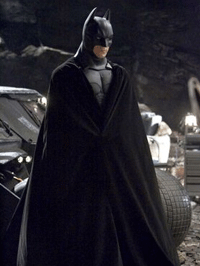
    In addition to the typical categories – which finally see their winners announced today – you’ll find some other fun arenas for awards citation. Call it a mish-mash of MTV-Awards-type kudos and other frequently heralded categories we find time to time in various critics’ awards and precursor ceremonies.

    No one is better at this sort of thing than Nat Rogers over at The Film Experience, so I recommend you all take a look at his Film Bitch awards when he dishes them out in the coming weeks.

    These will likely be my last extensive thoughts on the awards season this year, barring any brief comments I may or may not make here and/or there. There will, of course, be one final predictions update before the end of the year.

    It feels good to wrap everything up before Christmas vacation, I have to tell you. But the Oscar season is by no means over, so I’ll be diving right back in once 2006 finally rolls around.

    (more…)

  • If I had a ballot

    Customarily, here in the midst of our year in review, it is time for me to fill out my ballot.
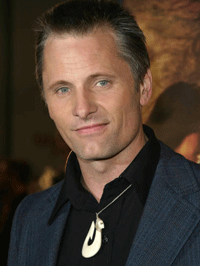
    I do this every year, pretending, for one brief moment, to be one of the 6,000 members of the Academy of Motion Picture Arts and Sciences and fulfilling my own fantasies about who does and does not deserve Academy recognition in their numerous categories.

    Be sure to check back on Friday as we wrap up the “Year in Review” with a list of superlatives. There you will find the respective winners of the categories listed below (given the top ten list you can easily discern Best Picture), as well as a bevy of other random categories for your reading pleasure.

    If I had a ballot:

    Best Picture
    Batman Begins (Warner Bros. Pictures)
    Crash (Lions Gate Films)
    A History of Violence (New Line Cinema)
    Last Days (Fine Line Features)
    March of the Penguins (Warner Independent Pictures)

    (more…)

  • INTERVIEW: Viggo Mortensen

    “I think Americans are good people, but I don’t think they’re better or worse than anybody else in the world. I am particularly proud of the fact that, in spite of the pathetic performance of our government in relation to what happened, how it could have been prepared for and reaction after the fact to the hurricane, and now there’s another one today, and tomorrow coming in hard – it didn’t matter what the government did or didn’t do or how they wanted to hide or make excuses. People took care of business, and continue to. I think people are essentially resilient and people surprise us – the good they can do, the compassion they can display. Humans are unique in that sense compared to other animals, just like in this story. They can reason and say ‘no, that’s not the right way. It may be difficult, but I want to struggle against being that way.’ They can also reach out to help people that they don’t even know for no particular reason other than it’s the right thing to do. And you can see that happening right now. That always give you hope for the future.”

    -Viggo Mortensen, Beverly Hills, Septmber 22, 2005

    Actor Viggo Mortensen has an eclectic sense of artistry.

    He is keen on storytelling, not only through his work as a thespian, but also through his efforts in literature and even photography. Maria Bello describes him as being a man whom you cannot separate from his art, and speaking directly with the actor, one detects an unabashed sense of cultural acuity – an attunement with the world of self-expression.

    (more…)

  • INTERVIEW: Maria Bello

    Actress Maria Bello tells it how it is.

    She seemingly refuses to censor herself, and in an interview setting she is perfectly comfortable allowing her thought process to be put on display. She’s headstrong, contemplative and overwhelmingly sensitive to the natural process of learning, be it through life, through career, through love or through family. She’s one of the few who seems to approach acting from within rather than from without, and as such, she was the perfect candidate for the demanding and crucial role of Edie Stall in David Cronenberg’s A History of Violence.

    An actress with roots in television, including a modest stint on NBC’s “ER”, Bello has made rather defining marks in her cinematic output thus far. She typically finds herself portraying ladies mesmerized by their leading men.

    In Permanent Midnight, she played the whimsical groupie (of sorts) to Ben Stiller’s former junkie screenwriter. In Auto Focus she found face-time opposite Greg Kinnear’s sex-addicted Bob Crane. In The Cooler she bounced off of the passive and reactive William H. Macy as a call girl searching for a pulse in lighted but lifeless Las Vegas. And this year, she offers her best work to date, opposite Viggo Mortensen, portraying equal parts of fear, loathing and intrigue as the wife of a man caught between a clouded past and a hopeful future.

    (more…)

  • INTERVIEW: David Cronenberg

    Filmmaker David Cronenberg has made a career out of disturbing imagery. From James Woods shoving a videotape through his stomach in 1983’s Videodrome to James Spader getting off with a crippled Holly Hunter in 1996’s Crash; Jeff Goldblum spewing acid in 1986’s The Fly to the construction of a weapon made of human bones in eXistenZ, Cronenberg has found a knack for concocting horrifying cinematic incarnations.
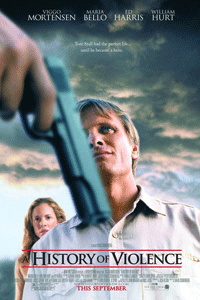
    His latest film, A History of Violence, opened in limited release last weekend. The film is, by and large, his most subtle effort to date. By that same token, it is also the most disturbing work of his career.

    One would never expect such fantastic imaginings to come from the brain of this modest, quiet and unassuming individual. Mr. Cronenberg sits with Zen-like contentment when both surrounded by a roundtable of harping journalists, as well as in private, having just received news of a rave review from The New York Times. He is a man who seems very comfortable in his own skin, peering out at the world he envisions through piercing blue eyes, under furry mantle-like gray eyebrows. He seems quite capable of amusing himself through his work as an artist.

    (more…)

  • REVIEW: “A History of Violence” (***1/2)

    A History of Violence“A History of Violence” is going to be David Cronenberg’s crowning glory. It’s the film that has something to say about every cinematic endeavor in his lengthy portfolio. It’s the film that time will remember him by.
    Based on a gritty graphic novel by John Wagner, the film is a commentary on the nature of violence, the mechanics of its simplicity and the mechanics of its complicity. It’s an account of the effect violence has on a household, on a town, on many different psyches. It’s one of the smartest subtextual films of the year, yet the subtext seems obvious. But it’s not.

    “A History of Violence” is a very intricate film.

    The fascination is that to be so meticulous in its thematics, the story is relayed in a very elementary fashion. No fancy tricks, no overwrought hand-to-mouth relay – just basic, almost painfully simple storytelling. I would say that not only is it Cronenberg’s most accessible film, but it is potentially his most disturbing. And, obviously, that is saying a LOT.

    The events take place in Millbrook, a picturesque small-town setting that stands almost archetypal in the midst of an upcoming storm. The storm comes in the form of two mass murderers waltzing into Tom Stall’s (Viggo Mortensen) downtown diner with evil intentions. After handily disposing of the would-be murderer/rapists, Stall is catapulted into the limelight as an unassuming hero. He soon finds himself at the whims of Philadelphia mobster Carl Fogaty (Ed Harris) and his band of cronies, expressing a vested interest in this small town savior.

    The violence in the film is extensive and at times outrageous, though it retains a level of creativity and relevance that keeps it from becoming gratuitous – shockingly. The gore is stomach-turning, to be sure, but vital to the components of the story Cronenberg is telling. Ultimately, it’s all seemingly a justification for the career he has made in the splatter business, as if it’s all been a long, slow ride to this moment, this declaration, this brand of insightful commentary.

    Furthermore, the film boasts one of the most organic ensemble performances of the year.

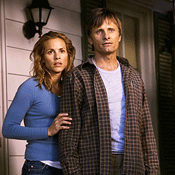
    (from left) Maria Bello and Viggo Mortensen in A History of ViolenceMortensen portrays Stall with a particular ease. Rather he inhabits him, giving the kind of performance that true acting is all about. At the same time, it’s the sort of work that gets ignored during awards season in favor of showier turns.

    Ed Harris springs onto the screen as the creepy Fogaty, and I have to say he sculpts the character off the page better than any other actor could have managed. On paper, Fogaty is assuredly a device if anything. Harris breathes him in and out and terrifies accordingly, though I must admit it’s missing a certain something to be considered formidable in the Oscar ring.

    William Hurt’s five minute cameo is one of the best pieces of work this year, a barrel of laughs and yet a swift study in acting perfection. Yes, perfection.

    But the real stand-out is Maria Bello. Bello was passed over by the Academy for a notice in 2003 for her multi-lauded performance in The Cooler, but I don’t expect that to be the case this year. If “A History of Violence” has any real shot at Oscar recognition, it is for her explosive performance. This is fire-breathing, gut-wrenching, head-spinning work. The layers that would be considered missing in a film like this, one that could easily be labeled “surface,” she adds them…in spades.

    A final note, “A History of Violence” also has something to say about passion. I’m not afraid to say that I haven’t quite put my finger on it yet, but it has something to do with two raunchy sex scenes that manage to remain out of the realm of gratuitous – much like the violence – as well as the motivations behind the character of Stall and why he is where he is at the film’s open. There is most definitely a point being made about desire, vehemence and conviction. It’s lurking – much like the film.

    I can’t wait to see this again.