In Contention

Tag: All the President’s Men

  • INTERVIEW: Dustin Hoffman

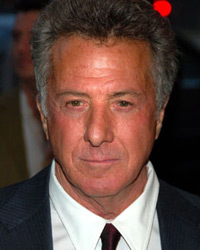
    Dustin HoffmanHe doesn’t seem like Dustin Hoffman for some reason.  He sounds like Dustin Hoffman.  He looks like him.  But there aren’t really any traces of his decades-long assemblage of characters.  And he’s got an approachability that seems somehow uncommon for a star of his stature.

    But there he is, piecing together a sandwich with arugula, veggie cheese, spicy mustard and wheat bread as he recalls his first major interview with Studs Terkel over 40 years ago.  Terkel has passed recently, which brought the topic to the fore.

    “It was Chicago, right after ‘The Graduate,’” Hoffman says.  “I went into his office and he had floor-to-ceiling books and everything, you know.  The office looked like him.  He turns the tape recorder on and it was an intricate and intensive interview that probably went on for over two hours.  We shook hands and he said, ‘Let me just check’ — and the tape didn’t work.  It had been blanked for some reason.  So he says, ‘You wouldn’t mind doing it again?”

    So it was that we kicked off our own two-hour conversation, one steering in and out of his legendary career, briefly touching on the particulars of his latest film, “Last Chance Harvey” (now playing in limited release and for which Hoffman received a Golden Globe nomination for Best Actor), but mostly wandering from this mundane particular to that.

    He has a fondness for iron furniture, a number of antiques peppering his Brentwood offices.  A large Italian “Midnight Cowboy” poster hangs in the lobby, but I’m caught off guard by the food and drink spread in the hallway as we move into his personal office.  The dainty dishes and cutlery seem to clash with the casual air of the actor before me.
    (more…)

  • THE LISTS: Top 10 films of the 1970s

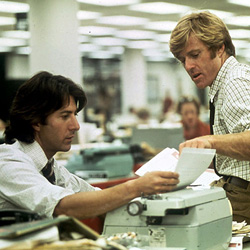
    (from left) Dustin Hoffman and Robert Redford in All the President's MenWhen critics and historians of the cinema sit down to discuss uh, cinema, the conversation almost always turns to the great decades in movie history. And n nearly conversation I’ve been a part of, the 1970s reigns supreme as the single decade of brilliance.
    It was a time of enormous artistic growth for film, as up-and-coming directors grabbed Hollywood and ran with it, merging their love for cinema and the works of John Ford, Billy Wilder, and Elia Kazan (among others) with their own fresh ideas. And the releases of “Bonnie and Clyde,” “The Graduate” and “2001: A Space Odyssey” had already announced the arrival of the new American cinema by the end of the 1960s.

    But the next 10 years brought us Francis Ford Coppola, who exploded onto the scene wit four brilliant works and mentored many of the younger directors of the time. Steven Spielberg would earn the name “whiz kid” for his incredible visual storytelling gifts that would eventually make him one of the greats of all time.

    Martin Scorsese was making unsettling character studies that alarmed the studios but thrilled critics and actors, who felt challenged by his work. Woody Allen evolved from comedy writer, to comedic actor-director, to world-class filmmaker by the end of the decade. And Oscar winning film editor Hal Ashby would make a name for himself behind the camera with a swath of works.

    Sidney Lumet, William Friedkin, Peter Bogdonavich, Bob Fosse, Roman Polanski, Bernadro Bertolucci, Alan J. Pakula, Milos Forman, and Michael Cimino would all leave their mark in the 1970s and continue directing to varying degrees of success in the 1980s and beyond.

    Society heavily impacted the work as films about the war in Vietnam dominated much of the 70s’ final years. Watergate raged mid-decade. Stories were plucked from the headlines and committed to celluloid. Movies were exciting, well made, and interesting. Films like John Frankenheimer’s “Black Sunday,” Milos Forman’s “Hair” and Don Siegel’s “The Shootist.”

    Big budget disaster films enlivened the trade, along with movies about divorce, drug addiction, mental illness, organized crime, vigilantes, prostitution, and countless other topical issues that were explored with great courage on screen. I found narrowing it down to a 10 best list to be nearly impossible and enormously frustrating because some the films left off the list should really be here. But that’s just a testament to the era’s resilience.

    (more…)

  • Who joins the great Best Picture snubs this year?

    It happens every year, a great film, in some cases destined to be remembered more than the eventual Oscar winner is snubbed for a Best Picture nod, or gets nominated and loses to an inferior film that happened to capture the public’s attention at that particular point in history.

    Some of the greatest films of all time lost the top award, “Citizen Kane” among them, arguably the greatest of all time (though I disagree). “The Treasure of the Sierra Madre”, easily John Huston’s best work, joins the list, as does “The Searchers,” which is in my opinion the finest western ever made and contains the greatest John Wayne performance of all time.

    Remember “Rocky” winning over “All the President’s Men,” “Network” and “Taxi Driver?” Or “Kramer vs. Kramer” over “Apocalypse Now?” In the last twenty years, Oscar has pulled some howlers, some choices that left me nearly putting my foot through the television upon the announcement. The first time I remember being really, truly angry at a lame decision was in 1981 when “Chariots of Fire” bested Warren Beatty’s “Reds,” which I believe to be among the best films of the 80s.

    (more…)