In Contention

Tag: Close Encounters of the Third Kind

  • ‘Revolutionary Road’ — snubbed today, sure to be remembered forever

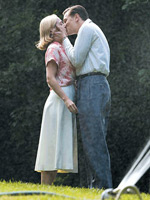
    Kate Winslet and Leonardo DiCaprio in Revolutionary RoadOne of the biggest surprises of the awards season for me is the fact that “Revolutionary Road” is being all but forgotten by many critics groups and has certainly slipped off the Oscar radar as a result. Is the film deserving?  Absolutley.  I think it is one of the best films of the year and among the finest I have seen this decade, but for whatever reason — and who can explain these things — it has not gotten a great deal of press.

    This is a major accomplishment, a work of art superbly directed by Sam Mendes who in eight years has become one of the most exciting directors in modern cinema. Though I count myself among those who though his breakthrough film “American Beauty” was very good but also radically over-praised, his follow-up, “Road to Perdition,” was superb and should have been among the nominees for Best Picture and Best Director in 2002, vastly superior to “Chicago.”

    His third film, “Jarhead,”  was darkly beautiful to look at but didn’t quite work with audiences who are still not interested in films about Afghanistan or Iraq (whichever installment).  Mendes possesses a gift with actors, one of those directors like Woody Allen, Martin Scorsese and more recently, Paul Thomas Anderson.  He’s able to bring out their best work.  It seems no surprise he married an actress.

    He is also patient with a narrative, allowing it to unfold with the knowledge the audience connects with the actors.  With “Revolutionary Road,” he has cranked out a crowning achievement in a career just getting started, and yet like so many other masterworks, it may slip through the cracks, barely noticed.
    (more…)

  • THE LISTS: Top 10 films of the 1970s

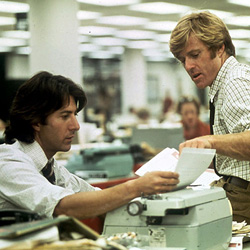
    (from left) Dustin Hoffman and Robert Redford in All the President's MenWhen critics and historians of the cinema sit down to discuss uh, cinema, the conversation almost always turns to the great decades in movie history. And n nearly conversation I’ve been a part of, the 1970s reigns supreme as the single decade of brilliance.

    It was a time of enormous artistic growth for film, as up-and-coming directors grabbed Hollywood and ran with it, merging their love for cinema and the works of John Ford, Billy Wilder, and Elia Kazan (among others) with their own fresh ideas. And the releases of “Bonnie and Clyde,” “The Graduate” and “2001: A Space Odyssey” had already announced the arrival of the new American cinema by the end of the 1960s.

    But the next 10 years brought us Francis Ford Coppola, who exploded onto the scene wit four brilliant works and mentored many of the younger directors of the time. Steven Spielberg would earn the name “whiz kid” for his incredible visual storytelling gifts that would eventually make him one of the greats of all time.

    Martin Scorsese was making unsettling character studies that alarmed the studios but thrilled critics and actors, who felt challenged by his work. Woody Allen evolved from comedy writer, to comedic actor-director, to world-class filmmaker by the end of the decade. And Oscar winning film editor Hal Ashby would make a name for himself behind the camera with a swath of works.

    Sidney Lumet, William Friedkin, Peter Bogdonavich, Bob Fosse, Roman Polanski, Bernadro Bertolucci, Alan J. Pakula, Milos Forman, and Michael Cimino would all leave their mark in the 1970s and continue directing to varying degrees of success in the 1980s and beyond.

    Society heavily impacted the work as films about the war in Vietnam dominated much of the 70s’ final years. Watergate raged mid-decade. Stories were plucked from the headlines and committed to celluloid. Movies were exciting, well made, and interesting. Films like John Frankenheimer’s “Black Sunday,” Milos Forman’s “Hair” and Don Siegel’s “The Shootist.”

    Big budget disaster films enlivened the trade, along with movies about divorce, drug addiction, mental illness, organized crime, vigilantes, prostitution, and countless other topical issues that were explored with great courage on screen. I found narrowing it down to a 10 best list to be nearly impossible and enormously frustrating because some the films left off the list should really be here. But that’s just a testament to the era’s resilience.

    (more…)

  • Spielberg and blockbusters

    Can he do it? After becoming (in his own eyes) a serious filmmaker with “Schindler’s List,” “Amistad,” “Saving Private Ryan,” “A.I.” and “Munich,” is Steven Spielberg able to re-create the magic he almost always brought to his pure entertainment blockbusters?

    It takes a look at his journey as an artist to even attempt a reasoned understanding of such a question.

    On one hand, I argue that he was always a brilliant director, “Jaws,” “Close Encounters of the Third Kind,” “Raiders of the Lost Ark,” and “E.T.” all great examples of his artistry, yet he himself was never satisfied by the reaction to those films by the Academy. It is well documented that Spielberg coveted acceptance in the film community, seeing the Oscar for Best Director as the ultimate acceptance from Hollywood. Snubbed for “Jaws” in 1975, he behaved like a petulant child as live cameras caught it all on film, invited in to see his reaction when he was nominated…but — he wasn’t.

    (more…)