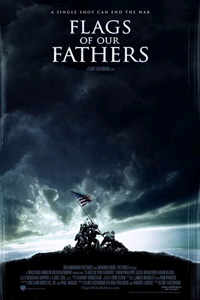
 Clint Eastwood is largely considered one of the most uneven directors working today. For every probing piece of thematic greatness (“Unforgiven,” “Mystic River”) there are three or four considerable missteps, from “The Gauntlet” and “Heartbreak Ridge” to “Midnight in the Garden of Good and Evil” and “Blood Work.”
Such inconsistency is the price a hard-working filmmaker pays, for anyone willing to crank out a new project every other year for three decades is bound to miss the bull’s-eye frequently.
At the same time, amidst these lesser efforts, Eastwood has always shown a process of honing his artistry, remaining a singular talent and every once in a while experiencing the serendipity of matching that talent with exceptional material. Indeed, more often than not, a failing Clint Eastwood film is doomed on the page before principle photography even begins.
“Flags of Our Fathers” is certainly a singular figment of the war film oeuvre, fit with promising themes rather unrepresented in the genre’s history that speak eloquently to today’s environment of deception of the masses for the gain of the establishment.
But it is also an exercise ultimately hampered by an unfocused and erratic narrative, one that constantly seems to be searching for itself and feels hastily lifted from the pages of James Bradley’s best selling book of the same name by William Broyles, Jr. and last year’s Oscar-winning scribe Paul Haggis.
Bradley’s book was a personal endeavor for the author. The son of John Bradley, one of the six infamous Iwo Jima flag-raisers immortalized by Associated Press photographer Joe Rosenthal in March of 1945, James Bradley crafted a human account of the lives of unassuming heroes captured in time. Only three of them survived the war to see the image’s impact on the western world, and within the pages of “Flags of Our Fathers,” their stories are told with painstaking clarity and at times sluggish accuracy.
The task in adapting the book as a film was to amplify the central theme of manipulation and marketing for the greater good. Broyles and Haggis succeed in doing this to a point, but as the yarn unfolds, the depth of potential seems to thin out in the mix.
The three survivors in the photo were John “Doc” Bradley (Ryan Phillippe), a medic who certainly saw his share of carnage on Iwo Jima; Rene Gagnon (Jesse Bradford), a man portrayed as intent on becoming a “hero”; and Ira Hayes (Adam Beach), a Pima Native American paradoxically proud to serve a country that had relegated his people to the confines of reservations.
Upon their return to the United States, the flag-raisers find themselves ensnared in a publicity tour that represents the core of what Haggis is trying to get across. Behind the scenes, the aim is for Rosenthal’s lasting image to spearhead a wave of hope and patriotism that will inspire citizens to purchase bonds as the country suffers financial asphyxiation four years into the war.
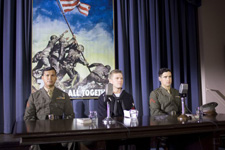 The ubiquity of the photo puts Gagnon in the appreciated place he had sought to be, Hayes in the hesitant position he feels he doesn’t deserve, and Bradley as an awkward observer of it all, strangely passive as a character, given the book’s origins.
This repetitive sense of exhaustive handling is intercut with the infamous battle that claimed the lives of over 27,000 human beings – three quarters of them Japanese. More congressional medals of honor were awarded for the Battle of Iwo Jima than any other battle in American history.
A large chunk of this military excursion is presented in the first act – a good ten or fifteen minutes of solid chaos. Had Haggis chosen to tell the story in a more linear fashion, keeping the battle at the top and using its memory as a haunting element throughout the rest of the film, the pieces might have come together more organically.
But the stink of manipulation and even amateurism emanates from the decision to continuously go back to Iwo Jima when it feels thematically relevant.
Eastwood and his technical crew, not the least of which being cinematographer Tom Stern and film editor Joel Cox, do a marvelous job of conveying an unnerving and multi-faceted battle sequence that will draw comparisons to Steven Spielberg’s “Saving Private Ryan.”
Eastwood is working with much more than land infantry here, however, mixing in air battalions, battleship artillery and the symbiosis of it all as it pertains to the taking of Mount Suribachi on the east side of the island. Exceptional visual effects mix seamlessly with Stern’s washed out photography for a truly gripping and visceral experience.
However, where Spielberg successfully utilized the Battle of Normandy to visually tell his story, Eastwood seems to get lost in the elements, sacrificing thematics for admittedly surprising capabilities in the trenches.
All of this might have made for a much more tolerable, even above average war film had the third act not dived so gratuitously into the binding structure of the rest of the film. Multiple perspectives and narrations carry the tale here and there through fleeting scenes depicting James Bradley (portrayed by Tom McCarthy) interviewing subjects and preparing his book.
It was laid out from the start, and a return ought to have been expected, but regardless, once the final act commences, the screenwriters make the unwise decision to concentrate on this aspect of the story for purposes much more sentimental than thematic. And each unrelenting cue of a typically repetitive Eastwood score amplifies this perception of the final leg of the film.
The performances throughout represent a true ensemble, but the focal points are surely Phillippe, Beach and Bradford. Phillippe handles an under-written leading role as well as can be expected (that’s really all that can be said), while Bradford puts forth a stock, self-serving and rather uncomplicated character that hedges its bets in an obvious attempt by the screenwriter to steer clear of disrespect.
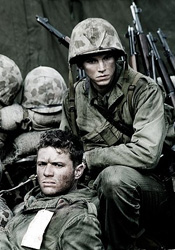 Elsewhere, John Slattery offers a great supporting turn as the point man on this public relations whirlwind. Barry Pepper, in the role of flag-raiser Mike Strank, comfortably stifles the urge to take a tough-as-nails character to the same places he has taken numerous similar characters numerous times before.
Neal McDonough and Robert Patrick fill out the higher military ranks accordingly, while Jamie Bell, Joseph Cross, Benjamin Walker and a thankfully muted Paul Walker (as mistaken flag-raiser Hank Hansen) seem to blend together in the surrounding scenery.
The real find of the film, however, is Adam Beach, already a 16 year veteran in the business and on the cusp of a defining moment in his career. Portraying an alcoholic Native American in Ira Hayes (a character that attempts to avoid cliché when it can), Beach’s role automatically exists as the most complicated of the lot.
There are times when the viewer catches a whiff of over-reaching in his performance, but more often than not, the 33-year-old actor lands the right emotional notes in key scenes that will evoke the most heart-felt reaction from audiences. Even amidst a continuously tepid reaction to the goings-on, this viewer felt the threat of a tear when Hayes visibly breaks down and hugs the mother of one of his fallen comrades with all the meaning in the world.
As war films go, “Flags of Our Fathers” had the opportunity to speak to greater truths of the actual machine of war than any other film of its kind. The John Ford “print the legend” quality of the story is definitely apparent, and as mentioned at the top, these notions speak volumes to the modern environment of vast manipulation, deceit and even celebrity. But they seem to be fighting through the dense foliage of spectacle at times, and at other times, the elaborate design of unnecessary artistry.
Much of this is ultimately forgivable, however, if somewhat hesitantly so.
Eastwood is as surprising as he is predictable in that he never seems to fully collapse under the burden of something new or unfamiliar. He has found himself adept at conveying epic stories through the intimate brushstrokes of character in the past, the truest examples being his early westerns “High Plains Drifter” and especially “The Outlaw Josey Wales.”
“Flags of Our Fathers” feels like his third or fourth war film endeavor much more than it does his first. It was a valiant effort and a unique experience, but it ultimately isn’t enough to stretch beyond definitive flaws in the screenplay.
During the production of “Flags of Our Fathers,” Eastwood reportedly felt as if he wasn’t conveying the full story of the Battle of Iwo Jima. With this in mind, he set about preparing “Letters from Iwo Jima” (formerly “Red Sun, Black Sand”). Told from the Japanese perspective and releasing February 9, 2007 from Warner Bros. Pictures, “Letters” may or may not find itself more in tune with its own thematic structure than “Flags of Our Fathers.”
Regardless, as a duet, the films will inevitably find themselves unique in the pantheon of anti-war cinema. It’s nice to see a seasoned filmmaker being this ambitious, and no matter how you slice it, these two films are an ambitious enterprise to say the least.
 It’s been a while since I’ve committed to a long-form review, and for that, I have to apologize. Short Takes here and there don’t exactly cut it, but we’ve certainly stayed afloat in this light with Guy’s wonderful work across the pond. I don’t get a chance to sit down and hammer out some thoughts very often, and I’m hoping that will change in the coming weeks.
 Does Clint Eastwood ever sleep? With “Changeling” and “Gran Torino” set to keep his profile high in 2008, Variety

