Given their dual tributes at Telluride this year, it seems perfectly reasonable to revisit this gem of a scene:
And lest fellow tributee Pierre Étaix feel left out, a nod to his work after the jump.
Given their dual tributes at Telluride this year, it seems perfectly reasonable to revisit this gem of a scene:
And lest fellow tributee Pierre Étaix feel left out, a nod to his work after the jump.
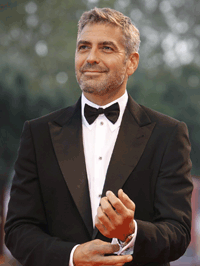 George Clooney has been tapped this year for one of Telluride’s three big tributes, and it’s certainly the biggest of the trio. Whether it’s press and patrons schmoozing with the star at yesterday’s Patron Brunch, whispers around town (“Did you hear George Clooney is here?” “I really hope ‘The Ides of March’ is a TBA.”) or the ecstatic response to Alexander Payne’s “The Descendants,” this mountain burgh has been taken by Clooney fever.
It’s a curious thing to see happen here at a festival that is so smooth and cool and not at all phased by celebrity. Clooney changes all those rules, though. And most of it has to be owed to his trooper disposition and charming charisma. He’s always “on,” and just about everyone wants to just throw back a few with the guy. Men want to be him, women want to…well, you get my drift.
I tend to stay away from the tributes and spend that time taking in a film at Telluride. But since the actor is set to be feted later this evening, I thought I’d at least dedicate some space to his still in-progress career and the highlights that have brought him to this point.
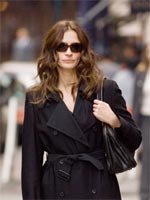 I must say, I liked the look of Tony Gilroy’s “Duplicity” from the get-go. However, being a sucker for jazzy caper thrillers in the “Charade” vein, as well as for most things starring Clive Owen, I wasn’t sure whether to trust my instincts there.
In any case, given the amiable slightness of the trailer and the indifferent release date (not to mention that awful title), I wasn’t expecting a critical hit — but going on the early trade reviews, it looks like that’s what we may have here. Todd McCarthy’s Variety rave gushes as follows:
Smart, droll and dazzling to look at and listen to, writer-director Tony Gilroy’s effervescent, intricately plotted puzzler proves in every way superior to his 2007 success “Michael Clayton.” The twisty, time jumping narrative forces viewers to keep on their toes, and it could well be that “Duplicity” is too smart for its own good as far as the popcorn masses are concerned. Still, this is about as good as it gets these days for sharp-minded Hollywood entertainment made for an intelligent audience.
Topping “Michael Clayton” isn’t the hardest of tasks in my mind, but given the devoted following the film enjoys, that’s no light praise: McCarthy invokes Lubitsch comparisons at one point. Meanwhile, nearly every major cast member and craftsman (a pretty dazzling array, it must be said, including Robert Elswit, Albert Wolsky and James Newton Howard) is singled out for kudos.
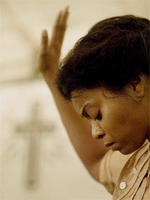 Stu Van Airsdale is cheekily posing a scenario whereby “The Curious Case of Benjamin Button” converts precisely zero of its 13 nominations into victory on Oscar night.
It’s not really worth picking holes in his argument — though we could start with the fact that “Button” is nominated for Sound Mixing rather than Sound Editing, or that he doesn’t seem to consider “Slumdog” the frontrunner for Film Editing — because the article is less interesting for its specifics than for how it taps into the general indifference that “Button” seems to be facing. Has a film with such an impressive Oscar tally ever looked a less formidable competitor going into the race?
On nomination day, AwardsDaily posted a handy list of the ten previous films that have received 13 or 14 nods. Seven of them won Best Picture. Two of them (“Mary Poppins” and “Who’s Afraid of Virginia Woolf?”) each took a healthy haul of five awards apiece, major acting trophies among them. The last, “The Lord of the Rings: The Fellowship of the Ring,” was limited to technical victories, though in an odd year, with splintered support for “Moulin Rouge!” and eventual champ “A Beautiful Mind,” it wasn’t a complete non-starter — and in any case, everyone knew there was more to come.
Right now, I side with Kris in predicting a scant three trophies for “Button,” in the Art Direction, Makeup and Visual Effects field. (Unpredictably scattered as the tech categories have been in recent years, I’d be very surprised if it missed in the latter two categories, at the very least.) So, is the film set to reap an all-time low from its nomination tally? Or are we underestimating it?
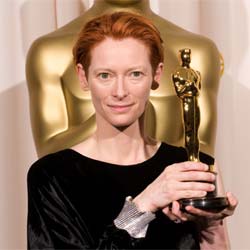
As it stands, I’m starting to wonder if Taraji P. Henson may have more of a shot in the comparatively open Best Supporting Actress field than I thought earlier. Last year, Tilda Swinton eked out a victory in the same category after “Michael Clayton” fans realized she represented the film’s only shot at a major award. If voters don’t want to humiliate the season’s biggest, most-nominated film, could Henson be a similar beneficiary? Just a thought.
 As we head into the thick of awards season, one of the biggest “will-they-won’t-they” questions about this year’s Academy Awards concerns one of their most favored sons, Clint Eastwood. Specifically: despite wildly polarized responses to the film, and a widespread perception that he has already been amply rewarded in other categories, can Eastwood ride the wave of sentiment to a first acting victory for “Gran Torino?”
That sneaky National Board of Review award last week suggests it’s still very much a possibility, whether or not people believe that it’s a performance for the ages — and, more to the point, whether or not it ranks with the best of Eastwood’s own onscreen work.
It’s no secret that, in the acting races, the Academy frequently bases their vote less on the performance at hand than the actor delivering it — one can point to any number of Oscar victories determined less by merit than by personal affection for an already rewarded star (let’s say Michael Caine in “The Cider House Rules”) or industry guilt over an under-rewarded one (most recently, Alan Arkin in “Little Miss Sunshine”).
Meanwhile, recent victories by the likes of Russell Crowe and Cate Blanchett point to the familiar “deferred-Oscar” syndrome, where an actor widely believed to have been snubbed in the recent past is hastily handed a statuette as a kind of cumulative acknowledgment of their recent strong work, frequently for a performance that doesn’t represent any particular breakthrough. (Kate Winslet might be vying for one of those this year.)
All are variations of the oft-lamented “right actor, wrong film” Oscars that are peppered throughout Academy history — a solution generally deemed more credible (though I’m not sure why) than the honorary “quick, before they die” lifetime achievement gongs doled out to the likes of Peter O’Toole and Kirk Douglas, actors who continually slip through the cracks in Oscar voting.
Age isn’t always the determining factor, though. The Academy has shown in recent years by passing over Lauren Bacall and Ruby Dee — both of whom would have been exemplary “right actor, wrong film” honorees — they’re not always in a sentimental mood. As the following list shows, reasons for rewarding actors for lesser work are many and varied: genre bias on the Academy’s part, mainstream emergence on the actor’s, or simply the voters’ collective nostalgia for a familiar face at the podium.
The one thing all these names have in common is that they’re distinguished, even great actors who deserve to have “Academy Award winner” forever attached to their monikers — just not necessarily for that performance. Will Clint Eastwood be the latest name to join their ranks? The jury is out.
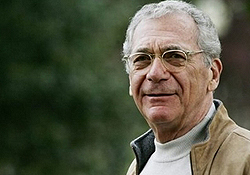 Trained as an actor at Sanford Meisner’s famed Neighborhood Playhouse — the stomping grounds of Robert Duvall — Sydney Pollack connected to actors because he was one of them…and a damned fine one at that.
In fact, his comedy “Tootsie” is not only the greatest American comedy ever made, it is also the greatest study of the art and craft of acting I’ve ever seen. The director, writers and star explored the depths to which an actor will go to get the role right, to find that all-important and essential truth. Without truth in a performance, there is nothing but failure.
There is a moment in the film when Michael Dorsey, the actor who has become actress Dorothy Michaels to find work, is no longer Michael at all. Dorothy has become a living, breathing character in his life. Hoffman’s astounding performance is the finest work of his career, a jaw-dropping feat of art that is often overlooked (criminally) when the great film performances of all time are discussed. And of course holding the film together, the glue, the guiding hand, was Mr. Pollack, one of the great directors of the 1970s, 1980s and beyond.
Though he lacked the box office breakthroughs of Francis Ford Coppola or Steven Spielberg, or the nasty edginess of Martin Scorsese, Pollack nonetheless was an artist, one of the few directors able to walk the line between making succesful mainstream films that worked on levels of commerce and artistry.His death at the age of 73 is one of the film world’s great losses, though he leaves behind a legacy that will be remembered for years after many of us have gone to that great screening room in the sky.
 With Cannes on the downswing, it becomes time to to start making preparations for the annual Toronto International Film Festival, for which screening announcements begin next month. I have been covering Toronto for more than 15 years and can safely say it is Christmas to a film critic.
Each September I move into the Delta Chelsea Hotel for the duration of the festival — it makes no sense to make the 90 minute drive home each night as the days begin at dawn and often tie into the following morning. My wife and girls make the drive into the the city for the weekend and swim while I screen. And if time permits, I take Sherri to a Gala screening at Roty Thomson Hall.
Over the course of each festival I see between 30 and 50 films (50 being my personal high, in fact) and though it sounds like tons of fun, and I would not miss it for the world, it is exhausting to say the least.
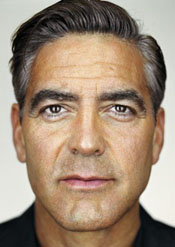 Do we really need another George Clooney profile?
I feel as though I can’t turn a corner in this town without finding his still handsome but clearly aging mug plastered on this magazine or that (while simultaneously popping up in the same typical tabloid outlets to boot — but that’s not his, or his publicist’s, fault).
First it was a Time Magazine worship session from political writer Joel Stein that made some sense in the midst of an Oscar derby that clearly held Clooney and his film, “Michael Clayton,” in the thick of things. Then, in the run-up to the release of “Leatherheads” (a film that I still haven’t seen and, despite the poor critical reception, kind of want to check out), he got one of those uber-cool Esquire covers that you might expect. But the PR overhaul was starting to reach an apex, I felt.
And hitting my doorstep today? A solid week after “Leatherheads” has already landed and underwhelmed? Clooney gets what might be close to a 10,000-word profile in the pages of The New Yorker.
We get it! He’s our movie star. As some outlets have proclaimed (searching for the narrative, as always), he might be “the last movie star.” I know the media want to keep the fellatio going as long as possible on this cat, but can’t they at least come up for air form time to time??
Who am I kidding? Everyone loves this guy. I love this guy. I just need some space, George. I need to find myself. I need to know myself…without you.
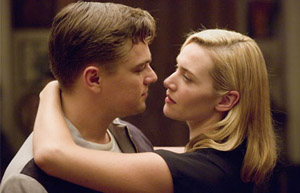 Another year, another set of wins…and another look ahead at what’s in store NEXT year.
It’s never too late to take a long gander at what we might see dominating the film awards landscape in 365 days, and with that in mind, I’ve been doing my usual mulling over the possibilities for a few weeks to put together the sadly thorough examination of the 2008-09 award season that follows. Let’s get into it. There are some major considerations to take into account. right off the top.
Like Leonardo DiCaprio, for instance, who is set to be the entertainer of the year. With performances in “Body of Lies” (Ridley Scott) and “Revolutionary Road” (Sam Mendes), DiCaprio is working with a duo of awards-proven talent this year. Perhaps that will work against him, much like it did in 2006, and no major Oscar success will come knocking. But we’ll wait until we see the performances. Each of them could be enticing.
This year’s Best Picture Oscar victor Scott Rudin is back again, by the way, with “Revolutionary Road,” recently inherited by Paramount Vantage and probably one of the true “frontrunners” this far out that we could put our finger on. The only other film in Vantage’s arsenal is Edward Zwick’s “Defiance,” which could simply be a commercial success, but might find its way to multiple nods like “The Last Samurai” and “Blood Diamond” in recent years.