 • Donna Freydkin talks to man of the hour, Christoph Waltz. [USA Today]
• Is 27 years without an Oscar too many to deny Meryl Streep in 2010? [Rope of Silicon]
• We’re happy to be among the top 50 “best blogs for moviemakers.” [MovieMaker Magazine]
• Donna Freydkin talks to man of the hour, Christoph Waltz. [USA Today]
• Is 27 years without an Oscar too many to deny Meryl Streep in 2010? [Rope of Silicon]
• We’re happy to be among the top 50 “best blogs for moviemakers.” [MovieMaker Magazine]
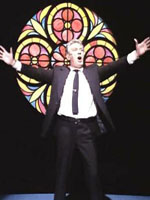 Peter Finch’es wide-eyed, frantic performance as newsman Howard Beale in Sidney Lumet’s “Network” became a touchstone for North America in 1976 because we too were “mad as hell and not going to take it anymore.”
Vietnam was over, though the vets were struggling with their various personal horrors. Nixon had resigned, leaving a mistrustful America in his wake. And up here in Canada, we were dealing with a Prime Minister who was often more playboy than politician. Lumet’s searing film, from an original screenplay by Paddy Chayevsky, was timely indeed.
Whispers of a posthumous Oscar have circulated Heath Ledger’s performance in “The Dark Knight” for weeks now, bringing Finch’s seizure of the Best Actor trophy back to the forefront of discussion. But was Finch’s win a recognition of the performance or was it fueled by his unfortunate dead in January of 1977?
Not particularly new or earth-shattering perspective, but worth a link nontheless. From a Xan Brooks item this morning in The Guardian:
History…is not on [Ledger’s] side. James Dean was twice nominated in the wake of his death and yet still finished up as a posthumous loser on the night. More recently, Oliver Reed (for Gladiator) and Ulrich Mühe (The Lives of Others) were both tipped in vain for at least a nomination. In fact, the only actor ever to be awarded a posthumous Oscar was Network’s Peter Finch. Felled by a heart attack during the voting period, he swept to glory on a tidal wave of grief.
By way of our friends at Cinematical I stumbled across this Onion A.V. Club article — a truly genius post. It’s a countdown of the top cameo performances of all time, a “one-scene wonders” list of 20 memorable cinematic moments.
Like Eric Snider at Cinematical, I can’t find a single bone to pick with The Onion’s #1 choice. In honor of all things Baldwin, I give you the searing opening sequence from James Foley’s (make that David Mamet’s) “Glengarry Glen Ross”:
httpv://www.youtube.com/watch?v=TROhlThs9qY
I also love the inclusion of Ned Beatty’s Oscar nominated five minutes in “Network,” though the rest of the list is quite arguable. The “Zodiac” tie in the final slot is an inspired choice, however.
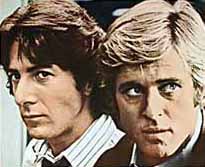 Continuing the conversation on great years for movies (1974 being my pick for the best), I thought I’d dig into a season rich with material that slipped through Oscar’s fingers.
The American bicentennial year was loaded with wonderful films — ground-breaking works that stunned both audiences and critics with their mastery. Three of them were nominated for Best Picture, some of the others were not, yet the eventual winner was a low budget love story about a boxer that wanted to prove he wasn’t just another bum from the neighborhood.
The true greats of 1976:
“All the President’s Men”
Alan J. Pakula’s superb adaptation of the Pulitzer Prize-winning book written by Bob Woodward and Carl Bernstein about their investigation of the Watergate burglary was born out of an astonishing script by William Goldman. Making sense of the politics within a dense book, incredibly detailed, Goldman’s work had the good sense to make the film a detective-like thriller with well-defined characters.
This could have been a dull, political film made to exploit the happenings in the United States at the time, but Pakula instead made one of the great films about journalism in the days before the Internet and e-mail. Robert Redford bought the rights to the book and produced the film, starring as Woodward, with Dustin Hoffman as Bernstein, both giving exceptional performances, but it was Jason Robards who blew them off the screen with his excellent performance as the crusty, wise, and ultimately loyal Washing Post editor Ben Bradlee.
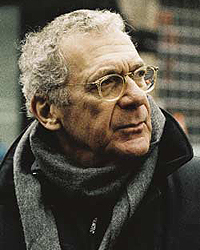 It has now been nearly four days since filmmaker Sydney Pollack passed away. The loss was not crippling for me, however, because of equal parts expectancy and, strangely, indifference.
As fine a filmmaker as Pollack was, he was always something of an afterthought in my cinema-going experience.
I want to be measured here, because the last thing I mean is disrespect. In fact, I’m aiming more toward appreciation of a sort of confident casualness that has been eradicated in this fresh new world of cock-sure filmmaking youths and the veterans who, at times, struggle to keep up, and at others, tap into their own former risk-taking ways to establish a new vision of the “old school.”
Pollack was never about that. He seemed to make his way from film to film with grace and a willingness to take stock of the lessons that came. I never knew him — can’t offer any first hand accounts of exchange — but if anything about his May 26 death strikes a profound chord with me, it is to know that an ever agreeable constant has been removed from this business, this art form. Sometimes the disconnect of casual dependency can sting as much as the loss of the closest of comrades.