In Contention

Tag: Pollock

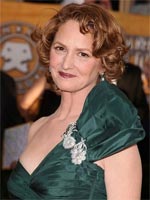
  • What about Melissa Leo?

    Yesterday, Kris pondered whether Kate Winslet’s Best Actress Oscar is quite the sure thing it appears to be on paper, or whether Meryl Streep can surf in on a tide of veteran goodwill and spoil the Brit’s party yet again.

    I’ve been saying since nomination day that I can’t imagine Winslet losing yet again, least of all for a performance in a Best Picture nominee (the first time she’s had that luxury since her non-starter nomination for “Titanic” in 1997). If she wins the BAFTA on Sunday, as almost everyone suspects she will, her campaign stays comfortably on course; if, however, Streep manages to pull off an upset, I may well change my mind.

    But allow me to play devil’s advocate for a minute. Why has the competition been reduced to two performances that are by no means necessarily the strongest in the lineup? Let’s perform a process of elimination. Streep’s performance has been polarising from the get-go, with the reverberations of Variety’s notably harsh review still being felt in the critical community. (As “Doubt” opens today in the UK, a number of critics find themselves bewildered, with the Guardian describing her work as “beyond absurdity.”)

    Of the competition, Angelina Jolie has drawn even less critical consensus than Streep, so it’s safe to say she’s out of the running. Anne Hathaway looked to be a frontrunner at one point, and barely anyone has a bad word to say about her performance, but judging from the tepid Academy reaction to her divisive film, I can’t help feeling that her ship has sailed. Kate Winslet’s performance has also been widely praised, and it’s clear that a large faction of the Academy appreciates “The Reader” — but it’s still a film with some notable detractors, and not everyone likes the way Harvey Weinstein muscled it into the race.

    And so we arrive at Melissa Leo. In many ways the odd woman out in this year’s star-heavy Best Actress race, she is arguably the one nominee whose performance — and film — have attracted the least criticism from any quarter. Critics have showered superlatives upon Leo’s raw, career-defining performance, with the venerable Roger Ebert singling her out as his favourite of the nominees.
    (more…)

  • INTERVIEW: ‘Appaloosa’ composer Jeff Beal

    Jeff BealLike a number of film music composers, Jeff Beal makes his home north of Los Angeles in the rocky, canyoned city of Agoura Hills.  One feels a sense of the old west before even seeing the ranch-style houses in his neighborhood and the tail-flipping horses tied out back.  Questions about his work on “Appaloosa,” Ed Harris’s latest entry in the western genre, seem to manifest out of thin, dusty air by the time we make it downstairs to his efficient but Spartan studio.
    At the beginning of the process, Harris told Beal he was not interested in anything overly romantic or mythic.  The mandate was the relationships, the conflict they bring about and the intimate world the characters inhabit.  It was a unique vision for Beal, but one he was more than willing to explore.  He had his share of wells to draw upon, but his work in high-end television projects really stuck out.

    “The only thing I can think of that was sort of similar was [HBO’s] ‘Rome,’” Beal said.  “It was a similar approach creatively because you were dealing with a historical genre, a genre that’s been done a lot, sometimes with a lot more overt flare.  And this was more like the ground view of these people.”

    To that end, Beal set about constructing a theme with little harmonic movement, something that would carry the feeling of the audience being visitors in the world of Virgil Cole and Everett Hitch.  Spring-boarding off a life-long interest in folk music (American or otherwise), Beal wanted to make the music reflect the story-telling nature of the narrative.

    “There was actually a second half that became more of a traditional piece of music because at the end of the day we decided we don’t need that because it’s better to have just a clean, simple statement,” he said.  “These guys are men of action.  It’s all about a process, one step in front of the other.  It’s a journey.  One of the phrases Ed gave me when we were starting was ‘rough elegance,’ which I loved.  A lot of the music sprang from that inspiration.”

    (more…)

  • TORONTO: Ed Harris on ‘Appaloosa,’ acting and film crticism

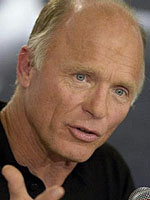
    Ed HarrisWalking into to interview with any actor/director can be a tad intimidating, even after 20 years of doing it.  They have a tendency to be…difficult.  But 30 minutes into my interview with Ed Harris, he pays me a compliment that could keep wind in my sails for the duration of the fest: “Thank you for your integrity, intelligence and dedication to your job.  This has been a pleasure.”  He smiled as we shook hands and he walked me to the door

    Harris has been an actor I have admired since first seeing him as squeaky clean John Glenn in “The Right Stuff” back in 1983, which he followed with a chilling turn as a mercenary in “Under Fire,” his bright blue eyes windows into hell’s furnace. His career has moved along an interesting trajectory, shifting between supporting roles and leads with ease, often dominating whatever film he takes on with powerhouse acting.

    Oddly enough, he did not receive his first Oscar nomination until 1995 when he gave a sterling performance as Gene Kranz in “Apollo 13,” followed by another brilliant turn in “The Truman Show” as a God-like TV producer. He nurtured his dream project, “Pollock,” through its funding, before taking up the reins as director and grabbing another Oscar nod in front of the camera. And in 2002 he was nominated for a fourth time for his AIDS-afflicted writer in “The Hours,” a critically acclaimed ensemble piece from director Stephen Daldry.

    It is doubtful that “Appaloosa” will see any Oscar attention.  Though it is beautifully shot and the art direction is sublime, the film was something of a letdown, despite strong work from Harris and co-stars Viggo Mortensen and Jeremy Irons.

    “I gave the book to Viggo here at this festival in 2005,” Harris said, “when we were here for ‘A History of Violence.’ There was no one else I really wanted to do the film with, and I certainly never considered anyone else. I just thought he and I would make a strong partnership on screen. We don’t hang out, I mean we’re friends, but we don’t see much of each other. He agreed to do it, and Viggo’s the sort of guy where his word is his bond, so that gave me the start to keep moving on the film. It didn’t really occur to me that the film was a western, what struck me was the relationship between these two men in 1882, that’s what really grabbed me about the film. That it happened to be a western was incidental.”

    (more…)