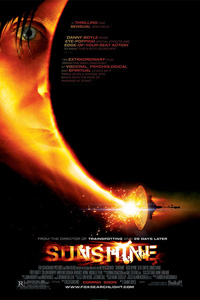
 I really wanted to like Danny Boyle’s latest mind-bending cinematic excursion. The elements were in place for the talented genre director to crank out one of the great science fiction films of our time. Writer Alex Garland was on board, a certifiable genius of the narrative form. A decent cast of actors were assembled. Technical achievements seemed to be lining up to pitched perfection.
But as I watched the film unfold, I soon stumbled upon that most sickening discovery every filmgoer feels at some point or another: the sense that I needed to let hope slip away. “Sunshine,” I had to admit to myself, was a colossal miss.
The film tells the story of a last-ditch effort in a future society to save our dying sun. Earth has plunged into an ice of sorts age in the year 2057. One mission to essentially reboot the giant star’s core with a massive bomb explosion has already failed as of seven years ago.
And now, a new, likely final attempt has been launched with an eight-member crew aboard the Icarus II, a vessel dwarfed by the gargantuan payload it pushes through the cosmos toward an uncertain end. It is the mission or nothing at all, and that is the reality the film embosses at every turn.
The Icarus II’s octet serves as the film’s ensemble throughout. Front and center are Mace (Chris Evans), a hard-boiled military mind (though he is the resident engineer) who embodies the spirit of “failure is not an option,” and Capa (Cillian Murphy), a physicist who has to be the most important member of the crew, given the events of the narrative. Also sticking out is Searle (Cliff Curtis), a psychologist losing himself to the wonder of that which the crew seeks to save, as well as Corazon (Michelle Yeoh), a botanist charged with maintaining the vessel’s oxygen garden, the crew’s primary source of oxygen and food.
Ship captain Kaneda (Hiroyuki Sanada) and navigation officer Trey (Benedict Wong) serve their plot points well enough. Mostly they just fade into the background with second in command Harvey (Troy Garity) and pilot Cassie (Rose Byrne).
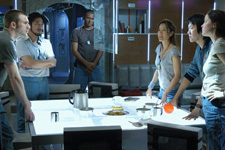 The ensemble performance is a solid one. Chris Evans especially proves again that even amidst artistic turmoil he is a charismatic presence. But if this bevy of crusaders sounds similar to “Sphere,” the Michael Crichton novel butchered in cinematic form by Barry Levinson in 1998, it should. It seems a staple of the genre has become the busload of specialists. But that’s not what “Sunshine” does to implode on itself.
You see, there is a lot of beauty in “Sunshine”’s visual realizations. Danny Boyle is a filmmaker who specializes in elevating that which should be seen in brighter intellectual and emotional hues to operatic levels. And this is certainly a Danny Boyle experience in that light.
But on the page, in the confines of story, Alex Garland has managed to mangle what might have been a more than passable sci-fi experience by resorting to tactics we’ve already seen in zingers like “Event Horizon,” “Mission to Mars” or the aforementioned “Sphere.”
To further expound upon this requiem for Garland’s talents, as they relate to “Sunshine,” never have I witnessed a deus ex machina so blatantly employed and so confusing in its existence. As the third act begins to clumsily unravel, one can’t help but furrow the brow and struggle to comprehend the direction, indeed the point of the narrative – if even on the terms of the story itself, which seem to fly out the window at this crucial juncture. The cinematography even seems to unnecessarily disorient at this stage.
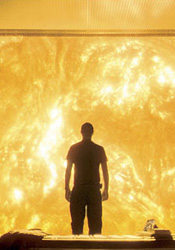 There are elements worthy of praise. As noted, Boyle is a visual technician without parallel. The visual effects are beautiful and seamless. Most especially, the sound work in the effects and mixing stages is another character unto itself, as necessitated by a film taking place in the vacuum of space. And the score offered up by John Murphy and Underworld is original and enjoyable. However, I can’t venture much further out onto the limb of commendation, I’m sorry to say.
The question “Sunshine” is posing is a valid one, and most important in the science fiction genre, it is a meaningful one. What if the planet’s solitary source of nourishment – in all its phases – were to lose its steam, lose its power? What if the sun were to die?
Basically, what if the giant light bulb went out? What the film does with that question, most especially in its third act, is somewhat artistically infantile at best.
It has been respectfully requested by the filmmakers that none of the film’s surprises be revealed through reviews, which is fair enough. If I knew where “Sunshine” was going prior to screening it, I might have waited for DVD.
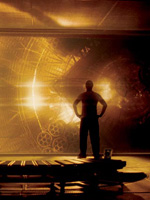 There are a number of ambitious films that fascinate me despite their level of failure. “Syriana” and “Hancock” are recent examples, but the quintessential exhibit has to be Danny Boyle’s “Sunshine,” which I caught once more today in the middle of career retrospective for the filmmaker.
 Filmmaker Danny Boyle is set to be feted this evening by the American Film Institute, but with just eight feature films under his belt, the dynamic director of such milestones as “Trainspotting,” “28 Days Later” and this year’s festival favorite “Slumdog Millionaire” is hardly due for a career retrospective. He’s still going strong, excited by each new project and willing to take his time on whatever strikes his fancy along the way. But as “Slumdog” begins to stand out as, perhaps, Boyle’s greatest cinematic accomplishment to date, the director shares with us what he’s learned along the way, film-by-film.