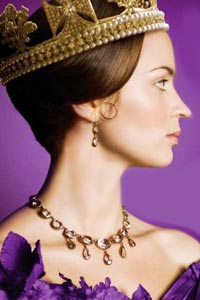
 Somewhere out there, wherever such souls reside, Anne of Great Britain must be wondering what she had to do during her reign to merit her own prettily mounted biopic. She may be the last relatively untapped figure in British heritage cinema’s well-worn library of queenly narratives, but she has once more been passed over for the privilege of fronting the latest middlebrow, true-life royal drama, fast becoming an annual fixture on the UK film calendar.
Instead, the powers that be (noting with reluctance that the lives of both Elizabeths have been sufficiently plundered of late) have returned to that old stalwart, Queen Victoria, for inspiration. Marginal inspiration, at that –- that “young” inserted in the title is intended as the film’s creative and commercial trump card, promising a sprightlier, sexier take on the figure more frequently depicted in her latter years as a stern, cabbage-faced matron.
Indeed, from the sly casting of impish Emily Blunt in the title role to the Easter-egg hues of Sandy Powell’s typically immaculate frocks, Jean-Marc Vallee’s film works overtime to convince us that the 18-year-old Victoria could be very amused indeed: as Blunt barely suppresses laughter at a stiff royal function, or skips down a corridor after being informed of her impending coronation, she effectively severs any connection or comparison with Judi Dench’s Oscar-nominated interpretation of the role in “Mrs Brown.”
Meanwhile, in depicting its subject as a modern woman suffocated by her surroundings and dated gender trappings, complete with adorable lapdog and an accent that is decidedly more Sloane Square circa 2009 than House of Hanover circa 1837, the film pulls a similar trick of characterization to last year’s “The Duchess.” Working, however, in an even softer register than that already lightweight film, “The Young Victoria” plays down court intrigue in favor of dewy-eyed first love; if “Elizabeth’s” populist coup was restyling royal history as political thriller, this lands squarely in rom-com territory, with Rupert Friend’s Prince Albert the dreamy yet ever-deferred suitor.
 What can I say? It was a big night for “Slumdog Millionaire” at the 81st Annual Academy Awards on Sunday.
 (Expanded thoughts and reasonings on yesterday’s list of predictions.)
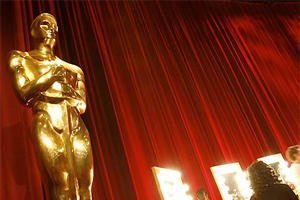 Well, this is what it all boils down to. I almost DON’T want to go on the record, but I kind of have to, right?
 After six months of Tech Support previews and interviews, the films have arrived, the nominations have been announced and the guilds, the critics and BAFTA have all announced their preferences. Today we take a final look at the races before the envelopes are opened on Sunday.
 It’s no secret that the BAFTA awards, which unfold at London’s Royal Opera House on Sunday evening, can be one of the most contrarian and surprising events on the awards calendar – but nowhere are they more unpredictable, and occasionally inscrutable, than in their technical awards.
 Onward. I bet Fox Searchlight wants this phase two to go by as fast as possible.
 Five months of Tech Support reach their climax on Thursday morning.
 The BAFTA nominations drop tomorrow, and while I hardly covered myself in glory with my foreign film Oscar forecast yesterday, I’m going to wade into the murky waters of prediction once more.
 Well, I
 Before the holiday I thought I’d make my first calls on the year’s Oscar winners. Bear in mind we don’t even have a list of nominees yet and anything can happen. I think around this time last year I was predicting “Into the Wild” for across-the-board wins and it only managed two nominations at the end of the day, so, grain of salt and all that. I just like to go on the record around this time, so here we go:
 Music is one of few of the “tech” awards cited by the Academy that tends to result in passionate discussions among moviegoers, including non-cinephiles. Awarded in the Best Original Score category, the film music composer has one of the most difficult and lonely jobs in filmmaking. Almost always arriving at the end of the editing stage, and typically the most expendable element of the mixture, he or she has to fashion music appropriate to the mood and, hopefully, serve as a nice commentary for the on-screen goings-on.
 I have a bit of a love-hate relationship with the BAFTA Awards. On the one hand, they can be far more daring and playful in their choices than the American Academy — this is an organisation, after all, that has handed their Best Film award to such enduring works as “The Purple Rose of Cairo,” “GoodFellas” and “Lacombe, Lucien,” while nominating the Oscar-snubbed likes of “Eternal Sunshine of the Spotless Mind” and “The Usual Suspects.”
 The British Independent Film Awards are an odd, under-the-radar institution that frequently like to avoid the obvious and champion the underdog. Last year, for example, they bypassed the starrier likes of “Eastern Promises” and “Notes on a Scandal” to award their top prize to Anton Corbijn’s magnificent, under-rewarded “Control.” The previous year, they were even more daring: Best Film justly went to “This Is England” over “The Queen,” while Helen Mirren and Forest Whitaker — gasp — lost to the unknown leads of Andrea Arnold’s “Red Road.”