In Contention

Tag: Thirst

  • 9/4 Web Round-up

    Spike Jonze• Steve Pond talks to AMPAS executive director Bruce Davis about the Oscars’ “crisis point.” [The Odds]

    • Redefining the cinema alien with “District 9.” [Daily Telegraph]

    • Spike Jonze and his latest gets close to 7,500 words in the Grey Lady. [New York Times]

    (more…)

  • Korea selects ‘Mother’ for Oscars, bypasses ‘Thirst’

    MotherThanks to The Film Experience for pointing out this news nugget: a month after Sri Lanka kicked off the convoluted, multi-tiered contest for Best Foreign Language Film by selecting their official entry, we have our first relatively high-profile submission, as Korea has entered Bong Joon-ho’s “Mother” into the race.

    Some might be surprised that the country’s selectors passed over Park Chan-wook’s “Thirst” — which won the Jury Prize at Cannes and has received an interesting Stateside promotional push from Focus Features — but they shouldn’t be.

    For one thing, the Koreans are probably as aware as any Oscar-watcher that the chances of the Academy blue-hairs going for an erotic vampire flick with healthy lashings of gore are, to put it gently, minimal. (It appears that “Thirst” was one of six films considered, however.)

    (more…)

  • 8/3 Web Round-up

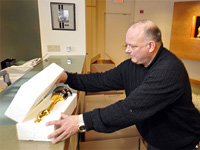
    Steven Miessner• Steven Miessner, the Academy’s white-gloved “keeper of the Oscars,” dead at 48. [USA Today]

    • Steve Weintraub talks “The Princess and the Frog” with directors Ron Clements and John Musker (at Comic-Con). [Collider]

    • The unmade films of Stanley Kubrick, including “Foucault’s Pendulum,” “Napoleon” and “Perfume.” [Empire]

    (more…)

  • Got blood?

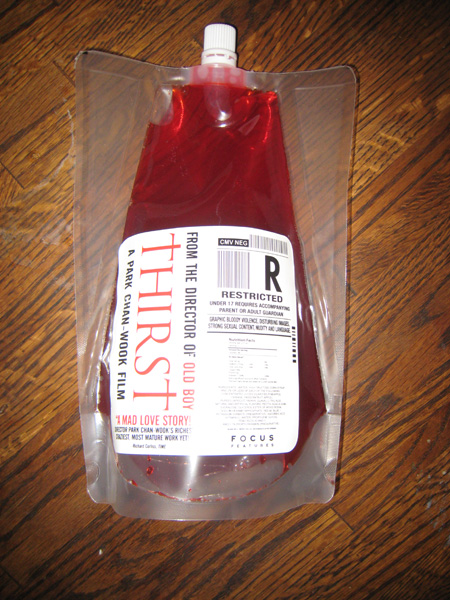
    When a milkshake arrived on my doorstep two years ago, that was one thing.  But shipping me a pouch of O positive to herald the forthcoming vampire flick “Thirst” from director Park Chan-Wook?  That’s crossing the line.

    Okay, I’m only kidding.  It’s fruit punch or something, with a straw.  But it’s a pretty nifty swag campaign from Focus Features (which already sent out neat-o satchels full of this and that for Shane Acker’s “9”).  Getting in the Comic-Con spirit, just over a week away…

    Thirst

  • Haneke lands Palme d’Or, Gainsbourg takes Best Actress

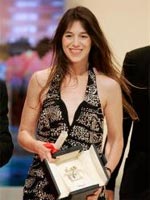
    Charlotte Gainsbourg winning Best Actress at the Cannes Film FestivalAs it turned out, the most logical on-paper prediction turned out the be the right one. After emerging as the bridesmaid from several festivals past — winning the Grand Prix in 2001, Best Director in 2005 — the venerable Austrian auteur Michael Haneke has finally won the Palme d’Or for his stark moral drama “The White Ribbon.”

    Whether or not jury president Isabelle Huppert, a two-time Haneke leading lady in the past, wielded much influence on this decision — or indeed, whether she even needed to — is something for the pundits to debate. (I personally doubt it, though there was no mistaking the sly smile on her face as she announced his name at the podium.) Either way, there’s little denying that Haneke was overdue for world cinema’s highest honor; perhaps there was a career-achievement angle to the award, but the critical acclaim for “The White Ribbon” has been extensive.

    From watching the ceremony, it was clear that Haneke wasn’t the most popular winner of the night; that designation clearly goes to hometown favorite Jacques Audiard, whose “A Prophet” — like “Gomorrah” last year — was by and large deemed the favorite for the Palme, but ultimately had to be content with the silver-medal Grand Prix. The rousing standing ovation he received, however, spoke for itself. (I should add that a second-place finish for Audiard was, embarrassingly, the only correct call I made the whole night.)

    The real talking point of the awards, however, will likely remain Charlotte Gainsbourg’s Best Actress prize for her evidently courageous work in “Antichrist” — a clear gesture of support by the jury for a film that has provoked prolonged media outrage since its unveiling, and a blatant slap in the face of Cannes’ alternative ‘ecumenical’ jury who went out of their way to condemn it. The irony of handing a female performance award to a film that has been repeatedly pelted with accusations of misogyny is rather delicious; at the very least, it’s an indication that this is a film to be taken seriously.

    (More commentary, and a full list of winners, after the cut.)

    (more…)

  • Cannes: sizing up the Competition, part two

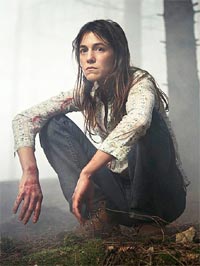
    Charlotte Gainsbourg in AntichristContinuing yesterday’s survey of the runners and riders in the race for the Palme d’Or…

    “ANTICHRIST” (Lars Von Trier)

    The pitch: You’ve seen the trailer. Charlotte Gainsbourg and Willem Dafoe star as bereaved parents who retreat to a remote woodland cottage to nurse their grief, only to be terrorised by unnamed forces of evil. (English dialogue)

    The history: Over his seven previous Competition appearances, Von Trier has enjoyed a gradual ascent from the Technical Grand Prize for 1984’s “Element of Crime,” to the Jury Prize for 1991’s “Europa,” to the Grand Prix for 1996’s “Breaking the Waves” (1996) to, at last, the Palme d’Or for 2000’s “Dancer in the Dark.” Nothing since then, however, with his masterful “Dogville” coming up surprisingly (and undeservingly) empty-handed.

    The outlook: The film may appear to be familiar (albeit bloody terrifying) horror fare in the trailer, but we should know by now never to presume what a maverick like Von Trier has up his sleeve. Cannes is usually averse to the genre, so whether the film made the lineup because it’s something more subversive, or simply because it’s directed by one of their favourite sons, remains to be seen. Either way, the film will need to be something special to get Von Trier back in the winner’s circle – after all, “Dancer in the Dark” proved so polarising, juries have been unwilling to take a chance on him since. He tends to put his actresses through the wringer, so perhaps there’s a chance for Charlotte Gainsbourg here – but who knows?

    “SPRING FEVER” (Lou Ye)

    The pitch: Erotic drama follows a young man hired to survey a married man’s homosexual affair; tangled relationships ensue as the spy and his girlfriend become sexually drawn to the adulterous couple. (Mandarin dialogue)

    The history: Not counting an unfortunate 2006 withdrawal after his “Summer Palace” fell foul of Chinese censors, this is Lou’s second Competition appearance.

    The outlook: There is a great deal of goodwill in the world-cinema fraternity for Lou, who has fought a continuous battle with the Chinese censorship board. His last film, the politically charged “Summer Palace,” resulted in the director receiving a five-year ban from filmmaking – a ruling Lou is flagrantly flouting by screening his new film (which was shot in secret on handheld cameras) at this year’s festival. It’s a courageous move, and I think there’s a strong chance the jury might like to demonstrate their support for the embattled auteur with a prize of some variety.

    (more…)
  • Early rave for Cannes entry ‘Thirst’

    ThirstPark Chan-wook’s erotic vampire film “Thirst” opened over a week ago in its native South Korea, but it will soon make its international bow at Cannes, where it’s one of several adventurous-looking films in the competition. Screen International, however, has got a head start and offered this review — and the news is good.

    Park has been in the wilderness for a few years, but critic Darcy Paquet (awesome name, by the way) calls the film a return to the award-winning form of his 2004 hit “Oldboy.” He raves:

    Since his breakthrough with Sympathy For Mr. Vengeance in 2002, Park’s work has been characterised by its visual inventiveness, dark humour, intense acting performances, and strange but compelling shifts in tone. The first 90 minutes of Thirst is a robust display of these talents, but it is anchored in a melancholic lyricism that is new to Park’s oeuvre. Although the focus of its narrative movement is not always clear, in its best moments, Thirst offers something of the poetic force of cinema’s timeless masterpieces.

    He also adds the interesting (to me, anyway) factoid that the film — about a Catholic priest who becomes a vampire following a botched medical experiment — is a loose adaptation of Emile Zola’s 1867 novel “Therese Raquin.” Well, there you go. I must admit I’ve never really connected with Park’s work before, but the current spate of contemporary vampire tales is an intriguing trend. This could be one to keep an eye on at the fest.

  • Troublemakers united

    IrreversibleYours truly began a two-part Cannes preview this morning, but there is plenty more such coverage around if you’re beginning to get festival fever. I particularly liked Jonathan Romney’s rundown in the Independent, in which the critic points out an interesting trend in this year’s lineup: namely the convergence of several renowned enfants terribles in one year.

    There’s almost always one title in contention whose extremities — whether of sex, violence or other — set tongues wagging along the Croisette, but this year looks to be particularly hard on the faint-hearted. Quentin Tarantino’s bound-to-be-grisly “Inglourious Basterds” looks positively milquetoast compared some of the other fare on offer, including “Oldboy” director Park Chan-Wook’s decidedly adult vampire tale “Thirst” and Lars Von Trier’s seemingly unnerving foray into horror territory, “Antichrist.”

    Michael Haneke’s new effort doesn’t look like a box of kittens either, but as Romney writes, none of these filmmakers instil quite as much fear in mild-mannered filmgoers as Frenchman Gaspar Noé:

    These days, the shocks come a little stiffer. A hardened colleague of mine walked out of Gaspar Noé’s Irréversible (2002) after the opening salvo of 13 blows to the head with a fire extinguisher – thereby missing considerably worse to follow … With Enter the Void, it’s more than likely that he’ll attempt to up the ante on Irréversible. Touted as “a hallucinatory maelstrom”, it involves a stripper’s brother who reviews the violent circumstances of his death, from the afterlife. Laden with special effects and screeching neon colours, Noé has promised it will be more psychedelic than violent – but at two-and-a-half hours, it certainly won’t be an easy ride.

    I’m interested to see whether Noé can build more critical cache this year beyond the controversy that greeted his previous work — for all its look-at-me theatrics, “Irréversible” is a much better film than it’s usually given credit for. With several other title jostling for the attention of the more excitable media outlets this year, perhaps there’s more of a chance people will find the film beneath the fuss.

    And as Romney points out, if anyone can handle it, it’s a jury that includes such notably fearless figures as Isabelle Huppert and Asia Argento. Bring it on.