 “World Trade Center” is a nearly flawless account of something so personal, yet so universal, that it leaves the instigating events of September 11, 2001 almost as an afterthought – lipstick on the rim of a wineglass long emptied.
he triumph of commanding such humanity in the face of a story that could have easily been played up as the rah-rah “9/11 MOVIE” some might have expected belongs in large part to screenwriter Andrea Berloff, who pitched a striking and rich tale to producers Michael Shamberg and Stacy Sher before burying herself into the lives of Will Jimeno and John McLoughlin (the two Port Authority survivors upon which the film is based). A huge chunk of that glory, however, deserves to be placed into the hands of Oliver Stone, a filmmaker who shows in this latest effort (in a career speckled with films that were his own, if nothing else) that he retains the professionalism to tell a story free of artistic whimsy or personal commentary.
The film tells Jimeno (Michael Peña) and McLoughlin’s (Nicolas Cage) story in a straightforward manner free of any fuss, unnecessarily schmaltzy or otherwise. The drama of this story is not manufactured and is very much real. Of the 20 individuals successfully retrieved from the rubble of the World Trade Center, Jimeno and McLoughlin were numbers 18 and 19.
Part of a confused and unprepared Port Authority team hastily assembled (as most efforts inevitably were that day), the two officers were in the lobby of Tower One when its fatal collapse ensued. Along with three other officers, the two men successfully retreated into an elevator shaft as the concrete jungle descended upon them. They had no idea what was happening, and indeed would not be aware that the World Trade Center had been obliterated until they were pulled from the rubble an ungodly number of hours later.
I read Berloff’s screenplay a few months ago and I found the material somewhat insipid upon an initial assessment. However, I must say I was more than pleasantly surprised to see the tale ultimately lifted so vibrantly off the page by Stone and the actors involved, finding the true pulse of the screenwriter’s work.
Berloff chooses to reveal Jimeno and McLoughlin’s story in the manner I reported on at that time, something of an “Apollo 13” template, cutting from the men in peril, to their wives, Allison (Maggie Gyllenhaal) and Donna (Maria Bello) respectively. Trapped, in their own way – on the outside, Allison and Donna waited in vain for word of their husbands’ survival, their demise, anything beyond the insistence of their simply being “missing.”
 Meanwhile, the longer Jimeno and McLoughlin remained submerged, the stronger their hope became in the face of losing the lives they loved, the lives in which they belonged more so than any other place on Earth. As their bodies physically gave way to the unforgiving pressure and internal bleeding, their spirits remained as solid as ever.
Nicolas Cage portrays McLoughlin with the steely sense of awareness and second-nature knowledge that seems about right. McLoughlin has seen much in his many years at the Port Authority, and if any man was the one to look to in such a crisis, he was the guy. He drafted the emergency scenarios relevant to another Word Trade Center attack following the 1993 bombing, but no one saw this event coming.
There simply was no plan. But McLoughlin dove in as if he just did not know what to do otherwise, and it takes a certain acceptance of whatever might come one’s way to be that headstrong and that assured without the slightest trace of self-awareness. Cage portrays as much with a delicate ease that is at once arresting and relaxing.
Jimeno, the rookie of the crew, was out to prove himself like any other new kid on the block. He wanted the acceptance of his comrades but he also knew where the boundaries of his job were drawn. The respect he unabashedly held for authority is present in Peña’s portrayal, as well as a certain, at times infectious, positivity that shines through the thickest of rock and dust debris covering the actor’s face.
Gyllenhaal and Bello portray two women cosmically intertwined who would not meet one another, nor know of their fated connection until the whole ordeal was resolved. As the pregnant and sometimes hysterical Allison, Gyllenhaal steps her game up a notch (and will do so further later this year in Marc Forster’s “Stranger Than Fiction”), while Bello (donning eerie yet somehow strangely appealing blue contacts) portrays the rock of a mother of four you’d expect Donna McLoughlin to be; she certainly seems like the sort of woman the thought of whom would keep a man alive.
The rest of the cast most notably includes an unrecognizable Stephen Dorff as the officer in charge of Jimeno’s and McLoughlin’s extraction once they were discovered, as well as a nice cameo from Stone staple Frank Whaley as a helpful paramedic who seemed to have a story worth telling of his own. Michael Shannon also co-stars as Dave Karnes, a former marine who, desperate to help the situation, drove from Connecticut to New York and made his way to ground zero. Had he not taken that moment to rediscover his passion for serving his country, Jimeno and McLoughlin might never have been found alive.
I have to mention clearly that, while such thematics as “serving one’s country” or “the brotherhood of many to save a few,” or what have you, might seem potentially over-bearing, they are not as much in this film. These strands and basic facts come together on screen in “World Trade Center” less as manipulation than they do as insistent historic rhetoric. And the old-fashioned relating of the story from the hands of director Oliver Stone is at times stunning.
 Humility is the most endangered trait amongst the filmmaking community today, and perhaps since the dawn of the medium. That Stone could so humbly remove himself and his ego from the spotlight in order to convey Jimeno’s and McLoughlin’s story is striking, not only due to the fact that this is Oliver Stone we are talking about, but I venture to say because few, if any other filmmaker, would have been so selfless about such a film. This will widely be reported as the most un-Oliver Stone film of the director’s career, and while that statement is true, it should not be seen as a slight, as if to say he finally came around or some such nonsense.
Stone is one of the most artistically gifted filmmakers of his generation, responsible for some arousing innovations in visually storytelling. But he is also capable of the basest aspects of the field, and “World Trade Center” is his charcoal sketch; it is his watercolor with primaries. He left the fancy toolkit at home this time around, and he may have found something invigorating lurking in his long-abandoned primitive brushstrokes.
Before closing here I think it is worth pointing out that, all due respect to the cinematography of Seamus McGarvey or the score from Craig Armstrong, Jan Roelfs’s painstaking recreation of ground zero is worth a specific mention above all else. The work put into the rubble trapping Jimeno and McLoughlin, not to mention the practical usage of set materials during the collapse of the first tower, are design elements of the highest order, and should “World Trade Center” become an awards giant this Oscar season, I should certainly hope Roelfs and his team will be remembered.
Ultimately I must say I am very proud of the Hollywood establishment for handling 9/11 in the successful manner we’ve seen this year. Universal’s “United 93” and Paramount’s “World Trade Center” are two drastically different films with drastically different themes. One is about dread, the other about hope. However, just as those two feelings can go hand in hand, so do these two films, serving as serendipitous compliments to one another.
“That day” was very much about dread and hope, and now that those two surface level, primal aspects of the event have been handled so capably, the filmmaking community is free to express itself through 9/11 in much more visceral, peripheral ways. Mike Binder’s upcoming “Reign Over Me” might just be that first step. In the meantime, “World Trade Center” is a beautiful, engaging and affecting experience, one of the very best films of the year.
 I don’t want to really dig in here or anything. It’s just a mark of time. There was an open sore in lower Manhattan tied up by bureaucracy, partisan nonsense and greed that became embarrassing, a symbol for a country so gridlocked by internal machinations that perhaps the truly poignant thing would have been to leave things undone. Because so much is still undone and unaccomplished and halted that a formerly proud beacon of progress is being lapped.
 You can never have too many of these, right? Right?
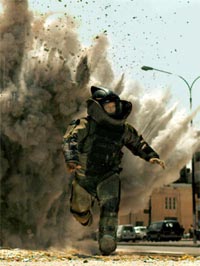 When it comes to extravagant Hollywood blockbusters, we’ve become accustomed to the phrase “the money is up on the screen” – delighting in the filmmakers’ own delight in the tools and tricks at their disposal.
 Alright, so
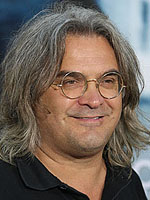 Filmmaker Paul Greengrass has been drawn to the sphere of politics since day one in his career as a filmmaker. He launched into the fray with 2002’s blisteringly realistic “Bloddy Sunday” (an account of the Derry massacre of 1972) and followed it up with a “Bourne” installment, putting his unique knowledge of covert military operations to use.
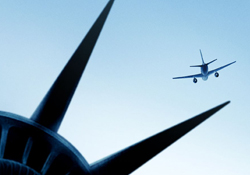 I finally got around to seeing the first 9/11 theatrical release earlier this week, Universal’s “United 93,” and the feelings it digs up, the questions it actually asks without hitting us over the head, and the overall commitment to ultra-reality that director Paul Greengrass is proving himself to be the master of, will all make it a unique entry in the coming wave of films rooted in that horrific day.