In Contention

Tag: Cannes Film Festival

  • POST-CANNES: “Martha Marcy May Marlene” (****)

    [Apologies for leaving my Cannes coverage in limbo as I unwound in Paris before returning to London housekeeping. A handful of films from my festival viewing roster are still owed some discussion in grouped capsule form, and I’ll get to those this weekend — hey, the films aren’t going anywhere, so why stick to the parameters of the festival diary? I’ll begin, however, with the last of my individual reviews from this year’s Cannes, and the last of my three four-star finds of the fest.]

    Elizabeth Olsen’s face is an ellipsis, a perturbingly lovely marker of concerns unspoken and unresolved, in writer-director Sean Durkin’s “Martha Marcy May Marlene,” a sharp blackberry winter of a debut feature that perhaps invites a re-evaluation of how we define the modern horror film. Little happens in the course of Durkin’s curtly time-shifting narrative that is definably horrific, yet the constricting rhythms of the editing combine with the between-the-lines anxiousness of Olsen’s performance to instil a kind of objectless dread in the audience, playing their preconceptions of the film’s sensationalistic subject matter against its own craftier revelations. Watching it, in short, feels like being slowly strangled from behind.

    (more…)

  • Taking post-fest stock

    Yesterday’s thoughts on Academy Award potential for “The Tree of Life” will serve as my post-Cannes Oscar column. Thanks to Guy for doing such a bang-up job covering the festival. For now, I’ve run a comb through the Contenders section and tiered things up a bit. No ranking and no predictions yet. Just defining the field a bit more. I won’t get into serious consideration until the year’s mid-way point, I expect.

    Check back tomorrow for a Malick-themed installment of The Lists.

  • On the Oscar prospects of ‘The Tree of Life’

    With “The Tree of Life” winning the Palme d’Or in Cannes today, Oscar talk has already swelled on Twitter (after whispered considerations in the wake of the premiere last week). I’ll be writing about the film again next weekend, when some of you will be able to take a look, but for now, I thought I’d speak on this.

    As we mentioned in the podcast Friday, I think Searchlight picking this demanding film up was an admirable move. It’s relationship-building with an important filmmaker (who has another film on the way, mind you). And its best chance at bringing in money was a counter-programming maneuver in the summer.

    But I don’t think this was ever considered a major awards threat, to be honest. I can’t imagine anyone watching it and expecting Academy types to embrace it. And I don’t think today’s unexpected award (Guy was hearing the only major fan of the film on the jury was Olivier Assayas) changes things.

    (more…)

  • CANNES: ‘Tree of Life’ wins Palme d’Or, Dunst takes Best Actress

    And so it came to pass that the pre-festival bookies’ odds were on the money. The most talked-about film at this year’s Cannes Film Festival, Terrence Malick’s “The Tree of Life,” was handed the Palme d’Or by Robert De Niro’s jury — a major vindication for a film that has been labelled both a masterpiece and a failure by duelling factions of critics on the Croisette.

    Malick, to the surprise of precisely nobody, did not pitch up to the ceremony, though I imagine he’s feeling somewhat relieved. However it performs outside the insular festival environment, his film’s cultural landmark status has been sealed: armed with this prestigious bit of hardware, Fox Searchlight can set about readying the film for the US awards season, though approval from more mainstream bodies could yet be an uphill battle.

    “The Tree of Life” isn’t the film I would have picked for the Palme by a long shot — as I wrote in my review, I think it’s an intermittently stunning work that ultimately overreaches, never marrying its three disparate sections — but it’s not an unintelligent pick: De Niro and his fellow jurors have opted for the title that looks likely to have the longest shelf-life in popular culture. In that respect, it’s a preferable choice to the film widely viewed as the favorite going into the awards tonight, Aki Kaurismäki’s charming but wafer-thin comedy “Le Havre” — which, in the evening’s most surprising turn, won not a single prize.

    (more…)

  • CANNES: What will win… and what should

    It’s a funny thing. For 10 days at Cannes, the Croisette hums with stimulating discussion and debate about movies; for the final two, all that chatter dissolves into a single blunt question: “What will win the Palme d’Or?” It’s a little like the Oscars, except without the initial stage of stimulating discussion and debate about movies. Let’s do it.

    On the one hand, I kind of want the beautiful, punishing 160-minute anti-procedural epic of Nuri Bilge Ceylan’s “Once Upon a Time in Anatolia” to win, since there’s £140 waiting for me in London if it does. (Gamble responsibly, kids.) On the other, I can make more convincing cases for a number of titles. Unlike last year, when it was easy to single out “Uncle Boonmee” and “Of Gods and Men” for the top two spots, this year’s lineup has been higher in terms of median quality, as well as more contentious — which allows for a wider range of hypothetical jury-room arguments.

    (more…)

  • Kaurismäki, Sorrentino among early Cannes winners

    The Cannes Film Festival closes up shop tomorrow with the announcement of the Competition awards — the final competing film, Radu Mihaileanu’s “The Source,” screened this morning to a tepid reception. Before we get to that, however, a wide array of smaller juries have their own trophies to dish out, and a number of them did so tonight.
    I’ve just returned from the tuxes-and-sneakers affair that is the Un Certain Regard awards ceremony, followed by a screening of one of their prizewinners, Andrei Zvyagintsev’s stunning “Elena.” (I’ll review the film later, but for now, allow to express my bafflement that this remarkable work wasn’t in Competition, particular when the director’s previous film, no more impressive a work, was.)

    There, a jury led by previous Palme d’Or winner Emir Kusturica (choice quote in opening speech: “I was the darling of this festival, and I did not behave myself very well”) infuriated critics across the Croisette by handing half their top prize (in a tie) to one of the festival’s worst-reviewed films: Kim Ki-duk’s documentary on himself, “Arirang.” It’s a handy reminder that critical response should never be the key consideration when predicting festival awards.

    (more…)

  • Shut up and ‘Drive’

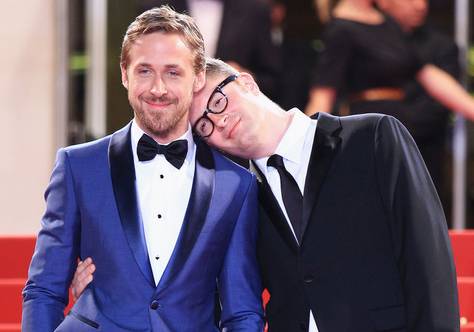
    Those of you who follow me on Twitter already know how I feel about wild-card Palme d’Or contender “Drive,” but I’ll have a review up a little later. For now, though, I can’t resist posting this shot of Ryan Gosling, his awesome royal-blue tux and director Nicolas Winding Refn at last night’s red carpet premiere — handily the sweetest photo of this year’s Cannes fest. Long live bromance.

  • SHORT TAKE: “The Skin I Live In” (***)

    Cannes Film Festival

    Pedro Almodóvar’s new feature opens with a pause: a beautiful young woman holds a tricky yoga position, her already fine-lathed physique vacuumed into a nude body stocking, stretched across a couch like a pale side of meat hung out for curing. So so taut, so fragile, it seems a simple tap on the shoulder will splinter her perfect form into a chandelier’s worth of glass shards — and that’s an apt note of tension on which to begin “The Skin I Live In,” a coldly kinky thriller in which Almodóvar’s career-long concern with the manipulation and violation of the human body is bent back so far it has nothing left to do but break.

    The girl is actress Elena Anaya; who she’s playing is a question the film keeps in play for far longer than you’d think feasible in a narrative that deftly splits and reshapes identity across a pair of linked tragedies in the life of Antonio Banderas’ demented genius of a plastic surgeon. Adapted — rather liberally, I understand — from Thierry Jonquet’s novel “Tarantula,” the film’s dense structure plays Snakes and Ladders with chronology (a late-film title card that reads “back to the present” drew chuckles in the audience for its apparent self-exasperation), staggering major twists across its running time that makes it a challenge to discuss in any narrative capacity. (It hardly flatters the reviewer’s role to say this, but audiences are better off reading as little about the film as possible before entering the theater: ignorance really is bliss here.)

    (more…)

  • OSCAR TALK: Ep. 56 — Special Edition! — Cannes so far, ‘Tree of Life,’ Von Trier, taking the 2011 awards pulse

    Oscar TalkWelcome to Oscar Talk.

    In case you’re new to the site and/or the podcast, Oscar Talk is a weekly kudocast, your one-stop awards chat shop between yours truly and Anne Thompson of Thompson on Hollywood. The podcast is weekly, every Friday throughout the season, charting the ups and downs of contenders along the way. Plenty of things change en route to Oscar’s stage and we’re here to address it all as it unfolds.

    It has been nearly three months since we last got on the horn to talk the film wards landscape. We promised another dip during Cannes, so here we are. Today Anne and I are joined by Guy Lodge as the two of them have been working the Croisette all week. Let’s see what’s on the docket today…

    (more…)

  • ‘Take Shelter’ takes first award at Cannes

    Nine days in, the Cannes Film Festival is winding down. Many of the US journos are flying home, and with Pedro Almodóvar’s “The Skin I Live In” having premiered this morning — review coming tomorrow — the superstar auteurs have all shown their hand. (That’s not to say Nuri Bilge Ceylan or Paolo Sorrentino can’t alter the shape of the festival, however.)

    But with the drop in energy comes the scent of gold, as we prepare for the annual Cannes parlor game of loudly criticizing the jury’s decisions. We’re still three days away from the Competition awards — though Aki Kaurismäki’s broadly liked comedy “Le Havre” (which I frustratingly still haven’t seen after three attempts) has emerged as the sizeable Palme d’Or favorite, while I hear rumors that Olivier Assayas is the lone “Tree of Life” fan on the jury — but the trophy run began tonight with the winners of the Critics’ Week sidebar.

    (more…)

  • How do you solve a problem like Von Trier?

    It couldn’t last. As the closing credits began rolling on Wednesday morning’s 8.30am Cannes press screening of “Melancholia,” Lars Von Trier’s elegant rumination on anxiety, the apocalypse and all those other swell things, I was stunned by how civil the atmosphere in the vast Lumiere theater was.

    Enthusiastic applause greeted the film — more surprisingly, so did a distinct absence of boos. Soaking up the post-screening chatter in the foyer, I didn’t once hear the words “misogynist,” “perverted” or “clitoridectomy,” but I did pick up a bushel apiece of “moving” and “beautiful.” A number of critics disliked it, of course, but it rather seemed as if Lars Von Trier had pulled off the (for him) impossible: a film that touched many and upset no one.

    And then came this.

    (more…)

  • Persona non whateva

    Guy is on his way to a screening of Nicolas Winding Refn’s “Drive” at Cannes right now, but he will eventually get around to addressing Lars Von Trier’s spanking by the festival, which now considers him persona non grata.

    In the meantime, however, I’ll align myself with this statement from David Poland’s assessment:

    Is von Trier an ass at times? Absolutely. Aggressive provocateur? Absolutely.

    But he is one of the few high profile filmmakers who pushes audiences to Think. You can hate what he makes, but you can’t deny that he is skilled and alive with ideas. Who will stand for this in a homogenized, instant-news-cycle culture if Film Critics and Festivals will not?

    (more…)

  • REVIEW: “Melancholia” (***1/2)

    Cannes Film Festival

    It’s the end of the world as we know it, and Lars von Trier feels fine. Well, not “fine,” exactly: he feels as despairing and sceptical and faithless as he usually does, but that’s clearly where he’s comfortable, and where his creative faculties thrive most actively.

    They’re certainly in rude health in “Melancholia,” a ravishing arthouse blockbuster that extends the self-therapy he began in 2009’s bracingly unhinged horror film “Antichrist,” but with more thematic cohesion and tonal restraint. The sensation-hungry, who label any new von Trier film ‘controversial’ before seeing a shred of footage, will likely be disappointed — that is, if they’re not appeased by some tame shots of Kirsten Dunst rutting on a golf course. (Luckily for them, as if realizing the deficit, the director compensated with some trademark shenanigans at the press conference.)

    For the rest of von Trier’s fans, however, the film’s lack of overt audience-baiting serves to place his formal gifts in starker relief. A subdued, even elegant, vision of the apocalypse that begins as a waking dream and continues in an actuality no less feverish, “Melancholia” represents the natural culmination of the depressive doubt in self and society that has needled most of von Trier’s features. As a statement on the spiritual bankruptcy of the human race, it may well prove unfurtherable: after destroying the world we live in — a spoiler only to the most tone-deaf of viewers, I assure you — where does the man have left to go?

    (more…)

  • CANNES: ‘The Kid With a Bike,’ ‘House of Tolerance,’ ‘Michael,’ ‘Footnote’

    Perhaps lulled by the twin effects of the Côte d’Azur sun and copious amounts of cheap rosé between screenings, I’ve fallen behind somewhat on the reviewing front — but lest you think I’ve only seen one film a day before heading back to the swimming pool at Villa Romance, it’s time for a bit of a Competition catch-up. (I’ll get round to a handful of Un Certain Regard and Critics’ Week titles — a couple of them very strong — as soon as I can.) Tomorrow brings another of my most anticipated titles of the festival, Lars von Trier’s “Melancholia,” which should steer Croisette conversation forward after a low-level day of screenings, over which talk of “The Tree of Life” has remained the dominant hum.

    “The Kid With a Bike” (***)

    “More of the same, but less,” I tweeted immediately after seeing the latest finely-honed study in urban realism from Belgium’s two-time Cannes champs, the Dardenne brothers. It’s a statement I stand by — it’s difficult not to think that after the muted acclaim for “Lorna’s Silence,” their 2008 flirtation with higher-concept storytelling, they’ve retreated to a safe space — even as I admit it doesn’t factor in some subtle novelties in the new film. “The Kid With a Bike” is literally their brightest film to date, for starters, shot mostly in crisp summer sunlight and poppy primary hues, which may also be why it feels like their most uncomplicatedly redemptive.

    (more…)

  • REVIEW: “The Tree of Life” (***)

    Cannes Film Festival

    Landscape has always been character in the films of Terrence Malick. The even, rolling fields of “Days of Heaven,” the sweatily green hill ladders of “The Thin Red Line,” even the dry-toast mesa of “Badlands”: all expansive, overwhelming environments that dictate the behavior of the films’ human occupants through sheer force of presence, for it’s often all they have to live in and live with. It’s an approach that, across 33 years of widely-spaced work, has drawn as many accusations of vacant pictorialism as it has rapt devotion — without the mystique Malick has accrued through his slow-loris work patterns, it’s difficult to say which camp might have emerged dominant — but it’s made for an oeuvre with a stylistic and textual throughline that belies its scattered production.

    Until, that is, “The Tree of Life,” Malick’s long, long delayed fifth feature that is at once his most interior work and his most grandiosely conceived. A fractured, impressionistic memory album documenting the roots of familial estrangement in a middle-class 1950s household in the director’s hometown of Waco, Texas, it arrives on the screen surrounded by bookends within bookends: scenes depicting the present-day social alienation of the family’s grown eldest son (Sean Penn), bracketed by vastly scaled sequences addressing more generalized concerns of theology, evolution and mortality.

    (more…)

  • SHORT TAKE: “The Artist” (***1/2)

    Cannes Film Festival

    “Please be silent behind the screen,” requests a sign in the cinema where silent movie star Georges Valentin’s latest work is screening, near the beginning of “The Artist,” Michel Hazanavicius’ semi-sweet paean to pre-talkie cinema.

    It’s a witty clue as to how Hazanavicius is going to run the ship in his own not-quite-silent movie: swooping strings accompany the film-within-a-film’s finale as Valentin (Jean Dujardin) waits confidently in the wings, only for sound to cut out just as the audience bursts into thunderous applause. It’s a neat trick, one the director pulls and reverses a few times in 100-odd minutes that follow, and one that cunningly aims to replicate in negative the disorientation 1920s picturegoers might have felt when films suddenly started speaking.

    If “The Artist” never quite becomes the ingeniously self-reflexive cinematic essay this scene promises, it succeeds on several warmer, more immediate levels: as an infectiously affectionate reminder of a lost art form’s joys, as a lushly imagined exercise in style, and most crucially, as a funny, emotionally connected entertainment in its own right. As in his pair of hit “OSS 117” films — droll spoofs of 1960s spy cinema, the casual pleasures of which his latest considerably builds upon — Hazanavicius’ approach to pastiche is exacting but not academic: story remains the top priority here, and he has settled on one that is snugly predicated on the film’s very own formal conceits.

    (more…)

  • CANNES: ‘Polisse,’ ‘Habemus Papam’

    “Polisse” (***) That the title for “Polisse” reportedly derives from writer-director-star Maïwenn’s misspelling of the word “police” aptly summarises both the charms and weaknesses of her third feature, a garrulous, chaotic, intermittently hot-wired ensemble soap braiding the personal and professional lives of officers in the Paris police department’s Child Protection Unit.No doubt the product of much earnest first-hand research into that environment — the numerous individual cases portrayed here are all rooted in fact — the film nonetheless feels creatively informed to a greater degree by the rhythms and structures of TV procedural drama.

    If that reads as a slight, it is and it isn’t: Maïwenn (the tearaway French star who had Luc Besson’s child at 17 and was allegedly the inspiration for Natalie Portman’s character in “The Professional,” so perhaps she knows more about CPU than most) gets what makes such shows propulsive, as she restlessly scurries between multiple crises rendered in cinematic shorthand, patly completing some strands and leaving others hovering for future episodes that will never get made. Casually bed-hopping and entering volcanic shouting matches at the drop of a hat, her characters don’t behave quite like human beings so much as the heightened reflections of them dictated by short-form storytelling; in some respects, Maïwenn’s writing is as phonetic and overheard as her spelling.

    (more…)

  • SHORT TAKE: “Restless” (*1/2)

    Cannes Film Festival
    Un Certain Regard

    “What can you say about a 25 year-old girl who died?” Written by Erich Segal before being plaintively voiced by Ryan O’Neal, this presumably rhetorical question is the opening gambit of “Love Story,” the simple but phenomenally successful weeper in which a young couple’s relationship is prematurely halted when the girl contracts leukemia — a bummer at any stage of life, but particularly so when you’re young and in love and have Ali MacGraw’s very nice hair.

    As it turned out, the film didn’t have an awful lot to say about the 25 year-old in question, beyond the indirect observations that love is sweet, death is sad and that neither one of those truths alters the other. Gus Van Sant’s new film “Restless,” meanwhile, asks the same question — just with a slightly lower number replacing the 25 — and, as laws of both algebra and Hollywood would have it, asks it to somewhat lower returns.

    (more…)