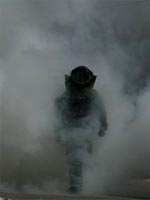
 One of the most common lines (usually used in praise) on our newly-crowned Best Picture winner is that it’s deliberately apolitical, taking no sides in the Iraq conflict as it aims simply to present the soldier’s experience on the ground. Kathryn Bigelow herself dismissed that as something of a misconception in a recent interview with Steve Pond:
I guess my feeling is that graphic portrayals of innocent children killed by bombs, and soldiers incapable of surviving catastrophic explosions … I think that’s pretty clear. And then also, to add to that, the movie opens with a quote, “The rush to battle is often a potent and lethal addiction, for war is a drug.” So it’s definitely taking a very specific position.
Blogging last night on the Oscar race, Michael Moore says much the same thing — less tacitly, of course, than Bigelow:
The truth is “The Hurt Locker” is very political. It says the war is stupid and senseless and insane. It makes us consider why we have an army where people actually volunteer to do this. That’s why the right wing has attacked the movie. They’re not stupid — they know what Kathryn Bigelow is up to. No one leaves this movie thinking, “Whoopee! Let’s keep these wars going another 7 years!”
 Ah, Oscar lists — the gift that keeps giving. I’m not going to ape Kris’s impressive
 In most cases, the adapted screenplay category of a given Oscar race is packed with Best Picture nominees or contenders. This year, however, there was a nice balance of adapted and original screenplays in the Best Picture category, and in fact, of the “top five” films that trickled down throughout the season, three were original and two were adapted, a rarity.
 •
 He may currently be basking in the glow of a surprise Oscar nomination, but when I call him up at his London home,
 (Your non-Harvey-influenced round-up for the morning…)
 Voted on by a handful of London critics (including IC friend Tim Robey), the Evening Standard Film Awards aren’t the glitiziest of honors, but they always make admirably singular choices. Celebrating the best in British film and talent, they often highlight names and titles below the radar of even the British Independent Film Awards.
 So
 In so many words, this is it. The Academy of Motion Picture Arts and Sciences unveils it’s slate of nominees bright and early tomorrow morning, and this being the first year with a 10-film Best Picture field, all eyes will be on the top category to gauge which way the wind blew on this AMPAS experiment.
 With
 The New York Film Critics Circle decided not to announce its list of winners in real time this year, which is a shame because it has always been one of my favorite aspects of the season. What we’re left with is scattered press release reveals, Twitterers scooping the group’s info as emails and phone calls circulated, and basically, the vibe that it’s just another cog in the wheel.
 For those of you bored of reading the same ever-narrowing list of names in the assorted Oscar-speculation pieces across the web, David Poland’s
 You’ve heard me natter on enough for months about how
 Regular Guardian readers will know that Peter Bradshaw, the paper’s perma-grouch film critic, doesn’t dole out five-star ratings lightly — in the past half-year or so, only “The Class” has made the grade. So I’m interested to see Bradshaw going