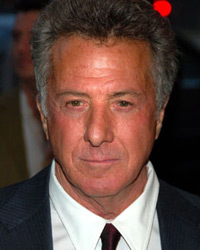
 He doesn’t seem like Dustin Hoffman for some reason. He sounds like Dustin Hoffman. He looks like him. But there aren’t really any traces of his decades-long assemblage of characters. And he’s got an approachability that seems somehow uncommon for a star of his stature.
But there he is, piecing together a sandwich with arugula, veggie cheese, spicy mustard and wheat bread as he recalls his first major interview with Studs Terkel over 40 years ago. Terkel has passed recently, which brought the topic to the fore.
“It was Chicago, right after ‘The Graduate,’” Hoffman says. “I went into his office and he had floor-to-ceiling books and everything, you know. The office looked like him. He turns the tape recorder on and it was an intricate and intensive interview that probably went on for over two hours. We shook hands and he said, ‘Let me just check’ — and the tape didn’t work. It had been blanked for some reason. So he says, ‘You wouldn’t mind doing it again?”
So it was that we kicked off our own two-hour conversation, one steering in and out of his legendary career, briefly touching on the particulars of his latest film, “Last Chance Harvey” (now playing in limited release and for which Hoffman received a Golden Globe nomination for Best Actor), but mostly wandering from this mundane particular to that.
He has a fondness for iron furniture, a number of antiques peppering his Brentwood offices. A large Italian “Midnight Cowboy” poster hangs in the lobby, but I’m caught off guard by the food and drink spread in the hallway as we move into his personal office. The dainty dishes and cutlery seem to clash with the casual air of the actor before me.