In Contention

Tag: Bonnie and Clyde

  • Beatty got back

    Usually, the news that someone is about to write, direct, produce and star in some film of no clear description for Paramount wouldn’t seem particularly worthy of notice until the parties involved release a few more details.

    But when the “someone” in question is 74 year-old Warren Beatty, the one-time Hollywood monarch whose name hasn’t appeared on screen since 2001 (as an ensemble member of all-star embarrassment “Town and Country”), it’s hard not to get curious.

    With Beatty not having steered a film of his own since 1998’s “Bulworth” — the fascinating but frustratingly scattershot political satire that never found a place in the popular imagination, despite netting him a writing Oscar nod and arguably featuring Halle Berry’s strongest performance — there’s likely a generation or two with little concept of what an industry force the man was across four decades. (Perhaps more enduring, on the pop-culture scale, is his reputation as Hollywood’s most storied lothario, though Annette Bening put a stop that 20 years ago.)

    (more…)

  • Arthur Penn (1922-2010)

    I had a bad feeling that after Gloria Stuart and Sally Menke we were bound to get a third (as it always happens), and so we have.  Arthur Penn has passed away a day after his 88th birthday.  He’s obviously best known for helming 1968’s “Bonnie and Clyde,” which changed the face of American cinema at a time captured brilliantly in Mark Harris’s “Pictures at a Revolution,” but there were other gems along the way like “Mickey One,” “Little Big Man” and “The Missouri Breaks.” Not to mention trailblazing work on the small screen (specifically during the 1960 presidential debates) and on the stage.  He will be missed.

    After the break, John F. Kennedy’s closing statements from the October 21, 1960 presidential debate, which Penn directed.

    (more…)

  • TCM’s ‘Summer Under the Stars’ posters

    Brad Brevet over at Rope of Silicon points me today over to the Turner Classic Movies website, which, in preparation for August’s mega “Summer Under the Stars” program, has released a modest series of redesigned posters for a few of the classic films set to be screened.  The “Magnificent Seven” and “Grapes of Wrath” posters are, of course, exquisite, but I was taken by the arresting simplicity of this one for “Guess Who’s Coming to Dinner?”:

    Guess Who's Coming to Dinner?

    Speaking of Stanley Kramer’s film, I finally got around to Mark Harris’s book “Pictures at a Revolution” last week, maybe 100 pages in so far.  It’s a look at a pivotal time in American film history through the lens of 1967’s five Best Picture nominees (“Bonnie & Clyde,” “Doctor Dolittle,” “The Graduate,” “Guess Who’s Coming to Dinner?” and “The Graduate”), and I can’t put the damn thing down.  It’s expertly rendered journalism that reads like a novel and every chance I get, I’ve been recommending it to film enthusiasts.  So it only makes sense I bring it up here.  Seek it out.

  • Gangster lovin’

    Johnny Depp in Public EnemiesJoe Queenan is one of my least favorite Guardian film contributors — too often perversely hard to please — but I did appreciate the boyish honesty of this piece, in which he sheds his usual cineaste grousing to indiscriminately geek out over guns and fedoras. With “Public Enemies” only a few days away, he extols the simple joys of the gangster genre:

    For those of us who secretly believe that gangster movies are the only ones worth making – despite our obsequious lip service to Truffaut and Antonioni – the timing could not be better. Aficionados of gangster movies view reality as a daisy chain connecting one gangland saga to the next, with ordinary life – family, children, career, lunch – occurring in between. We do not need an uninterrupted stream of gangster movies to survive, and we certainly do not need half-hearted twaddle like Knockaround Guys to function properly – but we cannot tolerate long gaps between high-quality releases.

    (more…)

  • POLL: The most influential films of all time, round one, part two

    Harrison Ford in Blade RunnerAnd with that, part one of the first round of voting comes to a close.  Go here for the background on our survey.

    Today, we have 10 fresh titles in the left sidebar for you to rifle through on the way to choosing THREE worthy of moving forward to the next round.  Each poll throughout the rest of round one will include 10 films and choices of up to three.  Last week’s poll was the big dive, 16 titles.  The five that moved on from there were:

    “Apocalypse Now” (1979)
    “Battleship Potemkin” (1925)
    “Citizen Kane” (1941)
    “Gone with the Wind” (1939)
    “Rashomon” (1959)

    I must say, I was sad to see “Bonnie and Clyde” left out.  The Arthur Penn classic was in the top five for a while, but it was too close for comfort on “Battleship Potemkin” as far as I’m concerned.  Literally, a final vote right at the deadline secured it a place in the top five over “E.T.: The Extra-Terrestrial.”  That says one thing to me: more people need to see it.  So to those of you who’ve never seen it, do yourself a favor: seek it out.

    No, it is not the most captivating film of all time and no, you won’t be seeing anything “new” by your standards.  But do a little digging and find out why the film has meant so much to the practice of film editing and montage and you’ll discover why its impact is probably felt as much if not more than the most seminal titles on our massive list of 66.

    Keep in mind when voting: this isn’t a popularity contest.  Don’t just rattle off votes for your favorite films (which, I imagine, has to be the main reason “E.T” was so high on the list during part one).  Take a moment to think about what the films have meant to the medium.  This list represents you, the readership, after all, so vote wisely.

    This poll will close Wednesday, April 29 at 2:00 pm EST.

  • OFF THE CARPET: Memo to the Academy

    The Academy Awards–MEMO–

    TO: Members of the Academy of Motion Picture Arts & Sciences
    FROM: Kristopher Tapley

    RE: The ballot you recently received

    Ladies and gentleman,

    As you sit to ponder the year’s best in your various fields of professional expertise, you might find yourself strong-armed into the consensus view 2008’s film product has been whittled down to over the last 30 days.  You might even find yourself at a loss, cramming as much as you can after a year of constantly working with nary a moment to spare a trip to the cinema.  Such last minute jitters can yield an unconsidered and, certainly, lackadaisical approach to your annual responsibilities as AMPAS members.  But I implore you to take your time with this, be measured, and above all, take pen to paper with a level of seriousness.

    While I would never presume to tell you how to go about filling in your respective ballots, I hope you don’t find it too bold of me to offer a few closing words of encouragement and suggestion as we close the book on 2008.  The glut of film awards season fades into a numbing hum you’d perhaps rather ignore until the holidays have run their course, so come back to these words at a later date if you must.  They merely represent the humble opinion of one passionate film lover who believes in the potential of your organization and the ideals it stands for.

    (more…)

  • THE LISTS: Top 10 biopics

    It’s no real secret that the Academy is partial to the biopic. Big or small, intimate or epic, celebratory or critical, they never seem to tire of the allure of actors channelling real-life figures, past and present. Lately, in the performance categories in particular, biopics have been the surest route to voters’ hearts, with seven of the last nine Best Actress winners falling under the category, and Daniel Day-Lewis having just broken a three-year run of biopic winners in Best Actor.

    The genre is no less prominent this year, with titles like “Milk,” “Frost/Nixon,” “Che” and “W.” all garnering varying degrees of awards buzz, for their star turns in particular. Meanwhile, from the arthouse, European titles like “Hunger” and “Il Divo” are significantly challenging the formal boundaries of the biopic, proving that the genre has far more adventurous terrain to cover than the solid, occasionally stodgy awards catnip the Academy frequently chooses to laud.

    Back in August, I wrote a post about how I was wearying of Oscar’s devotion to the genre; in turn, after my unenthusiastic “Frost/Nixon” review, a friend said to me, “Well, you do hate biopics.” I really don’t. But I am a little bored of the more linear, prosaic examples of the genre that reduce the narrative to CliffsNotes highlights in order to showcase a performance. (Step forward, “Ray” and friends.)

    Real life offers an infinite number of structural and cinematic possibilities, and it is the films that best take advantage of this fact that this week’s list is designed to celebrate. The ten films here take a wide range of approaches in portraying an equally diverse array of lives, but for me, they all pass the principal test of the great biopic: defamiliarizing the familiar. By creating living, breathing characters out of figures best known from history books and pop culture annals, they make real life as revelatory and surprising as fiction.

    It’s interesting to note how few of the films I’ve chosen qualify as the Oscar-bait that biopics are widely perceived to be — we have four Best Picture nominees here, and only one winner. It was by no means a deliberate or elitist move on my part, but the fact remains that a lot of the most interesting and audacious work within the genre doesn’t get the recognition it deserves.

    The biopic is clearly maturing — as I was drawing up the shortlist for this piece, I was surprised by how recent many of my inclusions were, but it’s clear that filmmakers are getting more adventurous with time. For example, in the 1950s, a film like “La Vie en Rose” would have been made as a stolid music weeper in the “I’ll Cry Tomorrow” mold — today it comes in a considerably more fractured form, structurally and stylistically. It’s just one of several recent films, from “The Assassination of Jesse James by the Coward Robert Ford” to “Marie-Antoinette,” to show that the biopic need never be safe cinematic territory. The following ten films prove that.

    10. “American Splendor” (Robert Pulcini and Shari Springer Berman, 2003)
    An ingeniously intertextual account of the life and work of comic book author Harvey Pekar, “American Splendor” goes against the grain of nearly every other biopic of a creative being by revelling in its subject’s ordinariness. Riffing off Pekar’s own autobiographical comics, Pulcini and Berman brought their keen documentarist’s eye to Pekar’s unremarkable world of beige offices and supermarket checkouts, making as much dramatically of the absences in his life as his achievements. Anchored by a quicksilver performance from Paul Giamatti, this achieves the rare biopic feat of matching its subject’s individualism.

    (more…)

  • Mr. Beatty, direct another film please?

    Interviewing Warren Beatty a few years ago in Toronto, I was struck at once by his intellect, which is laser sharp. The man misses nothing. He speaks slowly, taking long pauses before he speaks, and avoids personal questions, which I dislike and refuse to ask anyway.

    He was with Annette Bening at the time, supporting her efforts in “Being Julia.” But all I wanted to discuss was “Reds,” Beatty’s masterful film about John Reed and the Russian Revolution which won him the Academy Award for Best Director and was ousted for Best Pic by the vastly inferior “Chariots of Fire.”

    I had heard he could be a nightmare in interviews, but he seemed genuinely interested in discussing the film. He remembers sitting there at the ceremony, and when the other film won Best Costume Design, he said he knew it was over.

    Beatty was recently honored by the American Film Institute, which led me to go back and watch many of his films. I’ve come to the conclusion that, not only is he among the more under-appreciated actors and directors working in film today, but he has been for at least 40 years.

    (more…)

  • REVIEW: “The Last King of Scotland” (****)

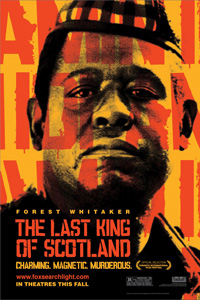
    Fox Searchlight Pictures\' The Last King of ScotlandEvery so often a film comes along that is so celebratory of the filmmaking process and fresh in its approach to visually conveying a story that it creatively demolishes anything within earshot.

    “Metropolis” was an early example, as Fritz Lang opened up the world in front of the camera like no one before.  Arthur Penn’s “Bonnie and Clyde” and William Friedkin’s “The French Connection” awakened the filmmakers of the 1970s to new boundaries willingly crossed.  And Quentin Tarantino brought unique and highly innovative ideas to light in the 1990s when he unleashed “Pulp Fiction” on the filmmaking community.

    Another such film has finally come along, and whether Kevin Macdonald receives the credit he deserves for melding the idiosyncrasies of documentation with the manner of narrative flow or not, “The Last King of Scotland” has become a landmark of ingenuity.  In this viewer’s opinion, it is the best film of the year thusfar.

    “The Last King of Scotland” was adapted from Giles Foden’s award-winning novel of the same name.  Charting the chaotic journey of Scottish doctor Nicholas Garrigan, Foden unveils the sadistic regime of Ugandan dictator Idi Amin in ways much less conventional than one would expect of such a tale.

    The fictional character of Garrigan was born out of the author’s many conversations with former Amin advisor Bob Astles, and the resulting tale is even, calculated and deliberately paced, very much a story meant for the page in its initial conception.  The process of adapting the material to the screen could have gone a number of typical ways, but the choices made by Macdonald and co-writers Jeremy Brock and Peter Morgan are exhilarating if nothing else.

    Scottish actor James McAvoy portrays Doctor Garrigan in the film.  Following an extremely brief introduction, and an equally swift scene conveying Garrigan’s place as his father’s son, the recent college grad rushes off to a new place in the world where he can be of service.  Anywhere but home will do, and the African country of Uganda becomes his new destination.

    All of this is carried across in a number of beats, not even necessarily scenes, and Garrigan is off on his journey within five minutes.  Lesser filmmakers would have taken inappropriate time establishing the character, meandering, before finally setting him off on his journey.  Macdonald trusts the viewer to stay with him, and unveils the events of the narrative through the eyes of his protagonist better than the most seasoned of directors.

    Garrigan soon settles into a missionary camp, providing health care for the few Ugandans willing to trust white doctors over village witch-doctors.  The camp’s head physician and his wife, Sara (Gillian Anderson), could certainly use the help.

    Meanwhile, political upheaval is the consistent state of affairs, as former president Milton Obote is overthrown by the regime of Idi Amin (Forest Whitaker), a “fighter for the people” – or so he would initially be considered.

    (from left) Forest Whitaker, Gillian Anderson and James McAvoy in The Last King of ScotlandFollowing an automobile accident that is cleverly repositioned from its place in Foden’s novel, Garrigan and Sara are summoned to the aid of Amin.  The president has sprung his wrist in the process of ramming his Maseradi into a giant bull.

    Amin is immediately impressed by Garrigan’s tenacity and strength of mind, and he later offers the doctor a position as his personal physician.  So begins one of the most interesting relationships between two men captured on the page or on the screen in some time.

    Garrigan is abundantly charmed by Amin, a man who can seemingly see right through those at his side.  The depth of his personality clashes with the childish nature of his sensibilities to form a persona impossibly ignored.  But the longer Garrigan remains drunk with the importance of his position (soon considered an “advisor” by Amin), the longer it takes him to wake up to his complicity in a disastrous regime that will have been responsible for the deaths of over 300,000 Ugandans before Amin would finally be overthrown in 1979.

    Kevin Macdonald has made a name for himself as a documentary filmmaker for the better part of a decade.  Most notably, 1999’s “One Day in September” won the Oscar for Best Documentary, a painstaking dissection of the 1972 Munich Olympics tragedy.

    2004’s “Touching the Void” was one of the most acclaimed films of that year, blending dramatic recreation with first hand accounts of the treacherous ascent of Siula Grande by mountain climbers Joe Simpson and Simon Yates.

    What the director does so brilliantly in his first foray into narrative filmmaking is draw upon his instincts as a documentary filmmaker.

    “The Last King of Scotland” is not shot like a typical narrative political thriller.  The camera wanders frequently to various peculiarities in the scene, typically finding the motion of Amin’s hands, no matter how mundane the gesture.

    The usage of zooms and erratic camera movement recalls guerilla filmmaking above all else, and it really feels like we are watching true events unfold, not dramatic interpretations of them.  Danny Boyle and “Dogme” regular Anthony Dod Mantle served as cinematographer.
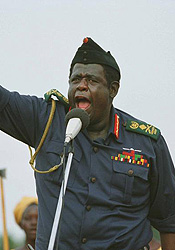
    Forest Whitaker in The Last King of ScotlandThe performances on the whole are fantastic, but the central tension and these two men’s effect on one another could not have been portrayed more succinctly.  James McAvoy is outstanding, and Macdonald should be applauded for casting someone so little-known.  One would expect a pseudo-star like Ewan Macgregor to be forced into such a scenario, but the right decision has been made and McAvoy holds his own opposite the most explosive on-screen incarnation of the year.

    Forest Whitaker’s Idi Amin deserves a place in filmmaking history as one of the more vibrant depictions of the medium.  One recalls the tagline of the film every moment he is on screen:  “Charming.  Magnetic.  Murderous.”  And when he enunciates each syllable of Garrigan’s name (“Nee-co-laas”), the chill rises up and down the viewer’s spine as it did when Sir Anthony Hopkins casually mentioned eating a man’s liver “with a side of fava beans and a nice Chianti.”

    Gillian Anderson and Kerry Washington (as Kay, one of Amin’s wives) are suited to the production, though Anderson’s sudden exit from the film early on feels as unnatural as it is in the novel.  It would have been nice to see more of her, and sporting a haphazard blonde hairstyle, she is sexier here than she has ever been.  However, Macdonald and his writers do a nice job of blending other characters and circumstances from the book into these two women, which makes for a fascinating adaptation on the whole.

    In fact, the biggest accomplishment outside of the style and innovation of the camera work would have to be the screenplay.  Foden’s novel, as mentioned, is deliberately paced.  But the writing team somehow made it much more electric and exciting, while at the same time combining various elements with the greatest of ease to make for a solid, swiftly-paced narrative.

    They utilize the Palestinian hijacking of an Air France flight in 1976, for instance, to its fullest effect as the climax of the film.  The flight was infamously held at Entebbe airport in Uganda while Amin, a PFLP supporter, supplied the hijackers with extra troops and weapons.  The event was the beginning of his downfall in the court of public opinion.

    Ultimately, “The Last King of Scotland” can work above or below the surface.  One could enjoy the film as a run-of-the-mill political thriller and be satisfied, taking nothing else away from it.  On the other hand, the depth present in the seamless creation of the story lies in wait for anyone willing to notice.

    It really is a staggering initial narrative outing, and if this is the talent Kevin Macdonald has been incubating while documenting the real world, we can only consider ourselves lucky that he has finally crossed over into the imaginary world.  He is truly an artist to watch.