In Contention

Tag: Do the Right Thing

  • Looking back on Oscar’s Old Left leanings

    Its installments come all too infrequently these days, but Best Pictures From The Outside In — a collaborative project between The Film Experience’s Nathaniel Rogers and his learned pals — is one of the best sources of Oscar discussion and analysis on the web.

    That’s not only because it provides ample opportunity for kvetching over the Academy’s past mistakes (our favorite sport, let’s face it), but because its system of pairing up Best Picture champs from opposite ends of history often reveals unexpected patterns of progression (or not, in some cases) among the voters.

    Their latest episode is a doozy on both counts, covering as it does one of the most roundly jeered winners in the category’s history, 1989’s thoroughly vanilla race-relations drama “Driving Miss Daisy.” (By contrast, the other featured champ, 1946’s “The Best Years of Our Lives,” holds up to this day.)

    (more…)

  • THE LONG SHOT: Minority report

    PreciousWhen the Academy Awards roll around in March, it will have been precisely two decades since the unlikely figure of Kim Basinger blasted Academy voters’ conservatism on air at the 1989 ceremony, with specific regard to their sidelining of “Do the Right Thing,” Spike Lee’s groundbreaking study of urban interracial tension.

    “We’ve got five great films here, and they’re great for one reason – they tell the truth,” the star opined before presenting a clip from one of that year’s Best Picture nominees. “But there is one film missing from this list that deserves to be on it because, ironically, it might tell the biggest truth of all.”

    As if in response, later that evening, the Academy handed their top prize to “Driving Miss Daisy,” as quiet and uncontroversial a portrait of the American racial divide as you could ask for. Let it never be said that the Oscars have no sense of irony.

    20 years on, much has changed. (Basinger has become an Oscar-winning actress, for starters. No one saw that coming.) More to the point, the amount of black Oscar winners in acting categories has trebled. And just two years after Basinger’s outburst, the Academy named 23 year-old John Singleton their first black Best Director nominee.

    (more…)

  • 7/20 Web Round-up

    The Cove• Edgar Arce talks “The Cove” with documentarian Louie Psihoyos. [Latino Review]

    • With Judd Apatow’s “Funny People” on the brain, Saul Austerlitz takes a look at the “dramedy” through the years. [Chicago Tribune]

    • Meanwhile, Patrick Goldstein looks at the mystifying missed opportunity of the film’s one-sheet. [The Big Picture]

    (more…)

  • “Do or die, Bed-Stuy”

    Do the Right ThingLike others, we’ve been paying mind on these pages to the 20th anniversary of Spike Lee’s “Do the Right Thing,” a film that now finds itself in the odd position of being both a period piece and a still-resonant state-of-the-nation address. Certainly nothing in the two decades since its release has surpassed it as a study of the intricacies of race relations in modern America. (Even supporters of “Crash” would have to admit that.)

    Anyway, my attention was brought to this beautiful tribute to the film’s legacy in black-interest magazine The Root, in which Kai Wright reflects on what changed — and remained — in the Bedford-Stuyvesant neighborhood that the film immortalized:

    Much has changed since 1989, my older neighbors say, but much hasn’t. We’ve got a few coffee shops for hipster art students—black and white alike—but Spike’s Sweet Dick Willie, Coconut and M.L. still set up their own corner cafes. They lounge on paint buckets and tumble out of parked gypsy cabs, interrupting their endless debates only to ogle women young enough to be their daughters.

    It’s hard to imagine a race riot anywhere in New York City these days, let alone Bed-Stuy. Frustrations are more likely to erupt inward—into domestic violence, drug abuse and depression, small beefs that spiral up into shootings. Maybe Spike can make another film about it, and this time Bed-Stuy’s people will actually do the right thing—and take their riot over to Wall Street.

    (more…)

  • 20 years later…

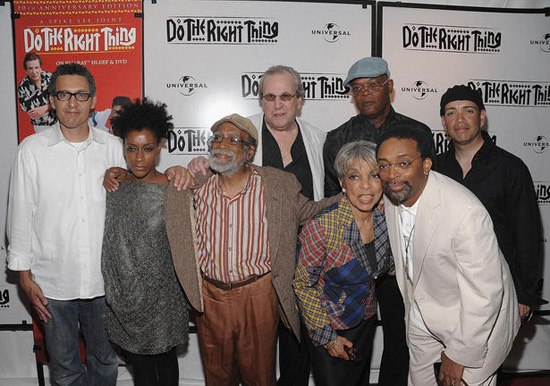
    (from left) John Turturro, Joie Lee, Bill Lee, Danny Aiello, Ruby Dee, Spike Lee, Samuel L. Jackson and Luis Antonio Ramos at the 20th Anniversary screening of Do The Right Thing

    More from the red carpet of the film’s 20th anniversary screening at Yahoo! Movies.

  • 6/29 Web Round-up

    Stephen Frears• Rachel Abramowitz catches up with Johnny Depp on the “Public Enemies” publicity trail. [Los Angeles Times]

    • Helen O’Hara remembers Michael Jackson’s movie moments. [Empire]

    • Jenni Miller talks to “Cheri” director Stephen Frears. [Cinematical]

    • Guillermo DelToro’s credo. [The Independent]

    • “Do the Right Thing” still asks burning questions. [Washingotn Post]

    • Hey, remember Julia Ormond? [New York Daily News]

    • David Cairns talks to “Pontypool” director Bruce Macdonald. [The Autuers’ Notebook]

  • Oscar might go for “Button”

    Cate Blanchett in The Curious Case of Benjamin ButtonThere is no good reason for me to think this, of course.  Call it a gut feeling, but I have a sneaking feeling the Academy might ignore “Slumdog Millionaire,” despite its countless awards, and go for homegrown studio product this year.  Let’s face it, the Academy has proven they march to their own drummer over and over again.
    “Slumdog” has already become a pop culture phenomenon around North America and Britain, making far more money than the filmmakers ever thought it would. Hell, before the festival season started the film was doomed, set for direct-to-DVD distribution.  Yes, Danny Boyle has won the DGA award, a solid predictor, but I’m not convinced.  Hollywood loves to congratulate itself, which we saw in 1997 with “Titanic” somehow winning a record 11 awards over the vastly superior “L.A. Confidential.”  David Fincher’s “Button” has been around for years, waiting for the right director, the right effects, the right time.

    So often in the past the Academy has gone for a film that is conservative and offends no one, ignoring the better work.”Driving Miss Daisy” over “Do the Right Thing” (which wasn’t even nominated), “Gandhi” over “E.T.: The Extra-Terrestrial,” “Oliver!” over “2001:A Space Odyssey.”  The list goes on and on.  “Button” is a handsomely mounted project, beautifully shot, meticulously crafted, with strong performances from the cast,and rock solid direction from Fincher.

    “Slumdog” may well prevail, but as a devil’s advocate, I am throwing it out there that “Button” could surprise, taking wins for both Best Picture and Best Director.  Am I crazy?

  • Spike Lee = the Jesse Jackson of film?

    Roger Simon seems to think so:

    Why would Lee pick this fight?

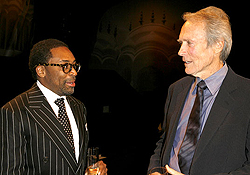
    Unfortunately, it couldn’t be more obvious. Like Jesse Jackson and Al Sharpton, time has been passing Spike Lee by. His worldview comes from another era and he has never really sought to revise it, to open his eyes. Proof of that is that for more than a decade Spike has barely made a film any of us can remember. Compare that to Eastwood, who, although some twenty-seven years Lee’s senior, is at the top of his career, having scored big in 2003-2004 with Mystic River and Million Dollar Baby.

    No wonder Spike’s jealous. So what does he do? He reaches back to an era when he was more successful. He plays the old identity/race card. Now we could all laugh and say this is just another case of an (prematurely) aging artist grasping for attention, but these times are more complex than that. We don’t know which way we are going – toward a post-racial future or back to a racist past.

    His argument is interesting because it is equal parts over-simplified and shrewd. The Lee/Eastwood dispute has been talked to death…and again…and again, but the overriding feeling I had following the initial Cannes fracas was sadness — sadness that Lee has shown yet again that he is unable to prove his (at times justified) contradictory opinions without the stench of clichéd rhetoric and steadily outdated reason.

    (more…)

  • Great Oscarless directors

    Alfred Hitchcock, Charlie Chaplin, Howard Hawks, Stanley Kubrick, Preston Sturges, Ernest Lubitsch, Hal Ashby, Alan J. Pakula, Sidney Lumet, Spike Lee, Paul Thomas Anderson.

    Collectively they represent some of the greatest directors in the history of the cinema, and together they share one rather unbelievable fact…not one of them is a Academy Award winner for Best Director.

    Each has the distinction of nominee, of course.  But to think that filmmakers such as James Cameron (The King of the World, remember?), Richard Attenborough, Ron Howard, Sir Carol Reed (for “Oliver,” man?), John G. Avilden, Michael Cimino, Robert Benton, Robert Redford, Robert Wise (for “The Sound of Music??”) and George Roy Hill, to name a few, have Oscars on their mantles and the giants above do not is simply insane to me.

    (more…)