In Contention

Tag: Il Divo

  • CANNES CHECK: ‘This Must Be the Place’

    The director: Paolo Sorrentino (Italy)

    The talent: Sean Penn (a Best Actor winner at Cannes back in 1997 for “She’s So Lovely”) pops up in his second film of the Competition, though this time in a clear lead role. Frances McDormand makes it two Oscar-winners on board, while the eccentric supporting cast includes Harry Dean Stanton, Judd Hirsch, Talking Heads frontman David Byrne (guess he sanctioned the film’s title, then) and Eve Hewson — the 19 year-old daughter of Bono.  Byrne also contributed the film’s score, with original songs by US folk star Will Oldham (aka Bonnie ‘Prince’ Billy). Overall, however, the crew remains heavily Italian; Sorrentino’s regular (and regularly flashy) cinematographer, Luca Bigazzi, is also on board.

    The pitch: Sorrentino’s first English-language feature — hardly a surprising move, given how his previous features toyed with Hollywood forms — sounds like a decidedly odd duck on paper. If you think the film’s various connections to rock royalty seem thematically related, you’d be right: Penn plays Cheyenne (!), a former Goth rock star living in wealthy retirement in Dublin, shaken out of his self-involved stupor by his estranged father’s death.

    (more…)

  • OSCAR GUIDE: Best Makeup

    Toni Servillo in Il DivoThe Academy’s makeup category is one of two fields that calls for a whittling down of the contenders via a “bake-off.” Reels of the work from the seven finalists are screened, so an impressive assemblage is all you need. The work on the whole isn’t really being considered, so this can yield surprises in the field.

    This year there were a couple of surprises to say the least. A little known foreign film pushed through while a costume drama that isn’t entirely memorable for its makeup (though perhaps is well-respected for hairstyling) also popped up. Meanwhile, the presumed frontrunner for the win — “District 9” — was snubbed outright, the general feeling being that CGI enhancement was its downfall.

    The nominees are:

    “Il Divo” (Aldo Signoretti and Vittorio Sodano)
    “Star Trek” (Barney Burman, Mindy Hall and Joel Harlow)
    “The Young Victoria” (Jon Henry Gordon and Jenny Shircore)

    (more…)

  • The bright side

    Abbie Cornish in Bright StarWell, I’ll start the good news selfishly, by noting that I didn’t entirely embarrass myself with my predictions: not counting the short categories (which I was too cowardly and uninformed to predict) I nailed 78/106, just two points behind Kris’s round tally of 80.

    But while I was pleased to see at least one of my out-on-a-limb guesses come good — seriously, why didn’t more people call that Art Direction nod for “The Young Victoria?” — I was better at predicting what wouldn’t get nominated.

    So, my season-long hunches that Julianne Moore would be frozen out in the supporting race, that “(500) Days of Summer” would be blanked, that “Up in the Air” would miss that crucial Film Editing nod, and so on, were all on the money. And my increasing sense that nobody really liked “Invictus” enough to put it atop their ballot proved right too.

    Now, if I only I’d known what would land in their place. You can’t have it all, I suppose.

    (more…)

  • My dream ballot: part one

    Where the Wild Things AreAs I did last year, I’m preparing for Tuesday’s announcement of the Oscar nominations by running through my own favorites in each category — following on from the ideal ballots posted by Kris and Chad in the past few weeks.

    “Preparing” isn’t quite the word: it implies a link between the processes of predicting and wishing, whereas I’m quite aware that most of my choices have scant chance of cropping up on Tuesday morning. But a guy can dream, can’t he?

    Today I’m running through the technical races, while tomorrow I’ll get to the big ones. For the most part, I’m sticking to the same format and rules for nominations as the Oscars, with a few select exceptions.

    Where some worthy 2009 U.S. releases are mysteriously absent from the Academy’s eligibility list, I’m not letting that stop me from giving them their due. Similarly, I’m happy to overrule some of the more inexplicable disqualifications of the arcane music branch.

    My technical ballot after the cut.

    (more…)

  • Makeup bake-off leaves seven

    Christopher Plummer in The Imaginarium of Doctor ParnassusVia AMPAS press release, the final group includes:

    “District 9”
    “Il Divo”
    “The Imaginarium of Doctor Parnassus”
    “Night at the Museum: Battle of the Smithsonian”
    “The Road”
    “Star Trek”
    “The Young Victoria”

    Well, there was always one spot in flux for me here and most recently I was giving it to “Cirque du Freak” for some great work by a veteran of the branch.  If I were to hazard a guess as to which of these gets it, I guess I’d say “Parnassus,” its one and only nomination.  There is some good work in “Il Divo,” too (from the artist who brought the natives of “Apocalypto” to prosthetic life), so maybe that could come around.  Or “The Road.” The rest seem like non-starters to me.

  • Sean Penn to headline new Sorrentino pic

    Sean PennNow this is an exciting pairing. You might remember that I’m pretty crazy about “Il Divo,” Paolo Sorrentino’s blazing political biopic-thriller that took a well-deserved Jury Prize at last year’s Cannes fest. (Seriously, check it out when you have a chance.)

    Between that triumph and his intricate, super-stylish 2001 noir “The Consequences of Love,” Sorrentino has shown a kinetic narrative sense and visual dynamism that seemed a virtual siren-call to Hollywood, so it’s no surprise to hear that he’ll be making his English-language debut with his next feature.

    Variety reports that Sean Penn — who, coincidentally or not, headed the jury that was so impressed by “Il Divo” last year — is set to star in “This Must Be the Place,” which will see Sorrentino teaming up with his regular producers once more. The thriller-ish pitch runs as follows:

    Penn would play a wealthy rock star who becomes bored in his retirement and takes on the quest of finding his father’s executioner, an ex-Nazi war criminal who is a refugee in the U.S.

    Penn strikes me as a good trans-Atlantic match for Sorrentino, both men having a muscular, showy approach to their respective crafts. I’m not sure what to make of the premise on paper; it seems to allow for quite a pulpy, heightened treatment, but there’s so little to go on. For now, the names alone have me hooked.

  • A friendly recommendation

    I’m not in the habit of imploring people to go see things — much like organic breakfast cereal, specialist cinema is tastier when you haven’t persistently been reminded how good it is for you — but I must make an exception on behalf of Paolo Sorrentino’s cracking political bio-thriller “Il Divo,” which opens Stateside on Friday (and is still on limited release across the pond).

    I feel it necessary to mention the film because, for all its widespread acclaim, the press for the film tends to depict it as a far harder sell than it really is. I’ve lost count of the number of critics I’ve read referring to the film’s intense grounding in the intricacies of Italian politics, hardly a surefire way to lure even the subtitle-schooled crowd.

    What they largely fail to mention, however, is that this wildly paced, darkly comedic film requires little to no previous knowledge of — or interest in — the figures at its centre to register as entertainment; it’s actually a more accessible, populist work than its ethnic and aesthetic peer “Gomorrah.” “The Consequences of Love.” As I wrote in my October capsule review (and my “Best of 2008” roundup, where it narrowly missed my Top 10), prime Oliver Stone is the closest point of reference here.

    The following trailer is fairly crudely assembled (the film itself is a technical dazzler), but it captures “Il Divo’s” whip-smart energy rather better than much of the media has. As a South African yogurt brand once advertised: “Try it. You might love it.”

  • My dream ballot: part one

    Back in December, Kris offered his take on how he would fill out his nominee ballot if he were an Academy member (affording himself the luxury, obviously, of voting in all categories). Of course, playing voter is a popular sport in the blog world, with Nathaniel Rogers’ annual Film Bitch Awards as thorough and intelligent a rundown as you could ask for. Would that the Academy displayed such passion and imagination in their choices.

    For my part, finalising my predictions was a dispiriting procedure, as I realized the range and depth of work that will inevitably go unrecognized as the AMPAS gravitates towards the favoured and the familiar. And so it is that, as the nominations loom over us, I decided to chalk up my own ballot, acknowledging those who I feel most deserve to hear names called on Thursday morning, whether or they’re deemed possible — or even eligible.

    Today’s post focuses on the technical categories; tomorrow’s will run through the main ones. (Before I begin, let me add the caveat that, much to my chagrin, I haven’t yet seen “Let the Right One In.”)

    Best Cinematography
    Wally Pfister, “The Dark Knight”
    Sean Bobbitt, “Hunger”
    Luca Bigazzi, “Il Divo”
    Darius Khondji, “My Blueberry Nights”
    Maryse Alberti, “The Wrestler”

    After last year’s banner year for the art of cinematography, this was a year of subtler accomplishments in the field. I must admit that much of the year’s most celebrated work in the field didn’t particularly dazzle me, with several revered names only working at (or below) par. Pfister’s muscular, burnished lensing of “The Dark Knight,” however, did not disappoint, while Bigazzi’s hyper-stylised work on “Il Divo” was no less kinetic.

    In something of a breakthrough year for female DPs, Alberti effortlessly captured the rhythms of human movement, while Khondji conjured up the year’s dreamiest palette for Wong Kar-Wai’s otherwise muddled “My Blueberry Nights.” The year’s crowning achievement, however, came from Sean Bobbitt, whose breathtaking compositions for “Hunger” took equal inspiration from the art gallery and the newsroom. Just missing the cut were “The Fall,” “Gomorrah” and “The Good, The Bad, The Weird.”

    (more…)

  • Small pleasures: Guy’s best (and worst) of 2008

    It’s a lovely thing when you realize, at least part of the way through adulthood, that we still possess the ability to surprise ourselves. When left to graze at leisure, the mind can stumble upon some unexpected notions, frequently overriding the conclusions we thought we had reached after twelve months of watching, writing and (occasionally over-) thinking. And more often than not, it knows best.

    This is what I discovered when I sat myself down on a poolside lounger in the remote hills of Portugal’s Algarve region and set about finalizing this list, which had been eating away at me for the better part of the last six weeks. After various tortured drafts drawn from my scrappy 2008 diaries, notebooks and In Contention entries — none of which looked sufficiently reflective or, frankly, right to me — I decided to dispense with notes entirely and start from scratch, using my memory as my sole resource.

    And so it was that when I asked myself, “What’s the best film you saw in 2008,” the answer that came was not only amazingly swift, immediately satisfying and ultimately inarguable, but it was not the answer I expected to receive. Of course, I knew the film would crop up somewhere prominent in the list — the mind is a filter, after all, not a magician’s hat — but it was one of several films this year (and indeed, on this list) that I would call “growers.”  You see them, you like them, but it takes a few weeks, months even, of rumination and interpretation before you realize just how much you love them.

    It’s something that should be borne in mind when it comes to awards voting, which work on a “survival of the fittest” basis: some films simply take longer than others to make a collective (or selective) impact. This may rule them out of competition time frames, but it doesn’t make them lesser achievements. Similarly, certain films that seem like huge, important deals at the time can leave us scratching our heads when removed from the flurry of the season. In a perfect world, Oscar voting would take place a year or two (or 10) after the release of the year-end glut — but it was ever thus.

    One perception of mine that hasn’t changed through the compilation of this list, however, is that it’s been a year of bijou pleasures. As one talked-up Hollywood title after the other disappointed, dissipated or dared to be merely “good,” the films left standing for me were mostly on the intimate side: small but beautifully formed works bound by character rather than concept, often asking penetrating questions about society, family and the nature of the individual. As the Americans, by and large, treaded water, European cinema soared, with France enjoying a particularly golden streak — the likes of which we haven’t seen in well over a decade.

    I may have complained often in these pages that it’s been a “bad year” for film, but as I look down the list of 20 titles that I finally arrived at, covering as it does a pretty rich variety of moods and forms, it now seems graceless to say so. When Hollywood flickers, different voices emerge, and for that we should be grateful. Perhaps it hasn’t been a bad year…just a smaller one.

    (more…)

  • WEEKLY WRAP: ‘Dark Knight’ disqualified, Rourke interviewed, ‘Australia’ unwrapped

    Kind of an in-between week, this. Here’s how it went down:

    • In probably the most discussed Oscar news of the week, “The Dark Knight” was dodgily ruled ineligible in the Best Original Score category.

    • On a happier note, we sat down with surefire Best Actor nominee Mickey Rourke.

    • A shortlist of 14 films was announced for the Animated Feature race — not that it’s a “race” at all.

    • “Australia” was revealed to a besotted Oprah… but is it really the Oscar-bait some people think it is?

    • Ahead of “Slumdog Millionaire”‘s Stateside opening, we considered the contributions of DP Anthony Dod Mantle and composer A.R. Rahman.

    • Kris was appreciative of Edward Zwick’s “Defiance” … even if several critics weren’t.

    • The dynamic Italian duo of “Gomorrah” and “Il Divo” led the nominations for the European Film Awards.

    • “Gomorrah,” meanwhile, has designs on more than just the Foreign Film category at the Oscars.

    • Tech Support showcased the frequently surprising Best Makeup category.

    • Entertainment Weekly named Robert Downey Jr. their Entertainer of the Year, which Richard Jenkins among the also-rans.

    • We were charmed by “Last Chance Harvey,” a low-flying contender in the acting categories.

    • And finally, in another biopic-heavy season, we counted down the all-time best examples of the genre.

  • Italy leads the charge at European Film Awards

    Proof positive that 2008 is a banner year for Italian cinema: Matteo Garrone’s “Gomorrah” and Paolo Sorrentino’s “Il Divo,” both masterpieces of a very different stylistic ilk, lead all nominees for the European Film Awards, with five nominations apiece.
    Joing them in the hunt for Best European Film are “The Class” and “Happy-Go-Lucky,” which makes four of my favourite films of the year in the list. Rounding out the nominees in that category are “Waltz With Bashir” and “The Orphanage,” neither film one to be sniffed at either.

    By any standards, that’s one hell of a group — I would be very surprised if the eventual five Oscar nominees for Best Picture match that collective quality. I’d be hard pressed to pick a personal favourite, though my gut says the Italian nominees will split the vote, and the wonderful “The Class” will emerge victorious.

    Four of those six reappear in the Best European Director category, with Steve McQueen (“Hunger”) supplanting Mike Leigh as the British nominee in that race. More puzzlingly, Leigh is also absent in the Best European Screenwriter category — curious, since “Happy-Go-Lucky” strikes me as more of a writerly achievement than the nominated “Waltz With Bashir.”

    More thoughts, and a full list of nominees, after the cut.

    (more…)

  • LONDON: Gongs for ‘Mice,’ ‘Tulpan’ … and my own awards

    My last post on the London Film Festival brings some happy news, as one of my favourite festival titles was justly rewarded last night. The festival is not a competion-based one, but three prestigious awards are still handed out before the final screening.

    One of these is the global festival staple, the FIPRESCI International Critics’ Award. I’m thrilled to see it went to Australian multi-hyphenate Matthew Newton for his superb debut feature “Three Blind Mice,” which I already gushed over here. At only 31 years of age, I predict big things for Newton, both before and behind the camera.

    Meanwhile, the Sutherland Trophy for best debut feature went to “Tulpan,” the Kazakhstani entry for Best Foreign Language Film, beating such heavyweight contenders as “Ballast” and “Hunger.” It’s an auspicious award with a 50-year history: previous winners include “L’Avventura,” “In the Realm of the Senses,” “The Fabulous Baker Boys,” “You Can Count on Me” and “Persepolis.” I was rather taken with “Tulpan,” so I’m pleased to see this underdog come through — it’s a dark horse to crack the Oscar shortlist.

    Other winners included the Italian character drama “Mid-August Lunch,” which took the Satyajit Ray Award for “artistry, compassion and humanity” in a debut film, and “Victoire Terminus,” a study of female boxing in the Congo that took the Grierson Award for best documentary. I’m afraid to say I missed both films, though I particularly wanted to catch the latter.

    And with that, bearing in mind that I couldn’t see everything, I thought I’d hand out my own inaugural (and no doubt much-prized) awards for the best that I saw at the fest, starting with my own personal Top Ten:

    TEN BEST FILMS OF THE FESTIVAL: 1. “The Class”; 2. “Synecdoche, New York”; 3. “Il Divo”; 4. “Slumdog Millionaire”; 5. “Three Blind Mice”; 6. “Wendy and Lucy”; 7. “The Good, The Bad, The Weird”; 8. “The Wrestler”; 9. “Sugar”; 10. “La Belle Personne”

    (more…)

  • LONDON: “W,” “Genova,” “Il Divo” and more

    We’ve reached the midway point of the London Film Festival, and today’s big event is the European premiere of “W.” As I eavesdropped on assorted critics’ reactions coming out of the press screening this morning, the dominant feeling appeared to be one of pleasant surprise; I have a feeling the film may find a rather warmer reception here than in its home country.

    I’m still gathering my thoughts on the film, which I thought riveting in some respects and messy in others, though it’s clear Stone has transcended the limitations of Stanley Weiser’s script. Josh Brolin and Elizabeth Banks offer such persuasive, full-bodied characterisations that the Madame Tussaud’s quality of certain supporting players (Thandie Newton in particular) pales by contrast.

    With that, here’s another roundup of notable films from the last few days, beginning with yesterday’s starry but rather under-the-radar Mayor of London gala selection:

    GENOVA (**1/2)

    There is much to engage the eye and ear in “Genova,” the new film from restless Brit auteur Michael Winterbottom. A return to his usual, more organic directorial style after the disappointingly conventional “A Mighty Heart,” the new film teems with activity: from the loose, jazzy rhythms of the editing to the fragmented, eclectic soundtrack overlaying busy dialogue, and above all, superb location work that turns the labyrinthine alleys of the eponymous Italian coastal city into a playground of threat and desire.

    (more…)

  • London Film Festival: six to watch

    So the 52nd annual London Film Festival begins tomorrow, bringing with it a feast of cinema cherry-picked from the rest of the fests, with a couple of new titles thrown into the mix too.

    As promised, I will be keeping you updated with proceedings, starting with tomorrow’s world premiere of “Frost/Nixon.” I’m seeing the film bright and early in the morning, and will have a review for you before the day is out.

    As I’ve said before, this year’s London lineup is a little more low-key than usual, but that’s the kind of year it’s been for movies. All the major festivals have struggled a bit this year, but London at least has the advantage of filtering their best bits, meaning plenty of hot films will appear, from “Slumdog Millionaire” to “Che.”

    But those tickets are hard to come by, and when one moves beyond the big, sexy drawcards, the waters get a bit murkier. With almost 200 films (not counting shorts) screening from every corner of the globe, there’s a lot to explore. I’ve been immersed in festival press screenings for the last fortnight, and have still seen only a fraction of what the festival has to offer.

    In the interest of providing alternatives then, let me offer up a handful of lesser-hyped titles that are really worth catching. More detailed reviews will be provided as the festival progresses, but for now:

    1234 (dir. Giles Borg)

    Lots of buzz circling around this under-the-radar crowdpleaser. A sweet-natured character comedy (with an ace soundtrack) about a lovelorn geek struggling to start up an indie band in boho East London, “1234” had the most packed press screening of the festival so far, and is bound to be a Brit hit. Ditch “Nick and Norah,” and catch this instead.

    (more…)

  • Garrone on ‘Gomorrah’: “It’s not real, but it’s true.”

    Viva Italia, is all I have to say. In the past 48 hours, I’ve been lucky enough to see the two films that have widely been heralded as marking a renaissance for the Italian film industry, a world cinema titan that had been lying dormant for a couple of years. No more.

    One of them is Paolo Sorrentino’s blistering, return-to-form political thriller “Il Divo,” which I will discuss closer to its appearance at the upcoming London Film Festival. The other is Italy’s submission for the Best Foreign Language Film race, “Gomorrah.” Possible masterpieces, both of them — and as solid a case as any for abolishing the silly “one film per country” rule that so plagues this problematic Oscar category.

    Walking out of London’s Institute of Contemporary Arts after Sunday’s UK premiere of “Gomorrah,” which was followed by a lively Q&A with director Matteo Garrone, I couldn’t shake the feeling that I might have just met one of next year’s multiple Academy Award nominees.

    Far-fetched, I know, but the film’s achievement is that staggering and far-reaching. Under the foreign-language committee’s new voting system, a nomination in that category should, by rights, be a slam-dunk, while Best Director and, particularly, Best Adapted Screenplay nominations are, to my mind, well within the realm of possibility. I will resist further gushing until I post a proper review in the next day or two, but for now, I want to share some of the thoughts Garrone offered at the Q&A.

    A modest, thoroughly disarming presence, far younger in demeanor than his 40 years suggest, Garrone himself seems a little bewildered by the film he has made and the discussion it has wrought. For those who don’t know, “Gomorrah” is a documentary-style examination of the Camorra crime syndicate that terrorizes Naples, based on the bestselling non-fiction expose by Roberto Saviano.

    (more…)

  • ‘Gomorrah’ is in — do we have a frontrunner?

    Well, as speculated a few hours ago, Italy has announced their submission for Best Foreign Language Film. And, to the surprise of precisely nobody, they have gone with Matteo Garrone’s “Gomorrah” — the sprawling, breathlessly acclaimed portrait of Naples mafia life that was arguably the breakout hit of May’s Cannes festival. (It received the runner-up prize.)

    It’s almost impossible to declare frontrunners in this category, given the foreign film committee’s wilful voting habits. Still, it’s safe to say that “Gomorrah” is the most anticipated and discussed contender to officially enter the race so far.

    Whether it will prove too bleak and violent for the blue-hair voters is difficult to predict — they acknowledged the edgy brilliance of “Amores Perros” in 2001, but since then, they’ve been unable to stomach the likes of “City of God” or last year’s “4 Months, 3 Weeks, 2 Days.”

    Based on the unanimously good word for the film, I’ve long been predicting that “Gomorrah” could even score breakout noms in the Best Director and Adapted Screenplay categories (a la “City of God”), but that was when I imagined Italy picking the more parochial “Il Divo” as their foreign-language entry. As it is, they’ve chosen the title with more crossover potential — it’ll be interesting to see what momentum Garrone’s film can build from its New York Film Festival screening.

    For my part, I’m seeing the film at its UK premiere this Sunday — hopefully to be followed by a Q&A with Garrone. I can’t wait.

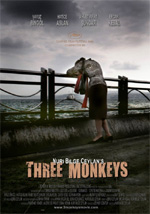
  • ‘Three Monkeys’ joins the Foreign Film mix

    Nobody who was paying attention at Cannes will be surprised that Turkey has selected Nuri Bilge Ceylan’s “Three Monkeys” as their entry in the foreign-language derby.

    The film was one of the critical sensations of the festival back in May and was many pundits’ pick for the Palme d’Or — it wound up with the Best Director award. Just to jog your memory, here’s a rave from the ever-reliable Jonathan Romney:

    An ostensibly routine noir-style psychological thriller vaults into the realms of high art in “Three Monkeys” … For the first time, Ceylan really involves himself in narrative complexity, spinning a subtly-twisty yarn with echoes of such crime writers as Simenon and James M. Cain … the smallest amount of trimming could well turn an exceptional film into a near-perfect one.

    I have been excited by this for some time. Ceylan’s 2002 film “Uzak (Distant)” is one of my favourite films of the decade so far, a work of visual wonder and immaculate storytelling grace. While wildly acclaimed, his follow-up, “Climates,” did less for me — it was exquisitely rendered, but on a narrative and thematic level, Ceylan seemed to me to be treading water. So I like the idea of this move into more genre-tinged territory. It’s one of my must-sees at the upcoming London Film Festival.

    I suspect the film may prove a little too resolutely arthouse for the frequently auteur-shy Foreign Film committee, but no matter. As when Mexico selected Carlos Reygadas’ bold, beautiful and thoroughly Academy-unfriendly “Silent Light” last year, I applaud Turkey for the bravery of their selection.

    (more…)

  • ‘Che,’ ‘W.’ among films announced to play London fest

    Looking down the list of titles in the newly-revealed lineup for next month’s London Film Festival lineup, my initial reaction was one of mild disappointment. Plenty of exciting titles, for sure, but it doesn’t quite match last year’s feast that included everything from “The Diving Bell and the Butterfly” to “The Assassination of Jesse James” to “Juno” to “4 Months, 3 Weeks, 2 Days.”

    My second thought, however, was that the lineup reflects more on what a tepid year for film 2008 is shaping up to be, rather than any lack of effort on festival director Sandra Hebron’s part. Tellingly, this morning Hebron herself cited critical opinion that, in the wake of a roundly derided Venice festival, “it wasn’t a vintage year for cinema.”

    But enough of the hand-wringing. There’s still much to get excited about, including “Che,” the two parts of which, interestingly, will be screened both together and apart; Oliver Stone’s potentially polarising “W”; “Hunger,” featuring a potential dark horse for Best Actor; “Religulous”; “Rachel Getting Married,” “Nick and Nora’s Infinite Playlist,” “Gonzo: The Life and Work of Hunter S. Thompson” and, to my immense delight, “Synecdoche, New York.”

    Not to mention that, as previously announced, the festival will be bookended by the world premiere of “Frost/Nixon” and Danny Boyle’s red-hot Toronto hit “Slumdog Millionaire.”

    (more…)