
In Contention

Tag: Kinatay

  • Tarantino’s love letter to ‘Bright Star’

    Abbie Cornish in Bright StarQuentin Tarantino is obviously quite the epistolarian. Just yesterday, I mentioned the sincerely admiring letter that he wrote to controversial “Kinatay” director Brillante Mendoza, praising the brutally violent and widely unpopular Filipino film for its daring and authenticity.

    Evidently, that wasn’t the only letter QT wrote in his Cannes hotel suite. And while it’s not unexpected that he’d support a fellow provocateur like Mendoza, some might be surprised to hear that he’s equally passionate about Jane Campion’s “Bright Star,” which I flipped for earlier this week.

    UK site Moviefone unearthed the following gushing note (written, like the Mendoza letter, in red ink) from Tarantino to Campion:

    My favorite film of yours … I don’t like period pieces like that. I loved this!!! Never has heartache been so realistically and movingly portrayed as Abbie taking to her bed … The lovers kisses … Abbie and Ben … touching … Brilliant. I loved it!!! Love – Your fan – Quentin Tarantino.

    (more…)

  • Tarantino cheers ‘Kinatay’

    Quentin TarantinoSome of you may have read my defense last week of Brillante Mendoza’s grimly violent “Kinatay,” a film that provoked mass hostility at Cannes in May for portraying the rape, murder and dismemberment of a young woman in unrelenting detail. Roger Ebert declared it the worst film ever to play at the festival, and the announcement of Mendoza’s Best Director award was roundly booed in the Cannes press room.

    For all that, the film does have its champions, and as it turns out, Quentin Tarantino is among them. Thanks to Ben Mortimer at ComingSoon for pointing me to this letter (itself courtesy of Letters of Note) written by Tarantino to Mendoza, congratulating the latter on his Cannes win and pretty accurately nailing why the film works. (For us, at least.) Spelling errors preserved:

    Bravo on your diffcult troubling work. Your decission to never dramatize the murder, never indulge in movie suspense…. was bold, daring, and to me, the whole point of making the movie in the first place. I felt it was completely a eyewitness acount of a horroble murder. I believed everything I saw. Your point wasnt to dramatize it. It was to capture it.

    The actual document is after the cut, in case you’ve always longed to see QT’s handwriting.

    (more…)

  • LONDON: ‘Dogtooth,’ ‘Kinatay,’ ‘Burrowing’

    DogtoothOnce more, Friday’s major festival screenings covered ground I’d already trod in Venice — the day’s glossiest gala slot was reserved for “The Road” (which you know did little for me), with a less prominent early evening slot for Tom Ford’s “A Single Man” (which did rather more).

    Given the current buzz levels for each film, they perhaps should have swapped places, but festival programmers can be forgiven for not knowing that in advance.

    In fact, it was a crammed day for anyone hoping to catch up on the hot Venice titles, including “Life During Wartime,” “The Double Hour” and “White Material,” still my film of 2009 so far. (Friend and critic Tim Robey shares my enthusiasm for the film, claiming the LFF will have a hard time topping it. Truth.)

    Hard as it was to resist giving “Material” another whirl, I took advantage of my head-start to catch a stark Swedish mood piece and two provocative Cannes winners that had been intriguing me since May, and not only because of Old Man Ebert’s proclamation that Brillante Mendoza’s “Kinatay” was the worst film ever screened on the Croisette. See if I agree after the cut.

    (more…)

  • VENICE: ‘Mr. Nobody,’ ‘Lola’

    Jared Leto in Mr. NobodyThe Lido finish line beckons, as this morning saw the press screening of the final film in Competition, Tom Ford’s “A Single Man.”

    Ford’s debut (which I’ll deal with in a separate Short Take) surpassed my expectations, completing a slight upswing in the standard of films on display that began with yesterday’s second Surprise Film selection: Brillante Mendoza’s “Lola,” which proved surprising in more than just a programming sense.

    Jaco van Dormael’s elaborate fantasy “Mr. Nobody” never quite gelled for me — and still, none of these titles touch “White Material” — but it’s been a pleasant day’s viewing nonetheless.

    Now the process begins of sorting the wheat from the chaff — with not a whole lot of wheat to go around, in my eyes — and playing the futile guessing-game of who will take home the gold. I’ll have a post with my predictions and preferences tomorrow, but for now, the last bundle of Competition reviews:

    “Mr. Nobody” (**½)

    Jaco van Dormael’s first film in 13 years betrays the formal rustiness and structural indiscipline that such a hiatus can cause in an artist, but there’s enough unique visual artistry and demented storytelling bravery on display here to make one glad he’s back.

    (more…)

  • We, the jury

    (from left) Asia Argento, Isabelle Huppert and Nuri Bilge CeylanIt’s admittedly pretty low-rent, but one of the most enjoyable Cannes traditions is the annual gossip about what went down behind closed doors in the jury room — ranging from minor cultural disagreements to all-out bitter in-fighting. At yesterday’s press conference, juror Asia Argento insisted that their deliberations should remain a secret, but not everyone is so discreet: William Goldman, of course, dedicated half a book to covering his own experience as a juror at the 1988 fest, and most entertainingly too.

    Last year’s Sean Penn-governed jury was reportedly one of the most placid in recent memory, agreeing unanimously on “The Class” for the Palme d’Or. This year’s panel, apparently … not so much.

    Critic Shane Danielsen — who, as the former artistic director of the Edinburgh Film Festival, knows the ins and outs of such proceedings — has done some digging, to juicy effect. Writing in the comments section of the A.V. Club’s Cannes blog, he claims the jury was highly divided, with a notable rift between Isabelle Huppert and James Gray. Meanwhile, contrary to widespread assumption, it might not have been Michael Haneke that Huppert was pushing  hardest for, but Lars Von Trier:

    Unusually troubled, apparently, with president Isabelle Huppert riding roughshod over everyone, and James Grey (sic) reportedly calling her a “fascist bitch” in their final meeting … Huppert reportedly remained ‘Antichrist’s biggest champion on a bitterly divided and fractious jury. Who, as they came onstage, looked either funereal (Lee Chang-Dong, Hanif Kureishi), grimly determined (Nuri Bilge Ceylan) or just plain pissed-off (James Gray).

    (more…)

  • Haneke lands Palme d’Or, Gainsbourg takes Best Actress

    Charlotte Gainsbourg winning Best Actress at the Cannes Film FestivalAs it turned out, the most logical on-paper prediction turned out the be the right one. After emerging as the bridesmaid from several festivals past — winning the Grand Prix in 2001, Best Director in 2005 — the venerable Austrian auteur Michael Haneke has finally won the Palme d’Or for his stark moral drama “The White Ribbon.”
    Whether or not jury president Isabelle Huppert, a two-time Haneke leading lady in the past, wielded much influence on this decision — or indeed, whether she even needed to — is something for the pundits to debate. (I personally doubt it, though there was no mistaking the sly smile on her face as she announced his name at the podium.) Either way, there’s little denying that Haneke was overdue for world cinema’s highest honor; perhaps there was a career-achievement angle to the award, but the critical acclaim for “The White Ribbon” has been extensive.

    From watching the ceremony, it was clear that Haneke wasn’t the most popular winner of the night; that designation clearly goes to hometown favorite Jacques Audiard, whose “A Prophet” — like “Gomorrah” last year — was by and large deemed the favorite for the Palme, but ultimately had to be content with the silver-medal Grand Prix. The rousing standing ovation he received, however, spoke for itself. (I should add that a second-place finish for Audiard was, embarrassingly, the only correct call I made the whole night.)

    The real talking point of the awards, however, will likely remain Charlotte Gainsbourg’s Best Actress prize for her evidently courageous work in “Antichrist” — a clear gesture of support by the jury for a film that has provoked prolonged media outrage since its unveiling, and a blatant slap in the face of Cannes’ alternative ‘ecumenical’ jury who went out of their way to condemn it. The irony of handing a female performance award to a film that has been repeatedly pelted with accusations of misogyny is rather delicious; at the very least, it’s an indication that this is a film to be taken seriously.

    (More commentary, and a full list of winners, after the cut.)

    (more…)

  • Cracks show in Cannes lineup

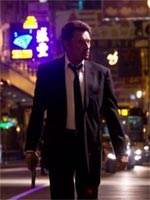
    Johnny Hallyday in VengeanceAfter surveying the reviews of Johnnie To’s “Vengeance” and Brillante Mendoza’s “Kinatay,” it seems safe to assume that neither film is a contender for the Palme d’Or — in the latter, we may even have our first real critical punchbag of the Competition.

    ScreenDaily dismisses “Vengeance,” an action effort teaming Hong Kong genre lord To with iconic French actor/singer Johnny Hallyday, as a “revenge shoot-em-up which fires mostly blanks,” citing a “contrived plot,” “wooden English dialogue” and a “stilted” lead performance as the key problems. Variety is more charitable, calling it “smoothly executed” but ultimately “more of the stylish same” from the director.

    Less predictable, and a lot more contentious, appears to be “Kinatay,” a grim, ultra-violent (the title translates as “slaughter”) tale of an ordinary man drawn into a crime syndicate — though apparently a lot weirder than that generic premise indicates. Variety slates the film, labelling it both “unpleasant” and “banal,” and predicting a general critical drubbing.

    Roger Ebert confirms that prognosis, with a vicious takedown in which he claims the film surpasses Vincent Gallo’s infamous “The Brown Bunny” as the worst in the festival’s history:

    There will be critics who fancy themselves theoreticians, who will defend this unbearable experience, and lecture those plebians like me who missed the whole Idea. I will remain serene while my ignorance is excoriated. I am a human being with relatively reasonable tastes. And in that role, not in the role of film critic, I declare that there may not be ten people in the world who will buy a ticket to this movie and feel the money was well spent.

    (more…)

  • Cannes: sizing up the Competition, part two

    Charlotte Gainsbourg in AntichristContinuing yesterday’s survey of the runners and riders in the race for the Palme d’Or…

    “ANTICHRIST” (Lars Von Trier)

    The pitch: You’ve seen the trailer. Charlotte Gainsbourg and Willem Dafoe star as bereaved parents who retreat to a remote woodland cottage to nurse their grief, only to be terrorised by unnamed forces of evil. (English dialogue)

    The history: Over his seven previous Competition appearances, Von Trier has enjoyed a gradual ascent from the Technical Grand Prize for 1984’s “Element of Crime,” to the Jury Prize for 1991’s “Europa,” to the Grand Prix for 1996’s “Breaking the Waves” (1996) to, at last, the Palme d’Or for 2000’s “Dancer in the Dark.” Nothing since then, however, with his masterful “Dogville” coming up surprisingly (and undeservingly) empty-handed.

    The outlook: The film may appear to be familiar (albeit bloody terrifying) horror fare in the trailer, but we should know by now never to presume what a maverick like Von Trier has up his sleeve. Cannes is usually averse to the genre, so whether the film made the lineup because it’s something more subversive, or simply because it’s directed by one of their favourite sons, remains to be seen. Either way, the film will need to be something special to get Von Trier back in the winner’s circle – after all, “Dancer in the Dark” proved so polarising, juries have been unwilling to take a chance on him since. He tends to put his actresses through the wringer, so perhaps there’s a chance for Charlotte Gainsbourg here – but who knows?

    “SPRING FEVER” (Lou Ye)

    The pitch: Erotic drama follows a young man hired to survey a married man’s homosexual affair; tangled relationships ensue as the spy and his girlfriend become sexually drawn to the adulterous couple. (Mandarin dialogue)

    The history: Not counting an unfortunate 2006 withdrawal after his “Summer Palace” fell foul of Chinese censors, this is Lou’s second Competition appearance.

    The outlook: There is a great deal of goodwill in the world-cinema fraternity for Lou, who has fought a continuous battle with the Chinese censorship board. His last film, the politically charged “Summer Palace,” resulted in the director receiving a five-year ban from filmmaking – a ruling Lou is flagrantly flouting by screening his new film (which was shot in secret on handheld cameras) at this year’s festival. It’s a courageous move, and I think there’s a strong chance the jury might like to demonstrate their support for the embattled auteur with a prize of some variety.

    (more…)