In Contention

Tag: Looking For Eric

  • Loach’s ‘Route Irish’ joins Cannes Competition lineup

    I told you on Friday that a 19th title was going to be added to the selection of films vying for the Palme d’Or at Cannes, and lo and behold, here it is. Variety reports that “Route Irish,” an Iraq War drama from festival habitué Ken Loach, has joined the lineup — just one year after Loach brought football-themed comedy “Looking for Eric” to the Croisette.

    It’s probably not the film that most people were hoping to see as a last-minute addition, but it does bump up the number of English-language titles in Competition to three, while also boosting the “venerable auteur” count.

    This marks the tenth Competition entry of the British director’s career — he won the Palme on his eighth attempt, with “The Wind That Shakes the Barley” in 2006 — and if that’s not a record, it confirms him as one of the festival’s true pets.

    (more…)

  • IFC previews its wares

    Isabelle Huppert in White MaterialDo you live in New York? Lucky you. I say that for many reasons, but chief among them right now is that you can attend this weekend’s Focus on IFC Films mini-festival, in which the dedicated indie distributor previews a selection of their upcoming theatrical and VOD titles at Brooklyn’s BAMcinématek.

    I mention this principally as another excuse to plug my favorite film 0f 2009, Claire Denis’s “White Material.” IFC acquired U.S. rights to this staggering Isabelle Huppert-led study of post-colonial Africa last month, and will introduce it under their banner on Friday night.

    Other films in the lineup include Ken Loach’s “Looking for Eric,” which I reviewed upon its UK release last June, Ji-woon Kim’s batty Korean spaghetti western “The Good, The Bad, The Weird,” which I thoroughly enjoyed at the London fest in 2008, and Elia Suleiman’s “The Time That Remains,” which I briefly reviewed in October.

    (more…)

  • SHORT TAKE: “Looking for Eric” (**1/2)

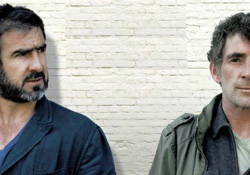
    Looking for EricIt’s been a long time, if ever, since Ken Loach made a film that could legitimately be called a crowd-pleaser, but this is precisely what he has made in “Looking for Eric.”

    Gentle, undemanding and buoyed by the effortlessly charismatic presence of the titular football god – it’s certainly the first Loach film to possess anything approaching star power – it’s less overtly comedic than the marketing campaign would have you believe, but also warmer and less agenda-driven than most of his work this decade.

    With that said, Loach’s renewed emotional engagement has sadly come at the expense of any tonal cohesion whatsoever. As the veteran filmmaker fumbles for the buttons to alternately tickle and touch his audience, his film lurches wildly from a jolly working-class jaunt in the vein of “The Full Monty” to reflective character-oriented miserabilism à la Mike Leigh.

    Paul Laverty, Loach’s longtime screenwriter, wields neither the broad drollery of the former, nor the penetrating human insight of the latter, so roughly halfway through, he finds a third way: falling back on the earnest social commentary of his and Loach’s own “Sweet Sixteen.” With the film shifting its story emphasis through each of these multiple personalities, any sense of narrative continuity slips through the cracks.

    If it sounds like I’m being overly harsh on a film for which the placatory adjective “nice” might have been invented, it’s because not enough people are doing the same: that such a minor-key and formally slapdash film should have played in competition at Cannes is generous enough, but the multiple festival reviews hailing it as some kind of paean to the human spirit are a little puzzling.

    (more…)

  • What will take the Palme d’Or?

    Abbie Cornish and Ben Whishaw in Bright Star It’s all over bar the voting. Tomorrow, Cannes jury president Isabelle Huppert will meet with her formidable, female-dominated team of eight – including the diverse likes of Robin Wright Penn, Asia Argento, James Gray and Hanif Kureishi – to pick over the 20 Competition titles they have seen over the last fortnight and select their collective favorites.

    As I’ve said before, the most surprising thing a Cannes jury can do is not to surprise: to hand the Palme d’Or to the critical and/or popular favorite. It can happen, of course – critics and pundits alike called it for “4 Months, 3 Weeks and 2 Days” the day it screened in 2007, and were proved right – but the list of upsets is long and illustrious.

    As you’ve probably heard by now, if the bookies have their way, French auteur Jacques Audiard will be brandishing the Palme this time tomorrow, his prison drama “A Prophet” having wowed critics and audiences across the Croisette. I’ll be delighted if he does, but I’ve questioned whether a French production can win two years running, after a two-decade drought to boot.

    Of course, such streaks aren’t unheard of: the U.S. held onto the Palme for three years between 1989 and 1991. Other questions running through my mind are whether Frenchwoman Huppert might want to avoid making the festival too much of a local affair, and whether Audiard’s all-male film will resonate as strongly with a mostly female jury.

    If not, there are a number of alternatives. By my count there are six titles seriously in the hunt for top honors. Michael Haneke’s “The White Ribbon” is fancied by many to finally land the director the top prize. Earlier today, the film made its presence felt by claiming the FIPRESCI critics’ prize for best in show, though it should be noted that the jury’s and FIPRESCI’s choices have only lined up three times this decade.

    (More speculation, and my final predictions, after the cut.)

    (more…)

  • Christian Cannes jury tells us what to think

    Willem Dafoe and Charlotte Gainsbourg in Antichrist

    UPDATE: I’m pleased at least to report that Cannes festival director Thierry Fremaux is as outraged by the situation as we are, denouncing it as a “ridiculous decision that borders on a call for censorship … scandalous coming from an ‘ecumenical’ jury which what is more is headed by a film-maker.” Well said, Monsieur.

    EARLIER: I shouldn’t allow myself to get worked up over a petty gesture by a small-minded panel of people, but this can’t pass without comment.

    You may or may not be aware that an annual “Prize of the Ecumenical Jury” has been handed out at the festival since 1974. Established and voted upon by a selected panel of Christian film professionals, it aims to honor “works of artistic quality which witnesses to the power of film to reveal the mysterious depths of human beings through what concerns them, their hurts and failings as well as their hopes.”

    I can’t say I’ve ever really understood the point of the award. Still, it has gone to some fine films over time, and not ones necessarily with a spiritual agenda — from “Paris, Texas” to “Cache” — so I always thought it harmless enough. No more. This year, they’ve decided to mount their moral high horses by handing their first ever “anti-award” to Lars Von Trier’s “Antichrist”:

    “We cannot be silent after what that movie does,” said Radu Mihaileanu, a French filmmaker and head of an international jury that announced the awards Saturday.

    In a statement, Mihaileanu said Antichrist is “the most misogynist movie from the self-proclaimed biggest director in the world,” a reference to a statement by Danish filmmaker Lars Von Trier at a post-screening news conference. The movie, Mihaileanu added, says that the world has to burn women in order to save humanity.

    (more…)

  • IFC to bring ‘Antichrist’ to U.S.

    Willem Dafoe in AntichristSpeaking of “Antichrist,” while some doubted that the controversial pic would see the light of day Stateside, IFC Films is ensuring that it will. The indie outfit has picked up U.S. distribution rights to Lars Von Trier’s film, and moreover, has announced that no cuts will be made to film ahead of its release. IFC president Jonathan Sehring’s states:

    “Since it premiered at Cannes on Monday, we haven’t been able to stop talking or thinking about ‘Antichrist’ … It is a towering work of cinema by one its greatest directors.  We are incredibly excited to bring this film to America and expect it to have a major impact on audiences not only in America but worldwide.”

    Given that the film will unquestionably land an NC-17 certificate, not to mention further media ire in the States, it’s a courageous move from IFC, and I think they should be commended for it. “Antichrist” certainly stands in stark contrast to IFC’s other Cannes acquisition of the day: Ken Loach’s gentle, well-liked character comedy “Looking for Eric.”

  • Polite reception for Loach’s latest

    Eric Cantona in Looking For EricAs I expected, Ken Loach’s “Looking For Eric,” his first Cannes entry since winning the Palme d’Or in 2006, hasn’t exactly set the Croisette alight. Critics seem to agree that the football-themed comedy is a modest charmer, but too slight to really hold its own in the competition. (Probably a welcome shift in pace, what with critics still reeling from “Antichrist.”) Variety’s Derek Elley speaks for most of the critics with his kind but reserved take on the film:

    Loach and writer Paul Laverty’s ninth feature together is a curious hybrid: Three movies — boilerplate, socially aware Loach; personal fantasy; romantic comedy — wrap around a central core of a hopeless soccer fanatic who’s given a second chance to sort out his life. As in many of Laverty’s scripts, problems of overall tone and character development aren’t solved by Loach’s easygoing direction, though when it works, “Eric” has many incidental pleasures.

    The Guardian’s Peter Bradshaw also likes it well enough, drawing comparisons to “Play It Again, Sam,” and describing the presence of football legend Eric Cantona — certainly the film’s biggest commercial drawcard, in France especially — as “excellent comic value.” The word “nice” is used at several points, which seems rather telling.

    As much as I like the 72 year-old director’s work — though it’s been aeons since he made anything approaching the level of “Kes” or “Poor Cow” — one has to once more wonder whether this is the kind of film that really needs to be on the Palme d’Or shortlist, at the expense of bolder, less exposed talent.

  • Cannes: sizing up the Competition, part one

    Penelope Cruz in Broken EmbracesWith the Cannes Film Festival only two days away, it’s time to take a long hard look (or just a look, if you prefer) at the 20 films in contention for the Palme d’Or, a typically eclectic bunch married by only one factor: all but one are from directors who have been in the race before. (And people accuse the Oscars of playing favorites.)

    Cannes is a notoriously tricky (and often well-nigh impossible) contest to predict: partly because the voting body is an ever-changing template, but largely because there’s been no time ahead of the festival for any kind of critical or popular consensus to build around the mostly unseen films on the shortlist.

    This may mean that in some cases the jury is susceptible to a film’s auteur cache — think “The Wind That Shakes the Barley” in 2006 — but it also allows for surprise attacks by less heralded titles on the basis of quality alone. Though it may seem an obvious winner in retrspect, few were talking about “The Class” last year before it snuck up on the last day and slayed the competition.

    With those caveats on the table, here’s a film-by-film (10 today, 10 tomorrow) rundown of this year’s lineup, detailing the Cannes credentials of each director, and offering some thoughts as to where they may sit in the competition. I make no promises — except that at least half my speculation will likely be proved wildly wrong in a fortnight’s time.

    “BROKEN EMBRACES” (Pedro Almodovar)

    The pitch: Already widely seen and reviewed, the film marks a return to film noir territory for the Spanish master, a complex melodrama headed by Penelope Cruz as an actress trying to rid herself of an aging lover. (Spanish dialogue)

    The history: On his two previous Competition appearances, for “All About My Mother” in 1999 and “Volver” in 2006, Almodovar entered the race as the bookies’ favourite, only to land the consolation prizes of Best Director and Best Screenplay, respectively.

    The outlook: Reviews so far have been kind, if reserved; several critics appear to delight in Almodovar’s trademark color-saturated visuals and off-kilter humor, but few have suggested that this ranks among his finest works. Almodovar is surely overdue for the festival’s top honor, but if a more unanimously lauded work like “Volver” couldn’t do the trick, my guess is that “Broken Embraces” won’t either. I think the jury may pass altogether.

    (more…)
  • Cannes-bound?

    With the “news” (which has, of course, been common knowledge for the better part of a year) that Quentin Tarantino’s “Inglourious Basterds” is set to compete at Cannes, it’s time to start contemplating what else might appear in the festival lineup.

    For my money, one of the safest bets has to be Ken Loach’s latest, “Looking For Eric.” A comedy centred on a working-class football fanatic who receives life coaching from legendary French footballer Eric Cantona, it looks like a refreshingly fanciful departure for a filmmaker celebrated usually for bleaker social-realist fare. That may not exactly sound like a festival gimme, but it’s been almost two decades since a Loach feature didn’t compete at one of the three major European fests — Cannes being the most hospitable of his work.

    Loach has an enviable track record at the Croisette — though 2005’s “The Wind That Shakes The Barley,” which finally netted him the Palme d’Or after eight attempts, never really caught on after the festival. The chirpy teaser below suggests to me that “Looking For Eric” may find more of an audience, even if it’s less award-friendly than previous Loach efforts. (Thanks to commenter Han for the tip.)