In Contention

Tag: Patton

  • LIFE WITHOUT OSCAR: 1969 and 1970

    Catch up with the idea behind this series here.

    As the 60’s came to a close, Oscar decided to embrace its dirty side and give X-rated “Midnight Cowboy” the top prize. Coming a year after “Oliver!” makes it quite a juxtaposition and the film remains one of the most interesting picks by the Academy, particularly as it triumphed in the “Year of the Western.”

    “The Wild Bunch,” “True Grit,” “Paint Your Wagon” and “Butch Cassidy and the Sundance Kid” all found themselves up for top prizes in a year that Tapley would probably have died to cover. Also great to see “Z” become the second foreign language Best Picture nominee in a year that Wikipedia claims is still the highest rated Oscar telecast ever. Take note current producers- there was no host and it lasted 145 minutes.

    The 70’s were introduced with “Patton” earning Best Picture. War, epic, biopic, strong male lead; it completely fits the bill for a Best Picture winner. Of course, George C. Scott would famously become the first actor to refuse his award this year.

    It was also the year The Beatles finally won an Oscar (for “Let it Be”) but had already broken up and failed to appear. Timely as ever, Academy.
    (more…)

  • Going to war with Oscar

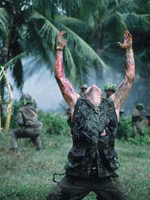
    Willem Dafoe in PlatoonOver at The Big Picture, Patrick Goldstein spent some time revisiting the three “bona fide” war films to win the Oscar for Best Picture (in the last 40 years): “Patton,” “The Deer Hunter” and “Platoon.” He notes that each of those films, when adjusted for inflation, grossed over $300 million, $280 million and $160 million respectively.  We all know where “The Hurt Locker”‘s tally sits.

    What he took away from another look was that each film captures modern day ambivalence toward war, which really, the best of war cinema does.  Which reminds me, I caught “Black Hawk Down” again on cable earlier this week (a brilliant film), and certainly the point is driven home there, though in more camouflaged strokes.  When Tom Sizemore sarcastically quips, “Just get it over with,” in response to a young soldier screaming, “They’re going to get us killed,” any notion that the film uses high octane tropes to drum up a sense of “duty” or American flag-waving quickly flies out the window.

    But I digress.  All of that is kind of inherent in the drive to make a war film, unless you’re talking about a golden age period that saw the likes of John Wayne (who Goldstein reminds “ducked out of the fighting himself”) standing up, larger than life, to the identity-less enemies of a nation.

    (more…)

  • Coming in June: Coppola’s ‘Tetro.’ Will it bring him back?

    TetroNo other director in the history of the cinema dominated a 10-year span as Francis Ford Coppola did the 1970s. Beyond directing four of the decade’s greatest films — “The Godfather”, “The Godfather, Part II”, “The Conversation” and “Apocalypse Now” — his name was on “Patton” and “The Great Gatsby” as screenwriter and “American Graffiti” as producer.

    In addition, Coppola created American Zoetrope in the hopes of building a haven for young directors to make small films free of the studios.  But he also believed what the press were saying: he was a genius who would turn whatever he touched into gold.  His ego got in the way and he alienated friend and comrade George Lucas, eventually making up with the director years later when positions of power had been reversed.

    In the years after “Apocalypse Now,” the Oscar-winning Coppola fell on hard times with one failure after another it seemed, his once golden touch lost in the jungles of the Philippines while making his Vietnam epic. There were glimmers of former greatness from time to time, such as the expressionistic brilliance of “Rumble Fish,” the Cab Calloway sequence in “The Cotton Club,” the haunting scene with Kathleen Turner and her grandparents in “Peggy Sue Got Married” and Jeff Bridges’s wonderful work in “Tucker.”

    But “One from the Heart” was a mess.  “The Outsiders” was a sentimental disaster of a film. And then there was “The Godfather, Part III,” a failure because Paramount failed the director, breaking their word after making the promise he would have complete control, refusing to pay Robert Duvall, integral to the story, half of what Al Pacino was making, forcing a major re-write (that cost…?) and casting his daughter (the poor girl) in a key role when she simply lacked the acting chops to work with that ensemble.  On and on.

    (more…)