In Contention

Tag: Amadeus

  • LIFE WITHOUT OSCAR: 1983 and 1984

    Catch up with the idea behind this series here.

    1983 was dominated by James L. Brooks and his sentimental weepie, “Terms of Endearment.” I can’t imagine it deserved the award, but I also have no room to complain since this is one of the few Best Picture fields where the winner is the only title I’ve actually seen.

    Linda Hunt won Best Supporting Actress for “The Year of Living Dangerously,” playing a man. Felicity Huffman would come close to doing the same in 2005, while Sarah Jessica Parker sees her efforts continually overlooked film after film (I kid, I kid).

    1984 was a battle royale between “Amadeus” and “A Passage to India,” with Milos Forman’s biopic eventually emerging triumphant. This year also saw Mr. Miyagi from “The Karate Kid” nominated in the same ceremony that awarded the first acting Oscar for an Asian to Haing S. Ngor.

    Take it away, Sally Field- “The first time I didn’t feel it. But this time I feel it! And I can’t deny the fact that you like me! Right now, you like me!”

    (more…)

  • THE LISTS: The top 10 Best Picture winners of all time

    Clint Eastwood in UnforgivenWith the Oscar season officially here it seemed only logical to dedicate an installment of The Lists to the little golden guy.  And as we push forward past the fests and into the thick of it, I figured the best idea would be a broad assessment of the Academy’s chosen best through the years, a bone of contention for a great many, as you read in this space and in the comments section year in and year out.

    But I must say, putting this list together was a joy.  The percentage of times I think the Academy has gotten it “right” is quite low, of course, but when I skimmed the cream of the crop I was left with, I felt, a wonderful collective representative of the finest of American cinema.

    Of course, that should itself be seen as damning the organization with faint praise.  After all, the Academy has failed to recognize a great many foreign classics with its top prize.  And by a great many I mean any.

    The most celebrated decade in cinema, the 1970s, has three representatives on the collective, each of them at the very top.  The 1990s and 1980s came in right behind with two to show for themselves, while the 1930s, 1940s and 1960s each had one entry.

    I’d say that’s a pretty decent cross-section.

    It goes without saying a list like this is incredibly subjective, but I’d be very curious to hear the readership’s thoughts on 82 years of this award, so when you rattle through my list, be sure to offer up your own in the comments section.  We have a diverse group here so I’m sure there will be a number of unique takes.

    (more…)

  • And often, the Academy gets it right…

    United Artists' Midnight CowboyAs much as I rant about some of the bizarre choices made by the Academy, let’s be fair…there are times when they are right on the money.

    The AMPAS allowed for an embracing of the New American cinema with their awards for Best Picture and Best Director for “Midnight Cowboy” in 1969, and only they had the courage (and the smarts) to recognize that “The Godfather Part II” was a superior film to the first in handing it the same two trophies. They had awarded “The Godfather” Best Picture two years earlier, but much of the precursor circuit (and all of the critics groups) largely ignored the sequel, opting instead for films such as “Alice Doesn’t Live Here Anymore” and “Chinatown,” among others.

    The five awards betsowed on “One Flew Over the Cuckoo’s Nest” in 1975 are among the group’s best choices ever, in particular the honors for actor Jack Nicholson and director Milos Forman.

    Though far too often dismissed as a chick flick, “Terms of Endearment” was a marvelous slice of life that the Academy embraced with five Oscars, including Best Picture, Best Actress, Best Supporting Actor and Best Director. By the way, is it not odd that first time winner James L. Brooks has never again been nominated in the directing category again, despite two Best Picture nominees in “Broadcast News” and “As Good As It Gets?”

    I remember cheering loudly the many wins for “Amadeus,” “Out of Africa” and “Platoon” three years in a row, and though I believe “Goodfellas” is a better film, I was pleased to see a western, “Dances with Wolves,” win seven Oscars.

    No arguments from me between 1991 and 1993, with “The Silence of the Lambs,” “Unforgiven,” and “Schindler’s List” all most deserving winners. And though I prefer “Pulp Fiction,” I understand why “Forrest Gump” took the top prize in 1994.

    Bravo, too, to the Academy for honoring “The Lord of the Rings: The Return of the King,” a bonafide movie masterpiece, and again the following year for “Million Dollar Baby.”

    So you see, for all my bitching (and we all do it…come on), I concede that the Academy does, from time to time, nail the best.

  • Amadeus deserving Best Pic winner

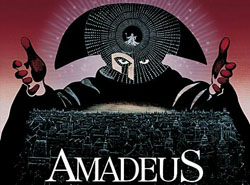
    OK! OK! Right you are, “Amadeus” was indeed a worthy winner in 1984 for best film. It was my hope that by not writing about it, you folks would realize I too liked the film, but in truth I should have covered it. I was worried about the article becoming too long.

    Milos Forman made a masterpiece out of the Peter Shaffer play, a stunning study of art and the differences between genius and mediocrity as played out in the Vienna Court during the time of Mozart. Imagine being old Salieri and listening to your own music become extinct while that of your hated rival becomes immortal.  And the only two people who really knew how brilliant Mozart’s work was were Mozart and Salieri, who quietly in the film despises Mozart the man, but adores Mozart the artist.

    I love the manner in which the wigs of Mozart are pink or purple, slightly different from the rest to suggest his rebelliousness, which came across in his music. He was the punk rocker of the opera set during his short lifetime.

    F. Murray Abraham was superb as Salieri, best of all when he is standing over music written by Mozart and realizes it is truly astonishing, while Tom Hulce is his equal in every frame as the brilliant Mozart.

    What I liked best about the film was the study of two artists, each in love with their art, one reasonably talented, the other gifted beyond human measure, finally coming face to face to create on Mozart’s death bed where Salieri sees and hears first hand how that brilliant mind composed, and simply cannot keep up. And what a stroke of genius to use the music of both on the soundtrack??!! A period masterpiece that never feels like a period film at all.

    And each one of you is right…I should have discussed it because I love it.