In Contention

Tag: Children of Men

  • TECH SUPPORT: Best Art Direction — Volume II

    Oh how things have changed since I last wrote in this space. In the past four weeks, Tech Support has taken a break, allowing the dust from the festival circuit to settle, and other titles to open. Over the next 10 weeks, we’ll take a second look at each of the crafts categories, finishing in mid-December – just as awards circuit takes hold.

    Today, we take a second glance at Best Art Direction. As stated last time, this category tends to reward period and fantasy films.The branch  has some favorites, but it’s not overly incestuous. And while being a Best Picture contender certainly helps, nominees can often come from the surrounding fray.

    Perhaps I’ll start with a film that I thought would score here, but came out of Toronto in even greater shape than I expected: Tom Hooper’s “The King’s Speech.” With prestige and period attached, I am virtually certain Eve Stewart, who was nominated in this category 11 years ago for Mike Leigh’s “Topsy-Turvy,” will be heading to the Kodak. Not only am I confident she’ll be nominated again, I think she has excellent potential to win.

    (more…)

  • Guy’s top 50 of the decade: #1-10

    Maribel Verdu in Y tu Mama TambienAnd then there were ten.

    Before I wrap up the list that I’ve trickled out over the last five days, I suppose I should write a few words on the decade that was. I entered the 2000s as a 16 year-old boy in Johannesburg who thought he knew a lot about movies. I left it as a 26 year-old man in London who knows a lot more than he did then — but realizes that he knows a lot less. There is still so much to see that I’ve barely touched upon — from this past decade alone.

    Probably no filmgoing decade in my lifetime will be as crucial to me as the one that passed, in terms of the shift and growth in my sense of how to read (and write) film.

    I may have already known that I loved movies, but in the 2000s I gained a sharper sense of how to love them, what I really respond to in a film — and the 50 titles gathered here (along with many, many others) helped fine-tune that notion.

    With that kind of personal learning curve attached to the decade, it’s hard to stand back and judge how it might stack against previous ones; strong, weak or average, it’ll always feel like my decade. As I compiled the list, however, did arrive at the conclusion that it started better than it finished. Sheer mathematics supports this personal view — the top 10 films I’m about to reveal all landed in the decade’s first half, and I don’t think that’s merely down to the advantage of distance.

    (more…)

  • The best films of a decade

    Tom Cruise in Minority ReportThis column has been the elephant in my living room for months.

    Putting together a list of the year’s best films is easy. It’s fresh. It’s in your mind. It’s, in many ways, the expected culmination.

    Putting together a list of the decade’s best films is a different chore altogether. Yearly rankings fly out the window as a proper gauge, because tastes shift and impacts either dwindle or deepen. Revisiting films is called for, but fitting in the works you missed along the way is also imperative. It can be maddening.

    And the truth is, you can’t see everything. All you can do is try to be as honest about how you feel as you can. And even then, no list can be definitive on a personal level, let alone authoritative.

    And so the whittling begins, and in many ways, the process is the reward. The ultimate collective is a mere reminder of the journey through 10 years of film product. But some things stuck out along the way.

    (more…)

  • Movie stingers: do they work?

    Columbia Pictures\' Hancock

    If you saw “Hancock” over the weekend, you probably noticed a brief scene in the middle of the closing credits sequence featuring Mike Epps and meant as a funny punch for your theater exiting pleasure.

    It got me thinking about inter- and post-credit sequences — called “stingers” — and whether they ought to be eliminated altogether.  I ask this despite a history that includes a precious few great examples in films like “Ferris Bueller’s Day Off” and perhaps extending way back to the point-and-shoot moment of “The Great Train Robbery” that sent audiences screaming out of nickelodeons in 1903.

    Most of the time, these moments are random, useless and nothing more than a send-off treat (like in “Hancock”).  Other times, they might be an “Easter egg” for those who know to stick around, like Samuel L. Jackson’s Nick Fury scene at the end of “Iron Man.” (There are also stingers after the credits of “WALL-E” and “Kung Fu Panda” this year.)

    More often, however, they have the potential to leave viewers who weren’t aware somewhat burned.  Or otherwise irritated — like Eric Snider of Cinematical, who dug into this issue in May.

    The question actually brings up another point, which is, are the closing credits of a film a part of the greater artistic whole?  Plenty of opening credit sequences provide direct commentary on a film and could therefore be argued part and parcel of the piece.  But with few exceptions, closing credits are a tacked-on necessity that even those featured in the roll wouldn’t consider any part of a directorial vision or collective filmmaking result — even if they are beautiful or interesting (i.e. “The Lord of the Rings: The Return of the King”).

    Then again, used to the right artistic effect, a subtle stinger might actually add to the overall canvas of a film.  Such is the case, I thnk, with the sound of children’s laughter after the credits of “Children of Men.”

    Typically, the existence of stingers just annoys me.  I’m more at ease with the inter-credits stuff.  As I was leaving “Hancock,” the Mike Epps scene kicked in and we all stopped and watch — har, har — off we go.  Fine, fair enough.  But if I miss something I realy want to see (like in “Iron Man”), it’s quite irritating.

    That doesn’t mean I don’t enjoy the scenes, however.  And I do have a few favorites.

    My top 5 movie stingers of all time after the jump! (spoilers obviously involved)

    (more…)

  • Battersea featured in ‘Dark Knight?’

    This one is a stretch, I know — and many of you could care less.  But I can’t escape “Dark Knight” news no matter where I turn.  Seriously, I just click on a link to a random news story about the revitalization of London’s Battersea Power Station, and there it is, staring me in the face.

    The Batman films are always valuable for their design elements, but I didn’t know this monolith — perhaps best known from the cover of Pink Floyd’s “Animals” (an image replicated two years ago in “Children of Men”) — was going to be featured in the film.  But it seems that’s the case.

    I can, like, see Battersea from my kitchen.  Very cool.

    Carry on…

  • ‘Blindness’ misses the bullseye, say critics

    Well, in my last post, I said that “Blindness,” with its immaculate credentials, could hardly miss – which of course was issuing an invitation for it to do just that. The latest from red-hot director Fernando Meirelles opened this year’s Cannes Film Festival a few hours ago, to frustratingly mixed reviews.

    In his review, Kirk Honeycutt of The Hollywood Reporter calls the film both “provocative” and “predictable cinema,” and while he does admire Meirelles’ craft, he ultimately finds the film emotionally lacking:

    This philosophical coolness is what most undermines the emotional response to Meirelles’ film. His fictional calculations are all so precise and a tone of deadly seriousness swamps the grim action … Removing a fable from the comfort of the printed page to the photo-reality of film can sometimes lead to its own kind of blindness.

    Variety’s Justin Chang is similarly lukewarm on the film, bemoaning its “diminished impact and excess of stylish tics,” and is less impressed than Honeycutt is by the film’s technical qualities:

    Meirelles adopts a cooler but, in its own way, no less fussy aesthetic. He often floods the screen in luminous white to mimic the sensation of blindness, at other times bathing his characters in the stuff so they appear to be, in one’s words, “swimming in milk.” This deliberately artificial effect gives the film a stagy, self-conscious air.

    However, it’s not all doom and gloom by any means. On the other side of the Atlantic, Peter Bradshaw of The Guardian offers an unqualified rave of the film:

    Blindness is a drum-tight drama, with superb, hallucinatory images of urban collapse. It has a real coil of horror at its centre, yet lightened with finely judged touches of gentleness and even humour. It reminded me of George A Romero’s Night of the Living Dead, John Wyndham’s Day of the Triffids and Peter Shaffer’s absurdist stage-play Black Comedy, showing humanity groping in the darkness. This is bold and masterly film-making from Meirelles: popular entertainment with challenging ideas.

    (more…)

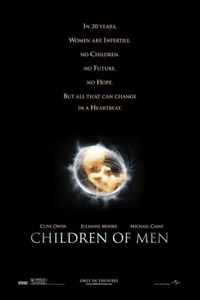
  • REVIEW: “Children of Men” (****)

    Universal Pictures' Children of MenAlfonso Cuarón’s is one of the most singular voices in the filmmaking community. Along with longtime collaborator, cinematographer Emmanuel Lubezki, the director has ushered forth textured visions of skewed fairytales for over a decade.

    With “A Little Princess,” he took audiences into the mind of a little girl and her trying tenure at a miserable boarding school. In perhaps his most underrated work, “Great Expectations” (a loose adaptation of the Charles Dickens novel), he unveiled the mysterious and fateful journey of a dreamer.

    “Y tu mamá también” brought the director’s choice of material into a more mature light, still keeping the exuberance of youth, while “Harry Potter and the Prisoner of Azkaban” became one of the most adult installments in a series aimed at a younger market.

    “Children of Men” fits rather paradoxically into these otherwise whimsical endeavors. Another sort of fairytale altogether, one cloaked in the mystique of dystopia, it is a film as unflinching in its bleakness as it is penetrating in its deep-seeded sentimentality. And in manifesting one of the most horrific visions of the future yet committed to film, Cuarón has given us his masterpiece, the crowning achievement of 2006.

    Adapted from the P.D. James novel of the same name (and, through much arbitration, crediting some five writers on the screenplay), “Children of Men” reveals the hellish world of 2027. Baby Diego has died, the affectionately labeled youngest person in the world -– 18 years old. Fertility is an aspect of the past, and humanity’s time is clearly borrowed. The world’s nations have crumbled to apocalyptic ruin. England remains the last refuge for potential stability and order…but those days are quickly slipping away.

    Theo Faron (Clive Owen) is a man lost in this sea of chaotic apathy, sliding amongst the beleaguered masses, one of the hordes, most concerned about his morning coffee and skipping out on work than with finding something of considerable happiness. His best friend, Jasper Palmer (Michael Caine), is a stoned hippie who listens to the oldies and laughs away the final years of human existence in the woods, surrounded by marijuana and nostalgia.

    An immigrants’ rights terrorist organization headed by the mysterious Julian Taylor (Julianne Moore) kidnaps Theo in broad daylight one day in order to attain transport papers for an unnamed woman. Julian and Theo, we learn, once had a child together, a child they lost and whose memory haunts them equally.
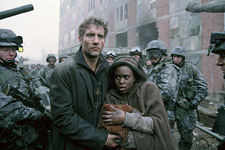
    Clive Owen and Clare-Hope Asitey in Children of MenThe unnamed woman is soon revealed to be Kee (Clare-Hope Asitey), a refugee holding the potential key (I feel as though I’ve just discovered the point of the character’s name) to the future of man: miraculously, she is pregnant, waiting to give birth to the first baby the earth has seen in 18 years.

    It soon falls to Theo to protect Kee and her unborn child, a veritable political football, and smuggle her to the Human Project, a scientist organization bent on curing the world’s infertility crisis.

    Through sheer drama and brutal tension, Cuarón sets about weaving a blistering yarn that draws parallels to current political climate. Truly penetrating visual cues bring the viewer’s mind to everything from ground assaults in Iraq to conditions at Abu Ghraib prison.

    Clive Owen’s portrayal is largely physical, as Theo is an elusive character (even by the actor’s own admission). Even still, this is one of the year’s great performances, an immediately believable portrait of a hero called to unconscionable task. Asitey is equal parts preciousness and irreverence as Kee, and Caine has far too much fun for his own good in the role of Jasper. Moore’s turn is fleeting, but elevated by her own angelic screen presence.

    Elsewhere, Peter Mullan has a great second act performance in store as one of Jasper’s amigos, while Chiwetel Ejiofor offers up yet another controlled supporting turn, this time as part of Julian’s terrorist organization. It is, however, the technical elements of the film that propel it head and shoulders above anything else in the market place this year.
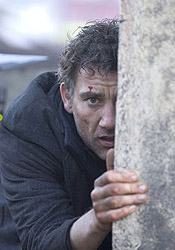
    Clive Owen in Children of MenSome of the set pieces Cuarón orchestrates are the most electrifying, living and breathing sequences ever imagined in the history of cinema. Much credit here is due to Lubezki and camera operator George Richmond, not to mention a meritorious technical and stunt crew who must have rehearsed these moments into the ground.

    You’ll hear it for the rest of the year, the cinematography on display in “Children of Men” is God-like in its skill and quality.

    Equally impressive is the production design of Jim Clay and Geoffrey Kirkland. Dreary, decaying urban landscape spans the frame. Graffiti and bullet holes decorate sets constructed with a defining clarity of intent, and ultimately the world envisioned on the drafting table becomes a character in its own right.

    The most interesting aspect of the mise-en-scène, however, has to be the director’s decision to litter the frame with various animals, usually dogs and cats. Representative of humanity’s longing and desperate need to replace children with something else, it is one of the more subtle aspects that isn’t brought out into the open for inspection, but upon examination is all too brilliant an element in the director’s arsenal for this, his finest film to date.

    “Children of Men” is a shocking portrait, indeed. From an opening scene that grips you by the collar and never lets you turn away, it is stomach-churning in its abjection, and it is resonant in its refusal to buckle under the cynicism with which Cuarón paints his canvas. It is stark and it is pointed, but it is warm and full of hope all the same. It is a miraculous achievement.