In Contention

Tag: Crash

  • LIFE WITHOUT OSCAR: 2005 and 2006

    Catch up with the idea behind this series here.

    We all remember Jack Nicholson’s raised eyebrows as he said the word, “Crash” at the end of the 2005 ceremony. What has to be, objectively, one of the biggest surprises of the last twenty years in the Best Picture category is, subjectively, one of the worst catastrophes the Academy has ever produced. “Crash” is a wretched film, but let’s focus on the positive. This was the first time a Best Picture winner was a film that premiered at festivals and was picked up for distribution.

    Ang Lee became our first non-white Best Director winner, George Clooney became the first person to receive acting and directing nods in the same year for different films, no film won more than 3 Oscars for the first time in nearly sixty years and the Best Documentary winner grossed more than the Best Picture winner. No shortage of talking points then.

    2006 was the year of Scorsese, finally winning the big prizes for “The Departed.” Biopics continued to reign in the acting categories, with Forest Whitaker joining last year’s Philip Seymour Hoffman in the category of non-traditional leading men walking away with Best Actor honors.

    Jon Stewart and Ellen DeGeneres were charged with hosting duties, both more famous in the TV realm and both serviceable MCs. Again it was up to Jack Black and Will Ferrell to bring the night’s best entertainment.

    So what should you throw into your Netflix queue other than “Crash?”

    (more…)

  • THE LONG SHOT: Follow the leader

    [Updated Oscar predictions here.]

    Hey, have you heard of this movie called “The Social Network?” You should probably check it out. It’s about Facebook and stuff and it’s supposed to be really good. So good, in fact, that it’s managed to tame the single most argumentative species in the animal kigdom, The Lesser Spotted Film Critic, into silent agreement. Of the 12 American critics’ groups to dish out awards so far, 11 have given their top honor to the film. (“Winter’s Bone,” you say? Get with the program, San Diego.)

    The enthusiasm for the film, of course, extends beyond the sometimes soundproof critics’ chamber, as less distinguished media collectives like the HFPA and the BFCA have voiced their approval – while this morning, give or take a Supporting Actor snub, the film passed its first industry award test with two key Screen Actors’ Guild bids. Expect the Directors’, Producers’, Writers’ and Editors’ Guilds to follow suit in the New Year.

    So, we can basically tie a ribbon around Oscar’s neck and hand him over to Scott Rudin and David Fincher now, can’t we? After all, against all its on-paper disadvantages, “The Hurt Locker” was in a similar position this time last year, and it didn’t budge, did it? (Indeed, it didn’t even unite the critics’ groups to this extent – of the 12 awarding bodies I mentioned above, only five selected Kathryn Bigelow’s Iraq actioner last year.) Scarcely anyone has a word to say against the film, so let’s sit back and let the sweep wash over us, right?

    (more…)

  • THE LISTS: Top 10 NC-17 rated films

    Amid the recent kerfuffle over the Motion Picture Association of America’s curious decision to slap Derek Cianfrance’s sensitive marital drama (and Oscar hopeful) “Blue Valentine” with a commercially inhibiting NC-17 certificate, I failed to note that the MPAA’s most drastic rating celebrated rather a significant anniversary last week.

    October 5 made it 20 years since Philip Kaufman’s sexually explicit literary biopic “Henry & June,” the first film ever to be given the NC-17 classification, opened in US theaters.

    Like “Blue Valentine,” Kaufman’s film was a high-end prestige item aiming for critical kudos and even a shot at year-end awards (indeed, it did wind up nabbing a solitary Oscar bid) that the sage folks on the ratings board nonetheless deemed a little too adult for the adults.

    For decades before then, the X rating (now defunct, but still prevalent in everyday speech) had been their standby for such films — of which one, “Midnight Cowboy,” managed to override the X-rated stigma to win the Best Picture Oscar — but had since become too closely associated with grimy pornographic material.

    (more…)

  • Looking back on Oscar’s Old Left leanings

    Its installments come all too infrequently these days, but Best Pictures From The Outside In — a collaborative project between The Film Experience’s Nathaniel Rogers and his learned pals — is one of the best sources of Oscar discussion and analysis on the web.
    That’s not only because it provides ample opportunity for kvetching over the Academy’s past mistakes (our favorite sport, let’s face it), but because its system of pairing up Best Picture champs from opposite ends of history often reveals unexpected patterns of progression (or not, in some cases) among the voters.

    Their latest episode is a doozy on both counts, covering as it does one of the most roundly jeered winners in the category’s history, 1989’s thoroughly vanilla race-relations drama “Driving Miss Daisy.” (By contrast, the other featured champ, 1946’s “The Best Years of Our Lives,” holds up to this day.)

    (more…)

  • THE LONG SHOT: Bait, switch

    Whether you choose to believe them or not – and speaking for myself, I don’t quite – the media powers that be have currently reduced the 2010 Best Picture race to just two titles: “The Social Network” and “The King’s Speech.” That’s entirely (and hopefully, lest things get too dull too soon) subject to change over the next four months, but given what we’ve seen at this point, it’s difficult to devise a could-win theory for many of the films most fancied for the remaining eight slots, be it “Inception” or “Another Year.”

    I don’t really blame those in the blogosphere who are narrowing things down to this pair of films: after a lackluster Toronto fest failed to turn up a hidden dragon along the lines of “Slumdog Millionaire,” the slate of contenders looks much as it did before the fall festival season began. With expectations for “Network” and “Speech” pegged high all along, meeting them was enough to seal frontrunner status.

    Moreover, the temptation to pit David Fincher’s modish Facebook story and Tom Hooper’s tony royalty porn against each other is hard to resist, given how conveniently the films are opposed: both acclaimed biopics after a fashion, but one concerned with present-day American youth, the other with British aristocracy of yore. “It’s the time-capsule piece versus the time-warp piece,” snarked one friend of mine recently, anticipating a narrative that will likely run all season, even if other frontrunners enter the fray.

    (more…)

  • Check the figures

    Russell Crowe in A Beautiful MindA few things puzzled me about this Variety piece in which Iain Blair takes on a familiar chestnut of a topic: the box-office divide between public favorites and Oscar contenders.

    The first is that he considers the “disparity between art and commerce” to be “accelerating” — a curious argument to make at a time when “Avatar,” “Up” and “Inglourious Basterds” (none of which Blair mentions) look likely to feature on the Best Picture list. Blair’s argument is well-tailored to last year’s Oscar race, but reads somewhat stale now.

    The second is, well, this entire paragraph:

    Sure, “Titanic” grabbed a ton of Oscars and racked up the biggest box office in history. But more recent critically acclaimed best picture winners such as “Shakespeare in Love,” “A Beautiful Mind” and “Chicago” did middling to poor business. And “Crash” and “The English Patient” simply crashed and, well, burned at the box office.

    (more…)

  • Why now?

    Sandra Bullock in CrashThe progression of “The Blind Side” from sleeper success to bona fide box-office phenomenon has cemented Sandra Bullock’s place in the Best Actress discussion. I don’t know if she’ll actually get a nomination — at this early stage, I’m guessing not — but in a tight race for the fifth spot, she’s currently one of the feistiest outside contenders.

    Having not seen “The Blind Side” yet, I can’t say whether I’m okay with this or not. (She’ll have to be very good to justifiably deprive Abbie Cornish of a nod, that much I know.) But as more pundits speculate that Bullock might be in line for one of those “paid her dues” nominations the Academy sometimes hands popular entertainers for attempting more gravitas than usual, I find myself wondering: why now?

    Where was this groundswell of support for Bullock four years ago, when she gave a strong, against-type performance in a film the Academy plainly loved?

    (more…)

  • One-man anti-‘Precious’ campaign

    Mo'Nique in PreciousWow, and I thought I didn’t get on with “Precious.”

    Jeffrey Wells has drawn attention to the concerted efforts of one Anthony Smith, a 29 year-old African-American working in film acquisition, to derail the “Precious” express. Smith has written an open letter decrying the film’s alleged use of racial and social stereotypes as both “dangerous” and “offensive,” which he is sending to assorted industry figures and op-ed pages.

    I quote his letter after the cut not because I particularly agree with or endorse it — as much as I didn’t like the film, I think accusing it of racism is a wild stretch. And as a work of fiction, I don’t think the film has any particular responsibility towards any particular social group, so I find much of Smith’s argument naïve at best.

    (more…)

  • THE LONG SHOT: Critical condition

    Gabourey Sidibe in PreciousAhead of its U.S. release this week, there is a wave of mild surprise in the blogosphere over the fact that “Precious,” the film deemed by some (yours truly included) to be the present Best Picture frontrunner, is currently sitting on a lowly Metacritic score of 57. Fitting neatly with the largely media-fabricated talk of a backlash against the film, some commenters are citing this rather arbitrary number as a debit against the film’s chances.

    As much as I’d personally like that to believe that — and as relieved as I am to see that I’m not the only person who didn’t respond to the film – such talk will doubtless be short-lived, given the paucity of reviews making up the current score and the likelihood of raves to come. If anything, public support is more crucial than critical consensus to this film’s campaign – if audiences don’t turn up to see this grim, minority-oriented indie, many Academy members won’t feel compelled to either.

    That said, it looks increasingly possible that “Precious” (I refuse to use that lumpy subtitle all season, by the way) could turn out to be a more critically divisive item than might have been expected following an ecstatically received festival run.

    (more…)

  • You said it, not me

    Sandra Bullock in CrashSo, what does Paul Haggis have to say about the recent revelation that “Crash” (not the 1996 Cronenberg film, surprisingly enough) has remained the most rented film on Netflix since September 2005?

    “I have no idea why anyone went to see the movie in the first place, let alone rent it.”

    Truer words, etc, etc. But snarkiness aside, Haggis has a fair point here: the film was never meant to be any kind of phenomenon. Whether by calculation, alchemy or sheer good fortune, it happened to resonate with certain audiences upon its spring release four years ago — and if those Netflix numbers are anything to go by, it still does. Credit where it’s due.

    Academy voters thrust a weighty reputation onto this slender film that forever altered the way audiences would approach it, and I’ve long been unsure how it would support that weight. For my part, I disliked “Crash” immensely when I saw it in the summer of 2005, but I didn’t resent it the way I do today — though the fault there lies with me, not the film.

    “Crash” is a fascinating case study of the way the public’s relationship with art can shift with time, but the film’s evident popularity on DVD suggests that the relationship is more in flux than its detractors may have guessed.

    (more…)

  • Define ‘upset’

    Let’s get this straight: an upset and an injustice are two very different things. When a nominee that isn’t widely expected to win beats one that is, that’s an upset. When a highly deserving underdog loses to a less deserving favourite, that’s an injustice. The latter arguably happens more frequently in Oscar history than the former, but that’s no reason to blur the line.
    I mention this in connection with a poll that Sasha Stone spotted yesterday, in which the following were named the biggest Oscar upsets of all time in the Best Picture category:

    1. “Shakespeare in Love” over “Saving Private Ryan” (1998)
    2. “Crash” over “Brokeback Mountain” (2005)
    3. “Dances With Wolves” over “GoodFellas” (1990)
    4. “Rocky” over “Taxi Driver” (1976)
    5. “How Green Was My Valley” over “Citizen Kane” (1941)

    Now I remember the 1990 awards clearly — I was 8 years old, and it was the first Oscar season that I followed keenly from beginning to end. And even I, at that tender age, knew that “Dances With Wolves” was a gimme, a slam-dunk, a no-brainer. However critically acclaimed Scorsese’s masterpiece was, it hadn’t a prayer against the film that swept the Guilds and the Globes — Kevin Costner enjoyed as great a stranglehold on the Oscar as Danny Boyle does today. “GoodFellas” winning would’ve been the upset, not the other way round.

    (more…)

  • The new millennium Oscars?

    Viggo Mortensen in The Lord of the Rings: The Return of the KingLooking back over the previous Oscar winners for Best Picture since 2000, the start of a new century (and a new millennium), I find myself wondering sometimes what the hell the Academy was thinking.  It’s no secret I disagree with the Academy a lot, but I can also admit that when they get it right, they get it right.

    But since 2000, their Best Pic choices have run the gamut from incredibly ridiculous, “Gladiator” and “A Beautiful Mind” being just goofy, to bang on, with “The Departed” and “The Lord of the Rings: The Return of the King.”  I am told the Academy is moving in a more progressive direction, willing to take more risks, and I suppose some of these winners do just that.  But they could have gone further.

    Year by year, here’s a quick look, with some thoughts about who might have won, and who should have at least been nominated…

    (more…)

  • Will BAFTA stick by their own?

    I have a bit of a love-hate relationship with the BAFTA Awards. On the one hand, they can be far more daring and playful in their choices than the American Academy — this is an organisation, after all, that has handed their Best Film award to such enduring works as “The Purple Rose of Cairo,” “GoodFellas” and “Lacombe, Lucien,” while nominating the Oscar-snubbed likes of “Eternal Sunshine of the Spotless Mind” and “The Usual Suspects.”

    Their technical awards are invariably more imaginatively awarded, too — take a look at their Best Film Editing category, for example, which in recent years has crowned “Eternal Sunshine,” “City of God” and “Mulholland Drive” as winners. And they can often be counted upon for gratifying upsets, as when Pedro Almodovar pushed past Sam Mendes for Best Director in 2000, or when “Trainspotting” blindsided “Sense and Sensibility” in the 1996 screenwriting race.

    For an awards show that fancies itself world-class, however, BAFTA can be infuriatingly parochial in their selections, stubbornly rewarding their own in the face of bigger, bolder competition. I doubt most of the voters could say with a straight face that “Four Weddings and a Funeral” was the very best film of 1994, nor “The Full Monty” of 1997, but they cleaned up nonetheless.

    For the last two years running, that kind of provincialism has ruled the voting, with this year’s awards looking particularly suspect. I think “Atonement” is a fine film, but handing it their top award seemed tokenistic at best, not least when the only other gong it took was for Best Art Direction.

    It’s a trend that Variety thinks could continue this year. In an article previewing the British contenders in the acting categories, they point out that Limeys have taken 16 acting BAFTAs in the last decade, compared to seven Oscars. Needless to say, they are frequently justified. It’s fair to say that this year, several British names will be cropping up in awards lists on either side of the Atlantic, and deservedly so — particularly in the Best Actress category, where thesps like Kristin Scott Thomas, Sally Hawkins and the ubiquitous Kate Winslet are all likely to figure.

    (more…)

  • INTERVIEW: Dennis Hopper

    Dennis HopperThe voice on other end of the line sounds nothing like the many wild and somewhat insane characters Dennis Hopper has portrayed throughout his career, which now spans more than 50 years. This is a man who has walked with James Dean (his mentor), John Wayne (who affectionately labeled him a “pinko”) and Francis Ford Coppola.

    As a director, Hopper was part of the movement that would bring the New American Cinema into play, closing the 1960s with his biker flick “Easy Rider,” and though he won prizes at Cannes and was hailed around the world, he has rarely directed since.

    Hopper portrayed perhaps the single most terrifying character in a film with his seething work as Frank Booth in David Lynch’s “Blue Velvet.’  The same year he was nominated for an Oscar for his work as the town drunk seeking redemption with his son through basketball in “Hoosiers.”  Even Hopper was stunned that the Academy failed to nominate him for Lynch’s film instead.  He remembers roaring, “HOOSIERS?  You’re kiddin’ me, man” when being told of the nomination. “Blue Velvet” was a film the Academy obviously feared, allowing a single nomination to David Lynch for his dreamy, surrealistic direction of the classic.

    Currently Hopper is celebrating the upcoming DVD release and a low-key Oscar campaign for Best Supporting Actor in “Elegy,” a fine little film in which he portrays the poet best friend of Ben Kingsley’s introspective professor — Sir Ben as Hopper calls him.

    “I was a big fan of Isabel’s [Coixet, the film’s director] work”, he explains. “So when my agent called and said I had an offer to be in a film with Sir Ben Kingsley and Penelope Cruz, I jumped in. It was a very human story, the sort of film I like to see, and being a big fan of Philip Roth helped me along. The film had comedy and tragedy, and most of all characters I think we can all identify with.”

    (more…)

  • Remembering cinema’s Bush years

    As the world prepares to bid farewell to George W. Bush following tomorrow’s election, I came across an apt article in the new edition of Sight and Sound, in which critic Michael Atkinson evaluates how the Bush presidency affected American film, and how the period might be interpreted by future film historians. As always with S&S pieces, it’s not available online, but it’s an insightful (and occasionally contentious) piece worth tracking down if you want to give a cinematic spin to your sense of closure.
    As has been noted before, Atkinson believes that the sense of public panic and political insecurity that  characterised the presidency has been most clearly manifested in the resurgence of the superhero movie:

    It’s easy to imagine that in a decade or two, the Bush years will be viewed as the discouraging ebb in the pop-cult continuum when everyone from eight to 80 was excited about ‘super powers’ … Clearly, a preadolescent bout of night terrors required succour, producing a trend that’s bound to date as badly as the Spielbergian blue light and Rambotics of the 1980s.

    This is the kiddie-escapist paradigm tinctured with memories of 9/11; today, the vigilantes in primary-colour tights we hanker for don’t confront the conjectural fears of the Cold War, but the all-too-tangible, falling-bodies verities of the new millennium. In “The Dark Knight,” Christian Bale’s Batman has to wrestle, as the Bush administration didn’t, with the necessity of being perceived as evil for the sake of what’s construed as the common good.

    (more…)

  • EW’s Oscar revote

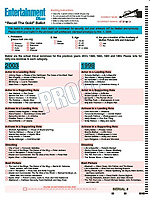
    Entertainment Weekly Oscar revoteFrom Thompson on Hollywood:

    Entertainment Weekly wants Hollywood to rewrite Oscar history by giving the film industry a chance to revise the Oscar history books. It’s called “Recall the Gold.”

    On October 6, EW is inviting more than 7,000 Hollywood insiders to participate in an extensive survey to re-vote on past Oscar races. EW wants to test which movies truly stand the test of time. With the benefit of hindsight, did the right films and performances win over the past 25 years? To look at 2003, will Robert Begnini still beat Tom Hanks? Will Shakespeare in Love still beat Saving Private Ryan? Will Gwenyth Paltrow still beat Cate Blanchett?

    Alright, let me stop it right here and get this out of the way: a nice diversion, nothing else.  Not to poo-poo the experiment, because it’s a fun idea, but the buzz and manipulation of a given Oscar season is in the same league as the manipulation that comes from loud fans and film-goers who think this film deserved to win over that and scream about it for years after the fact.  Nothing like this can happen in a vacuum, so let’s not consider an “Oscar revote” anything more than it actually is.

    And when you see that EW editor Sean Smith’s idea was inspired by the “Brokeback Mountain” loss to “Crash,” it becomes a little more irritating, in my book.  Let it go, folks.

    More:

    Monday EW is mailing out their official “Recall The Gold” ballot inviting the industry to vote in six major categories for five given years spaced five years apart–2003, 1998, 1993, 1988, and 1983–five, ten, fifteen, twenty and twenty-five years ago…

    “We built it from scratch,” says Smith. EW reporters and editors scrolled through their rollidexes. They added everyone who had ever been nominated or won an Oscar, and crew members of films that grossed over $100 million. They looked at the news reports of Hollywood people who had been added to the Oscar ranks in recent years. They culled creative directories for execs, producers, publicists, editors, costume designers, art directors, directors, cinematographers, writers, animators, sound mixers, composers–all the categories covered by the Academy.

    EW made one HUGE change. They invited top film (not TV) agents, who are not permitted to belong to the Academy, to join the list of Oscar revoters. And Smith thinks his list may skew slightly younger than the Academy’s. “We’re not trying to duplicate the Academy,” he says. “What do people working in the film industry think about these Oscar-winning movies now?”

    So, they added more people with agendas to the voting pool.  Nice.  Click the ballot image above for a larger image.  And read the rest of Thompson’s story here.

  • What does early (and excessive) Oscar hype do to a film’s chances?

    Cover of Entertainment Weekly featuring The CrucibleIn 1996, a fall movie preview of Entertainment Weekly arrived in my mailbox, the cast of “The Crucible” staring back at me on the cover, making clear to me this was going to be THE film of the fall. There were rumors floating within the industry that the film, based on the Arthur Miller play, could conceivably be nominated for 12 or 13 Academy Awards, and it seemed a cinch for at least a Best Picture nod.

    Having directed the play twice, studied it at length in university and being a huge Arthur Miller fan, I was thrilled that the film was finally going to get the intense big screen version it deserve. The 1959 French adaptation was okay, but not enough people had actually seen it. Here was a chance for one of the greatest dramas of the 20th century to make the transition to film with a superb cast, including Daniel Day-Lewis, Joan Allen, Paul Schofield and Winona Ryder.

    Somewhere along the way Fox panicked and released the film late in December, and though Day-Lewis finished second in balloting for the New York Film Critics Awards, the picture never caught fire as it had been predicted to do. Instead it was a dismal box office failure, nabbing only a supporting actress nomination for Joan Allen and an adapted screenplay nod for Miller.

    “The Crucible” is a great film, with powerhouse performances from Day-Lewis, Allen and Ryder, though many critics attacked the latter. But was the film a victim of over hype, or were audiences simply too familiar with the story? What happened?

    The same sort of thing almost happened to Steven Spielberg’s “Munich,” which at this time in 2005 was being touted as not just an Oscar nominee, but the likely winner for Best Picture and Best Director, sight unseen. It opened and was very good, but it wasn’t the searing masterpiece everyone had been hoping for.  And somehow “Crash” won the Best Picture prize.

    (more…)

  • “You can’t look away”

    I know there are a lot of “Crash” haters out there — I’m one of them. (Apologies to Kris — I know you’re a fan, and I respect that.)

    So it will either please or dismay you to learn that there is a longer, less well-acted and seemingly even more overwrought alternative to Paul Haggis’ didactic crowd-splitter.

    Ladies and gentlemen, I give you “Crash” — the TV series. (Thanks to Vulture for the heads-up.)

    (more…)