Across the movie blogs today, you’ve probably seen news of the sad passing of Hollywood super-producer Laura Ziskin, who lost a long battle with breast cancer over the weekend. Most of the obituaries have her name welded to the word “Spider-Man” in their headlines — certainly, her revival of the franchise in 2002 remains the most profitable work of her career. Still, that superhero franchise is hardly the only thing we owe her: also on her producing résumé are two films that shaped the careers of their female stars, “Pretty Woman” and “To Die For,” while industry legend has it that she was a key champion of “Fight Club” in the face of dismayed execs. One credit of hers I haven’t seen mentioned too often, however, is the 1987 Roger Donaldson thriller “No Way Out” — a remake, but one of my favorite pulp pieces of its era, and a reminder of what a terrific movie star Kevin Costner was back in his pre-Oscar prime. The trailer doesn’t really flatter the film, but if you’ve never seen it, let this be your excuse.
Tag: Fight Club
-
Helena Bonham Carter slights her own performance
 In last week’s episode of Oscar Talk, one reader cheekily asked Anne and Kris which probable nominee they would most like to see out of the running. After much hemming and hawing, Anne landed upon Melissa Leo, while Kris stumped for (or against, rather) Annette Bening.
While I’d co-sign neither of those choices, it’s just as well Kris didn’t choose that evening to cold-call me on the podcast, since I could easily have whined for hours on end about other contenders — and Helena Bonham Carter, widely seen as a shoo-in for her turn as the eventual Queen Mother in “The King’s Speech,” would have topped the list.
An inoffensive wallpaper performance to some, it struck me as distractingly twitchy, mannered work against the crisp, unfussy teamwork of leads Colin Firth and Geoffrey Rush.
-
THE LISTS: Top 10 below-the-line elements of Fincher films
 With “The Social Network” hitting theaters this weekend, audiences are reminded once again of director David Fincher’s skill and vision as a craftsman. The eight films he has assembled throughout an 18-year career in feature filmmaking have been dazzling showcases for below-the-line talent.
As you know, we make an effort to keep the spotlight on these elements of the filmmaking process. Art direction, cinematography, costume design, film editing, makeup, music, sound and visual effects are all key ingredients, and Fincher has always been a director consumed by their implementation in his work.
The seeds of this, of course, were planted early on in his commercial and music video career. They seemed to reach a full apex two years ago with the period and effects detail of “The Curious Case of Benjamin Button” (racking up eight of the 11 total nominations Fincher’s films have amassed in these arenas), but each film in his portfolio sports below-the-line creativity and artistry worth singling out.
So it seemed to me a great opportunity to dedicate an installment of The Lists to the best craft elements of Fincher’s filmography to date. Let’s dive in…
-
PAGE TO SCREEN: “The Accidental Billionaires” by Ben Mezrich
 (NOTE: This week’s Page to Screen text is the source material for David Fincher’s upcoming film “The Social Network.”)
If, with its short, sketchy chapters and preponderance of surface-level description, Ben Mezrich’s “The Accidental Billionaires” resembles less a work of literary non-fiction than a treatment for a more substantially developed screenplay, that’s probably precisely what the author intended: after all, the movie rights to Mezrich’s thin, gossipy account of the birth of Facebook were snapped up well before he’d even finished writing it.
Mezrich has turned this trick before: his 2003 bestseller “Bringing Down the House,” the story of a group of Massachusetts Institute of Technology students who managed to swindle millions out of top Las Vegas casinos, was recently turned into a reasonably profitable (if rapidly forgotten) film, “21.” Mezrich’s work certainly commands more respect from Hollywood than it does from literary critics.
A former sci-fi author, Mezrich delights in fudging (and often blatantly fabricating) the facts in his non-fiction work: a disclaimer at the start of “The Accidental Billionaires” acknowledges that numerous “conversations and scenes [have been] recreated and compressed,” verbs that sound decidedly euphemistic by the time the writer is casually describing the interior thoughts of people he admits to never having met. (Mark Zuckerberg, the young Facebook founder at the center of Mezrich’s story, refused any meetings or interviews with the author, giving this already skimpily researched volume a distinctly lopsided perspective.)
-
‘Amelie’ tops list of decade’s best cinematography
 The folks at Movieline got their hands on a list of the top 50 films of the decade, from a cinematography standpoint, as laid out by voters at American Cinematographer magazine. Topping the list: Bruno Delbonnel’s work on “Amelie.” Delbonnel is a favorite among DPs. After all, “A Very Long Engagement” won him the ASC honor in 2004 and he received his third Oscar nomination of the decade for last year’s “Harry Potter and the Half-Blood Prince.” But it’s still a surprising call.
Another delightfully unexpected pick is Jeff Cronenweth’s lensing of “Fight Club,” but I was personally irritated to find John Toll’s serene, thematically potent work on “The Thin Red Line” go completely unrecognized in the top 10 (he finally shows up at #17). I’d also say Roger Deakins, though at his usual top notch on “No Country for Old Men,” probably should have seen top 10 representation for “The Assassination of Jesse James by the Coward Robert Ford” instead. His work on the western just misses at #11.
I’ve been asked many times to offer up a list of the top 10 shots of the decade as a bonus to my annual top 10 shots of the year columns, but I don’t think I can do it. For one thing, it’s obviously a ton of work, but with so many shots in so many movies, I just think it would be tough to whittle it down. Too tough.
Check out the full list from American Cinematographer after the jump. (Note they’re picking from 1998 to 2008).
-
Can you ever get enough of Polish movie posters?
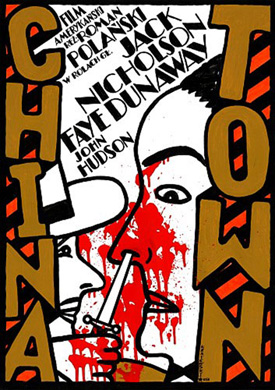
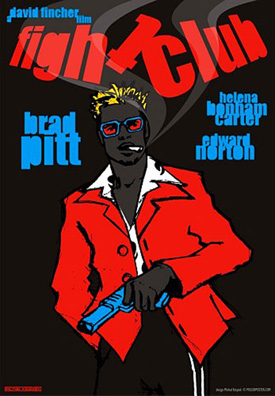
More at The Guardian, which is previewing an exhibition of 50 posters at London’s Cinéphilia West.
-
Remembering 1999, the movie year that was
 Last year I dedicated one of the first formal installments of The Lists to the films of 1999, one of the most electrifying slate of films to come along since Hollywood’s epic 1939 peak 60 years prior. There was an embarrassment of riches, truly, great work from the classic masters, eye-opening new work from future masters and everything in between.
There was exceptional independent filmmaking on display as well as impressive studio offerings. Envelope-pushing was the norm while formulaic studies also seemed curiously refined. As the century drew to a close, it seemed, in some ways, that 1999 would come to represent everything that made the medium so special for its first 100 hundred years.
Over at Movie City News, Noah Forrest has dedicated a new column to the discussion. He can be forgiven, I think, for twisting in the winds of indecision when it comes to pegging a personal best film from 1999, but he also offers a number of other superlatives to honor the films and performances from the year.
-
Those underrated gems of the 1990s
 So here we go again. The 1990s were an odd decade cinematically, ripe with excellent films, ground-breaking work, innovations as well as a large number of duds. There were also films released to rave reviews that never found an audience.
I combed through the decade and came up with 15 films worthy of discussion as the more under-appreciated of the 1990s, though I am positive you will all add immeasurably to the list, as you did with my take on the 1980s.
The independent movement gave us many great films through this span, as well as some formidable new talent, but I must confess I grew tired of the studio slagging through the decade. Among the critical community it became almost a rite of passage. There was some wonderful studio product here and there, of course: “Goodfellas,” “JFK,” “Unforgiven,” “Schindler’s List,” “Apollo 13,” “Saving Private Ryan” and “LA Confidential” are just a few.
My list, in no particular order…
In “Miller’s Crossing,” the Coen brothers do a masterful job of creating a funny and dark gangster film with superb performances from the great Albert Finney, Marcia Gay Harden, and the sleazy John Turturro in a film that gently pulls the audience into its story. Made on the cheap, the art direction and costume designs are great, and that story…man those Coens get so much out of, “What’s the rumpus?”
-
Why does the Academy fear controversy?
 In 1969, the Academy saw fit to give “Midnight Cowboy” the award for Best Picture — a first ever for an X-rated film. Some saw the moment as a bellwether signaling a new dawn for the group, that they were developing a growing acceptance for the films that would start coming at them around this time of creative invigoration in the cinema. But was it really?
I remember somewhere that a high-ranking Academy official stated that if “A Clockwork Orange” won the Oscar for Best Picture they would resign their membership! The film had already won top honors from the New York Film Critics Circle and was nominated for four Academy Awards, among them Best Picture and Best Director. A ground-breaking work, the best of Kubrick’s career, still looking futuristic 37 years later, the film is an obvious masterpiece. But it frightened the Academy for whatever reason.
A year later Bernardo Bertolucci’s “Last Tango in Paris” came along with a galvanizing performance from Marlon Brando and was certainly a better film than at least two of the pictures nomination int he top race, “The Sting” and “A Touch of Class,” yet as expected, the Academy backed away from the film, nominating only Brando and Bertolucci.
What is it in the makeup of this esteemed organization of artists that makes them steer clear controversial films, films that push the envelope, that go further out on a limb than most in exploring dark and sometimes daring subject matter?
-
THE LISTS: Top 10 films of 1999
 Remember that Entertainment Weekly cover from November of 1999? The headline boldly proclaimed: “The year that changed movies.” Indeed, it has become nearly a cliche to harp on and on about those 12 months of solid product as a time not equaled since the glory year that was, 1939, but to many, the truth was the truth. 1999 was the best year for films in a long, long time.
And it wasn’t a microscopic view of “quality” either. A broad net was cast, from genre successes aplenty to art house sensations, both finding equal play in the film awards circuit that year. And so it is that hammering out a list of the 10 best constitutes to be a pastime of sorts for the movie lover, especially those like me who were experiencing an awakening of sorts around that time.
1999 was my first year of film school — the dark ages, as I like to call them (because I’ve come to know film school as a fool’s errand of sorts, an education not easily passed from one person to the next but better learned through trial and tribulation). But I was still an eager, unjaded soul and took a trip to the local theater one day with a troupe of friends for our own double feature: Sam Mendes’s “American Beauty” and David O. Russell’s “Three Kings.” It was our first real understanding of the year that had been unfolding right before our eyes.
“American Beauty” has, of course, aged quite poorly, though Russell’s Iraq war film remains a staple of sorts, a unique blip in a consistently uneven genre. This was already the year that had seen the release of the first “Star Wars” installment in over 20 years (however disappointing), the last great exhibit from the portfolio of the cinema’s greatest artist (Stanley Kubrick’s “Eyes Wide Shut”) and a science fiction masterpiece that owed as much to William Gibson as anything else (at least those ideas were making it to the screen).
Moreover, this was a cinematic year that would see releases from more top-tier directors than any other year: Kubrick, Scorsese, Lucas, Lynch, Allen, Fincher, Burton, Leigh, Minghella, Anderson, Almodóvar, Mann, Lee, Stone, Jordan, Sayles, Soderbergh, Forman, Burton, Pollack, Darabont and Howard, while simultaneously launching the exciting careers of untold newbies. The range of quality, as expected, was certainly wide, but that all of these guys were in neck deep in their work during the same stretch of time had plenty to do with the perception of 1999, then and now.
So with that, I felt that this week’s top 10 list (a Tuesday regularity now, if you haven’t been keeping score) would address 1999, the year that was. Here are my picks:
 10. “Three Kings” (David O. Russell)
David O. Russell is a visionary of sorts, but he seems to always be right at the surface, just about to break through with an unyielding brilliance, never fully harnessing the wicked talent he clearly has. But for a brief moment in the fall of 1999, he discovered an outlet in this Iraq War dramedy that became more famous for its off-screen drama than what unfolded on-screen. Pity, because I would rank “Three Kings” in a list of the 10 greatest war films ever made without flinching. George Clooney, Mark Wahlberg, Spike Jonze and Ice Cube headlined a sprawling cast that probably deserved some ensemble attention. -
Edward Norton and the not-so-jolly green giant
 What can be said of the fearless Edward Norton, who recently became an on-screen comic book hero? I never understood his choice to take on the role of Bruce Banner, a.k.a. The Incredible Hulk. And now, post-release, I’m still puzzled.
He walked into a franchise that became a fast mess just five years ago. And according to IMDb, he turned the role down back then. Given the actor’s commitment to characterization in his performances, it makes sense that he would turn the other cheek. After all, so much of Bruce Banner, or at the least what audiences might want to see, is a technological creation. Unlike any of the characters in “Iron Man” or in the upcoming “The Dark Knight,” Mr. Norton doesn’t get to sport a good makeup job and put his true talents on display. He has to disappear all together. It seems so unlike him.