In Contention

Tag: No Country for Old Men

  • New ‘Drive’ posters

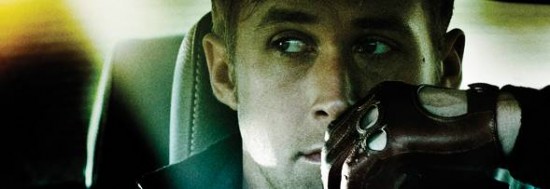
    Or, as a “Top Chef” contestant might title this post, “Drive” Four Ways. The US teaser poster for Nicolas Winding Refn’s Cannes winner unveiled a couple of weeks ago — the one that handily doubles as the cover for Ryan Gosling’s upcoming workout DVD — met a mixed reception. Some liked the kitsch, star-centered romanticism of it (though I can’t top Nick Davis’s “Aaron Carter inspirational cassette single” analogy), while many others thought it did an inadequate job of selling the film’s genre components. The film’s a fast-car thriller — where were the cars? And the thrills?

    Those objectors should be appeased by the film’s new US and UK one-sheets, both of which retain The Gosling Factor while shading in a little more of the action-film context. (A faint hint of camp is still present in the film’s trademark hot-pink cursive.) The US poster wins on the design front — and props for including a glimpse of the film’s key fetish object, Gosling’s leather driving gloves — but loses major points for recycling a tagline indelibly attached to “No Country for Old Men.” What were they thinking? Check ’em out after the cut.

    (more…)

  • THE LONG SHOT: It was always you

    “Let me get this straight. The one’s about a precocious computer geek who’s also a bit of an asshole.”

    “Yeah.”

    “And the other’s about King George VI.”

    “Yeah.”

    “And King George VI has a disability.”

    “Well, he has a stutter. I mean, it’s not crippling or anything — ”

    “But it’s an obstacle that needs to be overcome.”

    “Yeah.”

    “And I assume, at the end, he does. And becomes King.”

    (more…)

  • LIFE WITHOUT OSCAR: 2007 and 2008

    Catch up with the idea behind this series here.

    Welcome to the final entry in the Life Without Oscar series. Why call it a day with one, possibly two years left to consider? Well, for one thing, we won’t know which films are going to be snubbed from 2010 for another two weeks (although I’ll bet my house and home that the titles I’d be writing about have no chance). Instead, next week I’ll offer up my Best of 2010 wrap-up, which will be my last scheduled contribution to the InContention site.

    It’s been fun, marveling at the box office performance of “Avatar” together, trying to convince you to watch “Pootie Tang,” and generally engaging in debates through the comments. But we’re not done yet, so let’s keep things moving here.

    “No Country for Old Men” won Best Picture in 2007, in my opinion, the only respectable choice of the decade by the Academy. Then they had to follow it up with “Slumdog Millionaire,” a film that I couldn’t possibly hate more. Of course, more newsworthy among the blogging world was the Best Picture snub of “The Dark Knight,” and the possibly related fact that these would be the last Oscars to feature only 5 Best Picture nominees.

    Also, we decided that “I’ve taken like three pregnancy tests, and I’m forshizz up the spout” was dialogue from the best written movie of 2007. But speaking of best lines, Janusz Kaminski might have my favorite Oscar quip ever while becoming the first cinematographer to present an award- “Suck it, Anthony Dod Mantle.”

    (more…)

  • ‘Amelie’ tops list of decade’s best cinematography

    The folks at Movieline got their hands on a list of the top 50 films of the decade, from a cinematography standpoint, as laid out by voters at American Cinematographer magazine. Topping the list: Bruno Delbonnel’s work on “Amelie.” Delbonnel is a favorite among DPs. After all, “A Very Long Engagement” won him the ASC honor in 2004 and he received his third Oscar nomination of the decade for last year’s “Harry Potter and the Half-Blood Prince.” But it’s still a surprising call.

    Another delightfully unexpected pick is Jeff Cronenweth’s lensing of “Fight Club,” but I was personally irritated to find John Toll’s serene, thematically potent work on “The Thin Red Line” go completely unrecognized in the top 10 (he finally shows up at #17).  I’d also say Roger Deakins, though at his usual top notch on “No Country for Old Men,” probably should have seen top 10 representation for “The Assassination of Jesse James by the Coward Robert Ford” instead.  His work on the western just misses at #11.

    I’ve been asked many times to offer up a list of the top 10 shots of the decade as a bonus to my annual top 10 shots of the year columns, but I don’t think I can do it.  For one thing, it’s obviously a ton of work, but with so many shots in so many movies, I just think it would be tough to whittle it down.  Too tough.

    Check out the full list from American Cinematographer after the jump.  (Note they’re picking from 1998 to 2008).

    (more…)

  • THE LISTS: Top 10 Oscar nominee fields

    Ralph Fiennes in Schindler's ListIn exactly one week’s time, we’ll have a brand new list of Oscar nominations to pore over, pick apart and eventually file away in our subconscious with the other 81 editions of this annual collective. For Oscar geeks, nomination day is in many ways more exciting than the ceremony itself, celebrating a broader spectrum of work and throwing up far more surprises along the way.

    For all that, once the winners are announced, the nomination list as a whole tends to be disregarded, returned to only by trivia buffs and the geekiest of Oscar geeks. (Guilty on both counts.) And that’s shame, because a field of five nominees can often be more illuminating viewed collectively than even the worthiest of individual champions.

    Today’s list, then, is devoted to that most elusive of Oscar holy grails: the perfect nominee field.

    Yes, more often than not, the Academy will nominate several notable achievements in a single category. But rarer than hen’s teeth are the robust Oscar categories that feature a full house of five outstanding nominees, five contenders that would all be worthy of a win in any other year. No unremarkable coaster nominees sliding in on the coattails of a popular picture. No bad films with an expensively studio-bought  nominations. No filler. No fat. Just five superb achievements.

    (more…)

  • LAFCA picks the top 10 films of the decade

    Laura Elena Harring in Mulholland DriveYou can never have too many of these, right?  Right?

    Right?

    1. “Mulholland Drive”
    2. “There Will Be Blood”
    3. “Eternal Sunshine of the Spotless Mind”
    4. “Brokeback Mountain”
    5. (tie) “No Country for Old Men” and “Zodiac”
    6. “Yi Yi”
    7. (tie) “4 Months, 3 Weeks and 2 Days” and “The Lord of the Rings”
    8. “Spirited Away”
    9. (tie) “United 93” and “Y Tu Mama Tambien”
    10. “Sideways”

  • Guy’s top 50 of the decade: #21-30

    Maggie Cheung in In the Mood for LoveA little late, but we’re at the halfway mark now, and I must say I couldn’t be more delighted and flattered by your warm response to the list so far.
    I mentioned in my intro to the first installment that I’d prefer you to view this as a loose playlist than as a rigid ordered assessment, and I’m thrilled that some of you have already taken me at my word, seeking out less-seen titles like “Last Resort” on Netflix and the like. On behalf of the movies, I thank you.

    With that said, today’s bracket of ten perhaps offers less buried treasure than yesterday’s, even turning up a pair of Best Picture Oscar winners. Hey, sometimes films get popular for a reason — I’m not such a snob, after all.

    That said, I suspect at least one of the following inclusions might prompt some healthy disagreement. The list continues after the cut.

    (more…)

  • Cormac McCarthy on adaptation and ‘The Road’

    Cormac McCarthyAs much as John Hillcoat’s filmization of Cormac McCarthy’s “The Road” didn’t work for me, I think it remains one title that could spring a surprise or two this awards season. Though the film has some high-profile detractors including Todd McCarthy and Roger Ebert, many have been profoundly affected by the film, while its prestigious cache is beyond dispute.
    Helping the cause is that Cormac McCarthy, the estimable author of the Pulitzer Prize-winning source novel, is fully behind the film.

    Today’s online must-read is an extensive Wall Street Journal interview with McCarthy, in which he discusses his own personal investment in the novel — much of which is directly inspired by his own relationship with his son — and the decade-long relationship between Hollywood and his writing.

    McCarthy has a healthily hands-off approach to adaptations of his work, bluntly stating that once the rights have been sold, “you don’t embroil yourself in somebody else’s project.” Claiming to have had confidence in Hillcoat from the outset, he goes on to say that the filmmakers “absolutely” caught the spirit of his novel.

    (more…)

  • THE LONG SHOT: Don’t look back in anger

    Jake Gyllenhaal in Brokeback MountainFor all the movement in the awards game this week – Jeff Bridges leap-frogging into contention, the animation race swelling to five nominees, “Precious” continuing to gather momentum – my head hasn’t really been in it this week.
    That’s partly because we’re all still making blind prognoses until four unseen juggernauts – “Nine,” “Avatar,” “The Lovely Bones,” and “Invictus” – finally deign to show their faces. And partly because I’m only looking forward to one of those titles with sincere movie-fan enthusiasm, as opposed to professional curiosity. Sometimes you just get the wholly subjective feeling that it isn’t going to be ‘your’ Oscar season – and while I’m not there yet, the fear is setting in.

    So, with no current awards developments getting me particularly enthralled or incensed, I’ve spent most of my time lately in a reflective state. With ‘best of the 2000s’ lists already coming thick and fast, and my DVD trawl through the decade’s leftovers for my own list in full swing, Oscar’s own performance over the last 10 years has been on my mind.

    As I discussed in this space a few weeks ago, it’s been a slightly schizophrenic decade of Oscar winners, one that has blurred long-held definitions of “Oscar-bait.” One does have to wonder about the identity or cultural relevance of any group that can alternately celebrate such disparate achievements as “Slumdog Millionaire,” “Gladiator” and “No Country for Old Men.” Who are these people, and what do they know?

    (more…)

  • THE LONG SHOT: Critical condition

    Gabourey Sidibe in PreciousAhead of its U.S. release this week, there is a wave of mild surprise in the blogosphere over the fact that “Precious,” the film deemed by some (yours truly included) to be the present Best Picture frontrunner, is currently sitting on a lowly Metacritic score of 57. Fitting neatly with the largely media-fabricated talk of a backlash against the film, some commenters are citing this rather arbitrary number as a debit against the film’s chances.
    As much as I’d personally like that to believe that — and as relieved as I am to see that I’m not the only person who didn’t respond to the film – such talk will doubtless be short-lived, given the paucity of reviews making up the current score and the likelihood of raves to come. If anything, public support is more crucial than critical consensus to this film’s campaign – if audiences don’t turn up to see this grim, minority-oriented indie, many Academy members won’t feel compelled to either.

    That said, it looks increasingly possible that “Precious” (I refuse to use that lumpy subtitle all season, by the way) could turn out to be a more critically divisive item than might have been expected following an ecstatically received festival run.

    (more…)

  • “We’re going to be fine.”

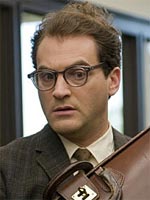
    Michael Stuhlbarg in A Serious ManThose of you who enjoy it when Kris and I butt heads over one film or another — as on the two occasions this past week alone that I’ve been unceremoniously fired — will be disappointed to hear that an entente cordiale has arrived in the shape of “A Serious Man.” (Ironic, really — since when did the Coen Brothers make movies designed to bring people together?)

    Anyway, while I don’t know yet whether my passion for the film will run quite as deep as Kris’s by the year’s end, I have no qualms whatsoever about echoing his sentiments that “A Serious Man” is an extraordinary feat.

    Novelistic in its reach and rhythms, but intrinsically cinematic in the way Roger Deakins’s calmly predatory camera investigates physical and personal space, it seems a direct (if deliciously perverse) rebuttal to claims made by the duo’s detractors that their films are overly hermetic, unwilling to engage with the world around them.

    (more…)

  • A new, diminished Miramax era

    MiramaxI’ll have to just say it: this is sad.  Just from a movie-goer, awards-watcher standpoint.  Miramax has indeed been “folded-in” at Disney for about a year, as David Poland notes in his characteristic “nothing surprises me” fashion.  And Greg Ellwood has put together a nice analysis of the event over at his Awards Campaign blog at HitFix.  But beyond all that, it’s just…a bummer.
    After all, it’s something of an end of an era for awards obsessives.  Miramax dominated the 1990s under the Weinstein brothers who founded the company, acquired by Disney in 1993.  The run is legendary, of course, and changed the way awards campaigns would be structured for years to come.  But even with the brothers’ departure in 2005, it seemed there could be a spark of renewal in the brand.

    2006 saw the first post-Weinstein Best Picture nomination in Stephen Frears’s “The Queen,” and a year later, “No Country for Old Men” took the Oscar, the first Miramax win since 2002’s “Chicago.”  But the slate of upcoming releases was increasingly thin, and now, the company has been downsized considerably.  Anne Thompson also has more details.  In a nutshell, though, Miramax, as we’ve known it for two decades, is no more.

    And like I said, it’s sad.  The changing face of the industry right now was both inevitable and necessary, but it’s going to be a bit weird to see this former awards giant virtually (if not completely) absent from the Oscar landscape.

  • The Coens abide

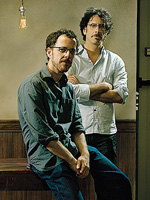
    (from left) Ethan Coen and Joel CoenI’ve been chewing on the Coen brothers’ “A Serious Man” like a thick piece of spiritual jerky ever since I walked out of the Clariety screening room in Beverly Hills yesterday evening.  I’ve retweeted other perspectives, exchanged emails with industry types equally leveled by it and, in my own way, started banging the drum for a film I think everyone should see.
    It’s sticking with me in the best of ways, I guess you could say.  It’s illuminating unexpected corners.  It really is settling in and staying there.

    So I was quick to devour this piece in The Toronto Star by Chicago Sun-Times religion columnist Cathleen Falsani.  Falsani is also the author of the book “The Dude Abides: The Gospel According to the Coen Brothers,” which explores the spiritual messages found in the Coens’ films.  So she was more than qualified to write up the siblings’ most personal and, certainly, most spiritual film to date.

    (more…)

  • An idle rant for a Sunday morning…

    … but one that’s been simmering inside me for some time. Who the hell are the numbskulls who select the pull quotes for DVD cover art? Do they get paid for their efforts? If so, why? And what in God’s name are they reading?
    I know it’s a trivial concern, and it’s not entirely limited to the DVD side of things: there are any number of theatrical one-sheets out there with the most mind-bogglingly (pick the relevant combination) banal/inappropriate/lazy/barely creditable selection of critical endorsements graffitied over their increasingly uninspiring designs.

    But it’s for DVD that the marketers involved produce their biggest headscratchers, going blindfolded as they select the most random possible quotes from the most unimpressive sources, seemingly oblivious to the fact that they’re actually trying to sell the movies to punters.

    (more…)

  • PAGE TO SCREEN: “The Road” by Cormac McCarthy

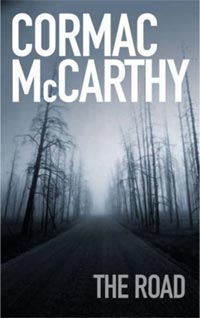
    The RoadWe’re working from the outside in on this one, folks. You may recall that Brian Kinsley offered a thorough examination of Joe Penhall’s “The Road” screenplay for this column back in September last year, which already addressed many of the challenges inherent in this particular adaptation.
    However, in keeping with Page to Screen’s return to discussing source material rather than scripts – and with John Hillcoat’s film on a lot of people’s minds this week – I thought it a good time to take another look at Cormac McCarthy’s much-garlanded novel. I should specify that I have neither read Penhall’s adaptation nor seen the film; the novel is the only text with which I am engaging at this point.

    It seems only fair to start with a blunt, and admittedly very guilty, confession: I don’t very much like McCarthy’s novel.

    Before the irate attack begins, let me clarify that this statement is not in any intended as a challenge to “The Road’s” literary worth, much less its potential for successful filmmaking. It is, in its paradoxical construction of loose, virtual shaggy-dog-style narrative and terse, urgent prose, an indisputably awe-inspiring novel, one that at once gazes into the back-to-back mirrors of who we are and who we will be, and arrives at some discomfitingly vivid prophecies in the process.

    I commend McCarthy’s avoidance of didacticism and rationalisation: the novel’s grim, apocalyptic future is presented as a terrifying inevitability rather than a cautionary allegory, offering no concrete indication of what led humanity to the long-desecrated point at which the narrative begins.

    That may not make the novel as ideologically constructive as the kind of “it takes a village” finger-pointing that colors so many other literary and cinematic warnings of man’s imminent self-destruction – the film, when it finally arrives, would surely make for an interesting double-feature with Andrew Stanton’s “WALL-E” – but it is certainly a much more jolting, unnerving experience for it.

    (more…)

  • Tell me something good

    I quite enjoyed this NYT series of “memos to Hollywood” from Manohla Dargis and A.O. Scott, which include some well-deserved chiding of the Internet, the MPAA ratings board, and romantic comedy producers, among others. But I was disappointed that when it came to the ever-popular sport of bashing the Academy Awards, Scott only had this tired argument to hand:

    It’s just not working: the Academy Awards broadcast, with its mixture of snark and high-mindedness; the pool of pseudoserious, faux-prestigious specialty-division B-pictures; the long, dreary slog of the awards “season.” You’re losing touch with the mass audience on one side and the tradition of popular art on the other. Take some risks, rejigger the formula, expand the membership pool. Do something!

    He’s not wrong, exactly: we can all fill page upon page with a list of the Academy’s recurring failings. Year after year, they demonstrate an aversion to both daring specialist cinema and successful genre work that renders them irrelevant as a yardstick of artistic worth — but it was ever thus. (And to be fair, both critics’ groups and festival juries are capable of making blindingly short-sighted decisions on occasion. Awards are a fundamentally problematic institution, whoever dishes them out.)

    (more…)

  • And now for something completely different

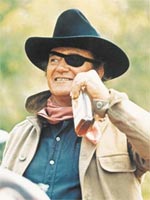
    Never let it be said that the Brothers Coen are predictable in their choice of projects. Having had their greatest crossover success to date with a film that dabbled in elements of the genre, Variety reports that they are set to make their first all-out Western — a remake of that hoary 1969 oater “True Grit,” best known today as the film that finally won John Wayne his gold-watch Oscar.

    On the surface, this isn’t the most promising of prospects — the story of a teenaged girl joining forces with a crotchety, aged US marshal to avenge her father’s death, the original “Grit” was a creaky, sentimental work that must have appeared dated even in its own time.

    But the Coens, obviously, are promising an interpretation far removed from that of Henry Hathaway’s film. Their intention is apparently to hew closer to Charles Portis’ source novel, telling the story from the girl’s perspective and placing less emphasis on the veteran character — which sounds like an improvement to me already. I admit I’ve never read the novel, though I gather it’s got harder edges than the 1969 adaptation.

    Encouragingly, the Paramount production will reteam the brothers with “No Country” producer Scott Rudin. Apparently, this project takes priority over their Rudin-produced adaptation of Michael Chabon’s “The Yiddish Policeman’s Union” that was being mooted — which, frankly, I’d have been more interested in seeing. But the Coens work in mysterious ways, so my mind is open.

    Finally, here’s a good omen: the last time they attempted a remake, they took on a masterpiece (“The Ladykillers”) and fell on their faces. Perhaps tackling a lesser work should reap greater rewards.

  • What does it all mean?

    Kate Winslet in The Reader“Pictures at a Revolution,” Mark Harris’s smart, keen-eyed study of the cultural implications of the 1967 Best Picture race, is without a doubt one of the best books ever written on the subject of the Academy Awards. So it’s hardly surprising that Harris, in a piece for yesterday’s Observer, has provided the most intelligent take on this year’s awards race to date.

    What’s particularly interesting is that, while he just wrote an entire volume on the countercultural meaning of a Best Picture race in a pivotal year in Hollywood history, he’s quick to avoid such a unified reading of this years nominees — effectively and wittily debunking several trends that many Oscar-watchers have attempted to glean from the crop:

    1) The Academy has a new, more global outlook, represented by the 10 nominations given to Danny Boyle’s Slumdog Millionaire. Alternatively, the Academy suddenly has a new, more insularly American outlook, as evidenced by the fact that 17 of the 20 acting nominees are from the US, the most since the early 1990s.

    2) The “gay mafia” in the Academy, outraged by the passage of the anti-gay marriage amendment Proposition 8 in California, powered the gay-rights drama Milk into the race with eight nominations. However, it will never win, because the Academy is hopelessly homophobic, as we all are presumed to have learned when Brokeback Mountain lost to Crash.

    3) In a time of great economic uncertainty for the major studios, Hollywood reasserted its authority by bestowing 13 nominations on the high-grossing, high-budget product of two conglomerates, The Curious Case of Benjamin Button. But the Academy simultaneously renounced any interest in supporting studios or representing popular taste by snubbing Christopher Nolan’s blockbuster The Dark Knight, excluding it from consideration for best picture, director or screenplay.

    (more…)