In Contention

Tag: Million Dollar Baby

  • LIFE WITHOUT OSCAR: 2003 and 2004

    Catch up with the idea behind this series here.

    2003 belonged to “The Lord of the Rings: The Return of the King” as it won every single award it was up for, tying the all time record haul of 11 trophies. Few could argue that Peter Jackson had accomplished something unique with the execution of this trilogy, but in my humble opinion, this is the most boring and bloated Best Picture winner since “Around the World in 80 Days.”

    Throw in the fact that Tim Robbins in “Mystic River” and Renee Zellweger in “Cold Mountain” are both embarrassingly bad performances and you can start to realize why Oscar and I have agreed to go our separate ways. At least “City of God” nabbed a few nominations, causing a stir in an otherwise sterile race.

    Clint Eastwood completed his transformation back into Oscar darling in 2004 with a Best Picture triumph for “Million Dollar Baby,” which also scooped up awards for Director, Actress and Supporting Actor, dooming Martin Scorsese to another year in the loser’s bracket.

    Billy Crystal hosted in 2003, mistakenly thinking that constant jokes about New Zealand were going to be entertaining. At least we had this though.

    Chris Rock took the reigns in 2004 and may have not won over Sean Penn, but I thought his bit interviewing moviegoers at the Magic Johnson theater about Oscar contenders was amazing. Anyway, hope you all watched “Pootie Tang” this week and are ready for some new suggestions.

    (more…)

  • THE LONG SHOT: Follow the leader

    [Updated Oscar predictions here.]

    Hey, have you heard of this movie called “The Social Network?” You should probably check it out. It’s about Facebook and stuff and it’s supposed to be really good. So good, in fact, that it’s managed to tame the single most argumentative species in the animal kigdom, The Lesser Spotted Film Critic, into silent agreement. Of the 12 American critics’ groups to dish out awards so far, 11 have given their top honor to the film. (“Winter’s Bone,” you say? Get with the program, San Diego.)

    The enthusiasm for the film, of course, extends beyond the sometimes soundproof critics’ chamber, as less distinguished media collectives like the HFPA and the BFCA have voiced their approval – while this morning, give or take a Supporting Actor snub, the film passed its first industry award test with two key Screen Actors’ Guild bids. Expect the Directors’, Producers’, Writers’ and Editors’ Guilds to follow suit in the New Year.

    So, we can basically tie a ribbon around Oscar’s neck and hand him over to Scott Rudin and David Fincher now, can’t we? After all, against all its on-paper disadvantages, “The Hurt Locker” was in a similar position this time last year, and it didn’t budge, did it? (Indeed, it didn’t even unite the critics’ groups to this extent – of the 12 awarding bodies I mentioned above, only five selected Kathryn Bigelow’s Iraq actioner last year.) Scarcely anyone has a word to say against the film, so let’s sit back and let the sweep wash over us, right?

    (more…)

  • THE LONG SHOT: Bait, switch

    Whether you choose to believe them or not – and speaking for myself, I don’t quite – the media powers that be have currently reduced the 2010 Best Picture race to just two titles: “The Social Network” and “The King’s Speech.” That’s entirely (and hopefully, lest things get too dull too soon) subject to change over the next four months, but given what we’ve seen at this point, it’s difficult to devise a could-win theory for many of the films most fancied for the remaining eight slots, be it “Inception” or “Another Year.”

    I don’t really blame those in the blogosphere who are narrowing things down to this pair of films: after a lackluster Toronto fest failed to turn up a hidden dragon along the lines of “Slumdog Millionaire,” the slate of contenders looks much as it did before the fall festival season began. With expectations for “Network” and “Speech” pegged high all along, meeting them was enough to seal frontrunner status.

    Moreover, the temptation to pit David Fincher’s modish Facebook story and Tom Hooper’s tony royalty porn against each other is hard to resist, given how conveniently the films are opposed: both acclaimed biopics after a fashion, but one concerned with present-day American youth, the other with British aristocracy of yore. “It’s the time-capsule piece versus the time-warp piece,” snarked one friend of mine recently, anticipating a narrative that will likely run all season, even if other frontrunners enter the fray.

    (more…)

  • The new millennium Oscars?

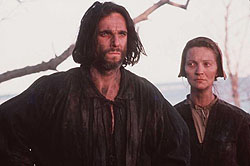
    Viggo Mortensen in The Lord of the Rings: The Return of the KingLooking back over the previous Oscar winners for Best Picture since 2000, the start of a new century (and a new millennium), I find myself wondering sometimes what the hell the Academy was thinking.  It’s no secret I disagree with the Academy a lot, but I can also admit that when they get it right, they get it right.
    But since 2000, their Best Pic choices have run the gamut from incredibly ridiculous, “Gladiator” and “A Beautiful Mind” being just goofy, to bang on, with “The Departed” and “The Lord of the Rings: The Return of the King.”  I am told the Academy is moving in a more progressive direction, willing to take more risks, and I suppose some of these winners do just that.  But they could have gone further.

    Year by year, here’s a quick look, with some thoughts about who might have won, and who should have at least been nominated…

    (more…)

  • THE LISTS: Top 10 ‘right actor, wrong film’ Oscars

    As we head into the thick of awards season, one of the biggest “will-they-won’t-they” questions about this year’s Academy Awards concerns one of their most favored sons, Clint Eastwood. Specifically: despite wildly polarized responses to the film, and a widespread perception that he has already been amply rewarded in other categories, can Eastwood ride the wave of sentiment to a first acting victory for “Gran Torino?”

    That sneaky National Board of Review award last week suggests it’s still very much a possibility, whether or not people believe that it’s a performance for the ages — and, more to the point, whether or not it ranks with the best of Eastwood’s own onscreen work.

    It’s no secret that, in the acting races, the Academy frequently bases their vote less on the performance at hand than the actor delivering it — one can point to any number of Oscar victories determined less by merit than by personal affection for an already rewarded star (let’s say Michael Caine in “The Cider House Rules”) or industry guilt over an under-rewarded one (most recently, Alan Arkin in “Little Miss Sunshine”).

    Meanwhile, recent victories by the likes of Russell Crowe and Cate Blanchett point to the familiar “deferred-Oscar” syndrome, where an actor widely believed to have been snubbed in the recent past is hastily handed a statuette as a kind of cumulative acknowledgment of their recent strong work, frequently for a performance that doesn’t represent any particular breakthrough. (Kate Winslet might be vying for one of those this year.)

    All are variations of the oft-lamented “right actor, wrong film” Oscars that are peppered throughout Academy history — a solution generally deemed more credible (though I’m not sure why) than the honorary “quick, before they die” lifetime achievement gongs doled out to the likes of Peter O’Toole and Kirk Douglas, actors who continually slip through the cracks in Oscar voting.

    Age isn’t always the determining factor, though.  The Academy has shown in recent years by passing over Lauren Bacall and Ruby Dee — both of whom would have been exemplary “right actor, wrong film” honorees — they’re not always in a sentimental mood.  As the following list shows, reasons for rewarding actors for lesser work are many and varied: genre bias on the Academy’s part, mainstream emergence on the actor’s, or simply the voters’ collective nostalgia for a familiar face at the podium.

    The one thing all these names have in common is that they’re distinguished, even great actors who deserve to have “Academy Award winner” forever attached to their monikers — just not necessarily for that performance. Will Clint Eastwood be the latest name to join their ranks? The jury is out.

    (more…)

  • ‘Gomorrah’ and ‘Changeling’: two that work

    Angelina Jolie in ChangelingIt’s been a while since I’ve committed to a long-form review, and for that, I have to apologize.  Short Takes here and there don’t exactly cut it, but we’ve certainly stayed afloat in this light with Guy’s wonderful work across the pond.  I don’t get a chance to sit down and hammer out some thoughts very often, and I’m hoping that will change in the coming weeks.
    Two films that jumped out this week, however, demanded some attention.  The first is Matteo Garrone’s “Gomorrah,” which I saw recently in preparation for the AFI Fest.  The film was well-received at Cannes and has become Italy’s entry in the Best Foreign Language Film Oscar race.

    I have to say, I’m in agreement with Guy’s assessment for the most part.  Garrone’s patch-work narrative might seem trite and even trendy at first mention, but the menagerie works because it isn’t pretentious.  There is no sense of contrivance or expressed intent to make these five separate narratives comment toward one another or intersect in a nifty manner.

    The assemblage is borderline slap-dash and is more impactful as a result.  In a sense, Garrone has cooked up five tense, detailed short films and simply sifted them together.  All roads lead to nowhere, and a list of sobering Camorra facts at the end of the film really sticks with the viewer — especially that last doosey.

    (More on “Gomorrah,” plus thoughts on “Changeling” after the jump.)

    (more…)

  • Reading ‘Gran’

    I’m about half-way through Nick Schenk’s script “Gran Torino,” the Clint Eastwood surprise of 2008 waiting to jump up and bite us all in the ass this December.  So far it’s a really casual, satisfying read.  Some bumps in the first act as Schenk has some trouble settling into the style of the narrative, the consistent racial slurs and the hard-ass Walt Kowalski character (to be played by Eastwood), but it settles in soon enough.

    Kowalski is an interesting mix of Paul Newman’s Sully from “Nobody’s Fool” and Eastwood’s own portrayal of Frankie Dunn in “Million Dollar Baby.”  Maybe even a dash of Walter Matthau’s Max Goldman thrown in.  In fact, I’d place “Torino” right in “Baby”‘s wheelhouse so far, lots of that young-people-shedding-light-on-an-old-codger’s-life stuff going on.

    More on Tuesday, when we review “Gran Torino” in our Page to Screen column.

  • And often, the Academy gets it right…

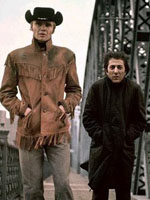
    United Artists' Midnight CowboyAs much as I rant about some of the bizarre choices made by the Academy, let’s be fair…there are times when they are right on the money.

    The AMPAS allowed for an embracing of the New American cinema with their awards for Best Picture and Best Director for “Midnight Cowboy” in 1969, and only they had the courage (and the smarts) to recognize that “The Godfather Part II” was a superior film to the first in handing it the same two trophies. They had awarded “The Godfather” Best Picture two years earlier, but much of the precursor circuit (and all of the critics groups) largely ignored the sequel, opting instead for films such as “Alice Doesn’t Live Here Anymore” and “Chinatown,” among others.

    The five awards betsowed on “One Flew Over the Cuckoo’s Nest” in 1975 are among the group’s best choices ever, in particular the honors for actor Jack Nicholson and director Milos Forman.

    Though far too often dismissed as a chick flick, “Terms of Endearment” was a marvelous slice of life that the Academy embraced with five Oscars, including Best Picture, Best Actress, Best Supporting Actor and Best Director. By the way, is it not odd that first time winner James L. Brooks has never again been nominated in the directing category again, despite two Best Picture nominees in “Broadcast News” and “As Good As It Gets?”

    I remember cheering loudly the many wins for “Amadeus,” “Out of Africa” and “Platoon” three years in a row, and though I believe “Goodfellas” is a better film, I was pleased to see a western, “Dances with Wolves,” win seven Oscars.

    No arguments from me between 1991 and 1993, with “The Silence of the Lambs,” “Unforgiven,” and “Schindler’s List” all most deserving winners. And though I prefer “Pulp Fiction,” I understand why “Forrest Gump” took the top prize in 1994.

    Bravo, too, to the Academy for honoring “The Lord of the Rings: The Return of the King,” a bonafide movie masterpiece, and again the following year for “Million Dollar Baby.”

    So you see, for all my bitching (and we all do it…come on), I concede that the Academy does, from time to time, nail the best.

  • Clint Eastwood: the unlikely Oscar favorite

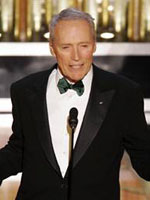
    Clint Eastwood at the Academy Awards in 2005Had anyone said to me in the 1970s that Clint Eastwood would in time become one of the finest and most important American directors in modern cinema, I would have laughed — quite loudly — in their collective faces.
    The star of “Dirty Harry” and “Every Which But Loose?”  The guy who shares the screen with apes?  Are you kidding???  Yet here we are, 37 years after he first pulled that 44-Magnum (“The most powerful hand gun in the world”), and things have changed.  He has won four Academy Awards — two as director, two as producer.  He has been nominated for each on two other occasions and has two Best Actor nominations to his credit as well. He has twice been honored by the Directors Guild of America for and won countless critics awards.

    Eastwood is indeed among the filmmaking elite.  And with the upcoming releases of “Changeling” and “Gran Torino,” he looks primed to flirt with the film awards season yet again.

    While researching my book “Clint Eastwood: Evolution of a Filmmaker,” my respect and admiration for the man has grown considerably. Obviously there was a great deal of admiration to start, otherwise I wouldn’t even begin a bhook on the subject.  But leanring more and more about Eastwood and his work has, understandably, taken things up a level.

    Eastwood challenges himself each time he makes a film.  His choices to act in films such as “Any Which Way You Can” were driven by the fact that he knew the studio would then finance a personal project such as “Bronco Billy.”  What really astounds me, though, is his growth as an actor through the years.

    (more…)

  • Who joins the great Best Picture snubs this year?

    It happens every year, a great film, in some cases destined to be remembered more than the eventual Oscar winner is snubbed for a Best Picture nod, or gets nominated and loses to an inferior film that happened to capture the public’s attention at that particular point in history.

    Some of the greatest films of all time lost the top award, “Citizen Kane” among them, arguably the greatest of all time (though I disagree). “The Treasure of the Sierra Madre”, easily John Huston’s best work, joins the list, as does “The Searchers,” which is in my opinion the finest western ever made and contains the greatest John Wayne performance of all time.

    Remember “Rocky” winning over “All the President’s Men,” “Network” and “Taxi Driver?” Or “Kramer vs. Kramer” over “Apocalypse Now?” In the last twenty years, Oscar has pulled some howlers, some choices that left me nearly putting my foot through the television upon the announcement. The first time I remember being really, truly angry at a lame decision was in 1981 when “Chariots of Fire” bested Warren Beatty’s “Reds,” which I believe to be among the best films of the 80s.

    (more…)

  • Lead actress contenders also join interesting group

    As the piece on actors managed to spark some interest and debate, of course I have to explore the women. Though I am studying just the last 20 years, the Best Actress Oscar has often left some of the greatest performances as mere nominees, or in some cases not even that.

    Katherine Hepburn, though nominated for “The African Queen,” “Summertime,” and “Long Day’s Journey into the Night,” sat at home while others won; sometimes they were deserving, sometimes they weren’t. Gloria Swanson gave possibly the greatest performance by an actress never to win the award with her seething work in “Sunset Boulevard,” easily among the most iconic portrayals in film history. Shall I even mention poor Judy Garland? Robbed of her Oscar for “A Star is Born?” Into the 60s we have Anne Bancroft’s Mrs. Robinson in “The Graduate” and Jane Fonda’s brilliant turn in “They Shoot Horses Don’t They?” — each of them Oscar losers.

    Since 1988, there has been an equal amount of questionable winners in the lead actress category, beginning with Jodie Foster’s win for “The Accused” in a year that saw Mery Streep astound audiences in “A Cry in the Dark,” which won the New York Film Critics Circle award. One year later Jessica Tandy won the Oscar for “Driving Miss Daisy,” besting critics fave Michelle Pfeiffer, who won honors from the LA and NYC critics, as well as the National Society of Film Critics. Insiders had stated that Tandy was destined to win the Oscar the moment she was cast, and indeed she responded with the finest work of her career.

    (more…)

  • Clint Eastwood — anything he does grabs Oscar’s attention

    Let me begin with something very personal, something I prefer not to do in this column. Movies have not mattered much this past week, as my wife of 18 years, the love of my life was diagnosed with a malignant brain tumor. This Thursday we journey to Sunnybrook Hospital in Toronto to allow the finest surgeons in the country to go in and take the tumor out, with the hope she does not have to have chemotherapy or radiation. There is a chance I could lose her, and that I couldn’t bear. The past few days have been a blur, and yet it is her who urged me back to the computer, with a gentle, “You can’t let the movie writing stop because of this…please…write…” God I love that girl. She is at this moment snoozing behind me as I write this.

    Later this year we will see the release of “Changeling,” the latest from Clint Eastwood who over the last 16 years has become one of the finest directors working in movies. Now seriously, had anyone ever told me in the 70s that one day I would be celebrating the works of Eastwood the director by writing a book about him and his work, I would have laughed in their face at the thought.

    Dirty Harry, the man who acted with apes, becoming a world class director? Yet here we are in 2008 and Eastwood has won two Academy Awards for Best Director, twice been honored by the Directors Guild of America, and won countless critics prizes for his work. Revered by actors, beloved by the studios for whom he works, and respected by his colleagues, he has quietly risen to the very peak of the directing world, sitting alongside Steven Spielberg and Martin Scorsese. His films have the lean feel and look of the best work of John Huston and Howard Hawks to whom story was paramount.

    (more…)