In Contention

Tag: Pulp Fiction

  • The kids are NOT all right (or alright, for that matter)

    This post is so unnecessary because it is an obvious lost cause. It really shouldn’t even be enough to get a rise, but in me, it just…does.

    You know, once upon a time the MTV Movie Awards (which are voted on publicly) actually seemed to reflect an edge in America’s youth. Think about it. “Terminator 2: Judgment Day” won the MTV award for Best Picture. “Menace II Society” won the MTV award for Best Picture. “Pulp Fiction,” “Seven,” “Scream,” “There’s Something About Mary,” “The Matrix,” “Napoleon Dynamite,” etc.  Room was even made here and there for prestige pics that tapped a pop culture vein.  “A Few Good Men,” for instance, or “Titanic,” “The Lord of the Rings” trilogy and “Gladiator,” one of only two times the award matched the Academy’s choice.

    And in the last five years?  Scary.  “Wedding Crashers,” “Pirates of the Caribbean: Dead Man’s Chest,” “Transformers” and far and away the two worst films to win a popcorn statue: “Twilight” and “The Twilight Saga: New Moon.” (Why, Bill, why?)  What the hell happened to the MTV audience?  What happened to the kids’ edge?  Who are these people?

    (more…)

  • THE LISTS: Top 10 Tarantino characters

    Christoph Waltz in Inglourious BasterdsIt’s been over a month since we cranked out an installment of The Lists, but with Quentin Tarantino’s “Inglourious Basterds” set for release on Friday, it seemed a good time to cook up a new collective.

    When most people praise Tarantino’s skill as a screenwriter, they tend to focus on his well-honed ear for dialogue.  But I have always been much more enchanted by his ability to create a wide array of separately interesting characters that are nevertheless of a piece with the filmmaker’s pulp sense of the world.

    Each of Tarantino’s films are ensembles of one level or another, usually elevated off the page by the performances he gets out of actor eager to take on something fresh.  And no matter the quality of Tarantino’s work behind the camera, the material is always, if nothing else, unique.

    So a list of the greatest characters ever conceived by the man seemed to be the best course of action.  The list doesn’t merely include characters from Tarantino’s films as a director, mind you.  Those he conceived in original screenplays filmed by other directors were considered as well.  Eight films are featured on the list, two of them twice.

    The only Tarantino-affiliated films that don’t appear are “From Dusk Till Dawn” (a personal favorite that, if I was asked on another day, might show up somewhere) and the “Death Proof” segment of “Grindhouse” (which, if I were feeling particularly generous one day, might yield a mention for Kurt Russell’s Stuntman Mike).

    All other Tarantino extravaganzas are well-represented.  Let’s dig in here…

    (more…)

  • Your ranked list of the 10 most influential films of all time

    Citizen KaneAnd with that, our poll series comes to a screeching halt.  I’ve already offered some thoughts on how all of this turned out.  I hope readers unfamiliar with some of the films I’ve been harping on will take that to heart and at least seek them out.  You owe it to yourself as a film lover, believe you me.

    Here is your ranked list.  For background on all of these shenanigans, click here.  I want to thank everyone who participated in the polls and made this a real community effort.

    1. “Citizen Kane” (Orson Welles, 1941)
    2. “Star Wars” (George Lucas, 1977)
    3. “2001: A Space Odyssey” (Stanley Kubrick, 1968)
    4. “The Godfather” (Francis Ford Coppola, 1972)
    5. “The Wizard of Oz” (Victor Fleming, 1939)
    6. “Psycho” (Alfred Hitchcock, 1960)
    7. “Jaws” (Steven Spielberg, 1975)
    8. “Pulp Fiction” (Quentin Tarantino, 1994)
    9. “Snow White and the Seven Dwarfs” (David Hand, 1937)
    10. “Toy Story” (John Lasseter, 1995)

    Honorable mention: “Annie Hall,” “Apocalypse Now,” “Battleship Potemkin,” “The Birth of a Nation,” “Casablanca,” “The Godfather Part II,” “Gone with the Wind,” “The Matrix,” “Metropolis” and “Rashomon”

    One of these days I’ll cook up my own list.  Until then, once again, thanks for participating.

  • POLL: The most influential films of all time, round one, part five

    I’ve got family coming into town this afternoon, and since this week’s poll had three runaway winners in “2001: A Space Odyssey,” “The Godfather” and “Pulp Fiction,” and I doubt three more hours will close the gap on the stragglers (poor “Jurassic Park”), I think it’s time for a new installment.  Next week will be the final round one poll and we’ll be closer to the end and your view of the 10 most influential films of all time.

    Once again, check the background on this series here.  Have a look in the left sidebar and chalk up no more than three films to survive and move on to the next round.  This week should make for an easier selection than last week.  As always, though, it’s a random assortment.  Blame the fates if you find yourself facing a Sophie’s Choice.

  • Just the one, then?

    Quentin TarantinoYou may or may not have caught this piece on Quentin Tarantino in Sunday’s New York Times magazine. Overall, it’s a fairly flimsy Cannes-oriented interview that serves mainly as an accompaniment to some pretty pictures (very pretty, in the case of the Diane Kruger shots), but two of QT’s statements jumped out at me.

    In the first, he (fairly, I think) defends his decision to hand “Fahrenheit 9/11” the Palme d’Or in 2004 as a reward for being “a movie of the moment” — but when the conversation turns to “Inglourious Basterds,” he offers up this line:

    NYT: On this movie, you worked very quickly. Was that partially to have the film ready in time for Cannes?

    QT: Yes. I wanted to have a masterpiece before the decade’s out.

    I’ll let slide the overweening pride of Tarantino’s statement for a moment — partly because, as many misgivings as I personally have about the new film, it’s that brash confidence that also gave birth to a genuine masterpiece like “Pulp Fiction.” Largely, however, it’s because I detect a note of cryptic self-deprecation there.

    Perhaps I’m reading too much into his wording. But the use of the indefinite article “a” rather than, say, “another,” intrigues me. Is he admitting that, “Basterds” aside, he hasn’t made a masterpiece this decade? If so, on behalf of “Kill Bill: Vol. 1” — and only that, I hasten to add — I’d like to disagree.

  • Could Woody Allen be a surprise Best Director nominee?

    Woody Allen at the 2002 Academy AwardsIn 1994, Woody Allen’s masterful “Bullets Over Broadway” was not really on anyone’s charts as a potential Oscar nominee. A very funny film about a playwright who enlists a gangster to help him bring life and reality to his play, it was one of Allen’s best works with hysterically funny performances from John Cusack, the great Dianne Wiest (who won an Oscar), Chazz Palminteri, Jennifer Tilly, Jack Warden, Mary Louise Parker, Rob Reiner, Jim Broadbent, and Tracey Ullman. The film premiered here at the Toronto International Film Festival with excellent reviews, but it seemed overshadowed that season by Quentin Tarantino’s “Pulp Fiction,” without question the movie of the year.

    The day the Academy Award nominations were announced, as expected, “Forrest Gump” and “Pulp Fiction” dominated, but in a huge surprise, Allen’s film was up in seven categories including Best Director, Best Screenplay, Best Supporting Actor (Palminteri), Best Supporting Actress (Weist and Tilly) and a couple of technical awards.

    I have always believed the film to be one of Allen’s funniest and finest films, with beautifully created characters and knockout performances throughout. Wiest is miraculous as a manipulative diva seducing the director/writer portrayed by Cusack because she knows it to be the only way to create a better character for herself. Her “don’t speak” becomes more and more insane throughout the film.

    I have always felt the film was robbed of a Best Picture nomination, likely edged out by “Four Weddings and a Funeral,” but it really did not matter as “Forrest Gump would dominate the ceremony.

    This year, Allen has directed and written a critically acclaimed film in “Vicky Christina Barcelona,” with a powerhouse performance from Penélope Cruz (the Oscar frontrunner), and solid work from Javier Bardem, Rebecca Hall, and Scarlett Johansson (two of them Golden Globe nominees). The film is funny, sexy and dangerous, both vintage Allen, but also a newer, darker Allen, a director evolving.

    (more…)

  • And often, the Academy gets it right…

    United Artists' Midnight CowboyAs much as I rant about some of the bizarre choices made by the Academy, let’s be fair…there are times when they are right on the money.

    The AMPAS allowed for an embracing of the New American cinema with their awards for Best Picture and Best Director for “Midnight Cowboy” in 1969, and only they had the courage (and the smarts) to recognize that “The Godfather Part II” was a superior film to the first in handing it the same two trophies. They had awarded “The Godfather” Best Picture two years earlier, but much of the precursor circuit (and all of the critics groups) largely ignored the sequel, opting instead for films such as “Alice Doesn’t Live Here Anymore” and “Chinatown,” among others.

    The five awards betsowed on “One Flew Over the Cuckoo’s Nest” in 1975 are among the group’s best choices ever, in particular the honors for actor Jack Nicholson and director Milos Forman.

    Though far too often dismissed as a chick flick, “Terms of Endearment” was a marvelous slice of life that the Academy embraced with five Oscars, including Best Picture, Best Actress, Best Supporting Actor and Best Director. By the way, is it not odd that first time winner James L. Brooks has never again been nominated in the directing category again, despite two Best Picture nominees in “Broadcast News” and “As Good As It Gets?”

    I remember cheering loudly the many wins for “Amadeus,” “Out of Africa” and “Platoon” three years in a row, and though I believe “Goodfellas” is a better film, I was pleased to see a western, “Dances with Wolves,” win seven Oscars.

    No arguments from me between 1991 and 1993, with “The Silence of the Lambs,” “Unforgiven,” and “Schindler’s List” all most deserving winners. And though I prefer “Pulp Fiction,” I understand why “Forrest Gump” took the top prize in 1994.

    Bravo, too, to the Academy for honoring “The Lord of the Rings: The Return of the King,” a bonafide movie masterpiece, and again the following year for “Million Dollar Baby.”

    So you see, for all my bitching (and we all do it…come on), I concede that the Academy does, from time to time, nail the best.

  • In Paris…

    …and I just finished a Royal with cheese:

    httpv://youtube.com/watch?v=SLtwFugudZE

    Also, I must have a “Le Chevalier Noir” poster.  MUST.  Pics to follow.

    Happy Sunday (and I swear the “Dark Knight’ chatter will die down around here soon).

  • REVIEW: “The Last King of Scotland” (****)

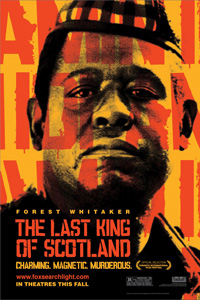
    Fox Searchlight Pictures\' The Last King of ScotlandEvery so often a film comes along that is so celebratory of the filmmaking process and fresh in its approach to visually conveying a story that it creatively demolishes anything within earshot.

    “Metropolis” was an early example, as Fritz Lang opened up the world in front of the camera like no one before.  Arthur Penn’s “Bonnie and Clyde” and William Friedkin’s “The French Connection” awakened the filmmakers of the 1970s to new boundaries willingly crossed.  And Quentin Tarantino brought unique and highly innovative ideas to light in the 1990s when he unleashed “Pulp Fiction” on the filmmaking community.

    Another such film has finally come along, and whether Kevin Macdonald receives the credit he deserves for melding the idiosyncrasies of documentation with the manner of narrative flow or not, “The Last King of Scotland” has become a landmark of ingenuity.  In this viewer’s opinion, it is the best film of the year thusfar.

    “The Last King of Scotland” was adapted from Giles Foden’s award-winning novel of the same name.  Charting the chaotic journey of Scottish doctor Nicholas Garrigan, Foden unveils the sadistic regime of Ugandan dictator Idi Amin in ways much less conventional than one would expect of such a tale.

    The fictional character of Garrigan was born out of the author’s many conversations with former Amin advisor Bob Astles, and the resulting tale is even, calculated and deliberately paced, very much a story meant for the page in its initial conception.  The process of adapting the material to the screen could have gone a number of typical ways, but the choices made by Macdonald and co-writers Jeremy Brock and Peter Morgan are exhilarating if nothing else.

    Scottish actor James McAvoy portrays Doctor Garrigan in the film.  Following an extremely brief introduction, and an equally swift scene conveying Garrigan’s place as his father’s son, the recent college grad rushes off to a new place in the world where he can be of service.  Anywhere but home will do, and the African country of Uganda becomes his new destination.

    All of this is carried across in a number of beats, not even necessarily scenes, and Garrigan is off on his journey within five minutes.  Lesser filmmakers would have taken inappropriate time establishing the character, meandering, before finally setting him off on his journey.  Macdonald trusts the viewer to stay with him, and unveils the events of the narrative through the eyes of his protagonist better than the most seasoned of directors.

    Garrigan soon settles into a missionary camp, providing health care for the few Ugandans willing to trust white doctors over village witch-doctors.  The camp’s head physician and his wife, Sara (Gillian Anderson), could certainly use the help.

    Meanwhile, political upheaval is the consistent state of affairs, as former president Milton Obote is overthrown by the regime of Idi Amin (Forest Whitaker), a “fighter for the people” – or so he would initially be considered.
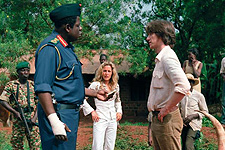
    (from left) Forest Whitaker, Gillian Anderson and James McAvoy in The Last King of ScotlandFollowing an automobile accident that is cleverly repositioned from its place in Foden’s novel, Garrigan and Sara are summoned to the aid of Amin.  The president has sprung his wrist in the process of ramming his Maseradi into a giant bull.

    Amin is immediately impressed by Garrigan’s tenacity and strength of mind, and he later offers the doctor a position as his personal physician.  So begins one of the most interesting relationships between two men captured on the page or on the screen in some time.

    Garrigan is abundantly charmed by Amin, a man who can seemingly see right through those at his side.  The depth of his personality clashes with the childish nature of his sensibilities to form a persona impossibly ignored.  But the longer Garrigan remains drunk with the importance of his position (soon considered an “advisor” by Amin), the longer it takes him to wake up to his complicity in a disastrous regime that will have been responsible for the deaths of over 300,000 Ugandans before Amin would finally be overthrown in 1979.

    Kevin Macdonald has made a name for himself as a documentary filmmaker for the better part of a decade.  Most notably, 1999’s “One Day in September” won the Oscar for Best Documentary, a painstaking dissection of the 1972 Munich Olympics tragedy.

    2004’s “Touching the Void” was one of the most acclaimed films of that year, blending dramatic recreation with first hand accounts of the treacherous ascent of Siula Grande by mountain climbers Joe Simpson and Simon Yates.

    What the director does so brilliantly in his first foray into narrative filmmaking is draw upon his instincts as a documentary filmmaker.

    “The Last King of Scotland” is not shot like a typical narrative political thriller.  The camera wanders frequently to various peculiarities in the scene, typically finding the motion of Amin’s hands, no matter how mundane the gesture.

    The usage of zooms and erratic camera movement recalls guerilla filmmaking above all else, and it really feels like we are watching true events unfold, not dramatic interpretations of them.  Danny Boyle and “Dogme” regular Anthony Dod Mantle served as cinematographer.
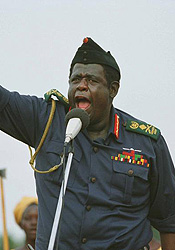
    Forest Whitaker in The Last King of ScotlandThe performances on the whole are fantastic, but the central tension and these two men’s effect on one another could not have been portrayed more succinctly.  James McAvoy is outstanding, and Macdonald should be applauded for casting someone so little-known.  One would expect a pseudo-star like Ewan Macgregor to be forced into such a scenario, but the right decision has been made and McAvoy holds his own opposite the most explosive on-screen incarnation of the year.

    Forest Whitaker’s Idi Amin deserves a place in filmmaking history as one of the more vibrant depictions of the medium.  One recalls the tagline of the film every moment he is on screen:  “Charming.  Magnetic.  Murderous.”  And when he enunciates each syllable of Garrigan’s name (“Nee-co-laas”), the chill rises up and down the viewer’s spine as it did when Sir Anthony Hopkins casually mentioned eating a man’s liver “with a side of fava beans and a nice Chianti.”

    Gillian Anderson and Kerry Washington (as Kay, one of Amin’s wives) are suited to the production, though Anderson’s sudden exit from the film early on feels as unnatural as it is in the novel.  It would have been nice to see more of her, and sporting a haphazard blonde hairstyle, she is sexier here than she has ever been.  However, Macdonald and his writers do a nice job of blending other characters and circumstances from the book into these two women, which makes for a fascinating adaptation on the whole.

    In fact, the biggest accomplishment outside of the style and innovation of the camera work would have to be the screenplay.  Foden’s novel, as mentioned, is deliberately paced.  But the writing team somehow made it much more electric and exciting, while at the same time combining various elements with the greatest of ease to make for a solid, swiftly-paced narrative.

    They utilize the Palestinian hijacking of an Air France flight in 1976, for instance, to its fullest effect as the climax of the film.  The flight was infamously held at Entebbe airport in Uganda while Amin, a PFLP supporter, supplied the hijackers with extra troops and weapons.  The event was the beginning of his downfall in the court of public opinion.

    Ultimately, “The Last King of Scotland” can work above or below the surface.  One could enjoy the film as a run-of-the-mill political thriller and be satisfied, taking nothing else away from it.  On the other hand, the depth present in the seamless creation of the story lies in wait for anyone willing to notice.

    It really is a staggering initial narrative outing, and if this is the talent Kevin Macdonald has been incubating while documenting the real world, we can only consider ourselves lucky that he has finally crossed over into the imaginary world.  He is truly an artist to watch.