In Contention

Tag: Babel

  • ‘Amelie’ tops list of decade’s best cinematography

    The folks at Movieline got their hands on a list of the top 50 films of the decade, from a cinematography standpoint, as laid out by voters at American Cinematographer magazine. Topping the list: Bruno Delbonnel’s work on “Amelie.” Delbonnel is a favorite among DPs. After all, “A Very Long Engagement” won him the ASC honor in 2004 and he received his third Oscar nomination of the decade for last year’s “Harry Potter and the Half-Blood Prince.” But it’s still a surprising call.

    Another delightfully unexpected pick is Jeff Cronenweth’s lensing of “Fight Club,” but I was personally irritated to find John Toll’s serene, thematically potent work on “The Thin Red Line” go completely unrecognized in the top 10 (he finally shows up at #17).  I’d also say Roger Deakins, though at his usual top notch on “No Country for Old Men,” probably should have seen top 10 representation for “The Assassination of Jesse James by the Coward Robert Ford” instead.  His work on the western just misses at #11.

    I’ve been asked many times to offer up a list of the top 10 shots of the decade as a bonus to my annual top 10 shots of the year columns, but I don’t think I can do it.  For one thing, it’s obviously a ton of work, but with so many shots in so many movies, I just think it would be tough to whittle it down.  Too tough.

    Check out the full list from American Cinematographer after the jump.  (Note they’re picking from 1998 to 2008).

    (more…)

  • Guy’s top 50 of the decade: #1-10

    Maribel Verdu in Y tu Mama TambienAnd then there were ten.

    Before I wrap up the list that I’ve trickled out over the last five days, I suppose I should write a few words on the decade that was. I entered the 2000s as a 16 year-old boy in Johannesburg who thought he knew a lot about movies. I left it as a 26 year-old man in London who knows a lot more than he did then — but realizes that he knows a lot less. There is still so much to see that I’ve barely touched upon — from this past decade alone.

    Probably no filmgoing decade in my lifetime will be as crucial to me as the one that passed, in terms of the shift and growth in my sense of how to read (and write) film.

    I may have already known that I loved movies, but in the 2000s I gained a sharper sense of how to love them, what I really respond to in a film — and the 50 titles gathered here (along with many, many others) helped fine-tune that notion.

    With that kind of personal learning curve attached to the decade, it’s hard to stand back and judge how it might stack against previous ones; strong, weak or average, it’ll always feel like my decade. As I compiled the list, however, did arrive at the conclusion that it started better than it finished. Sheer mathematics supports this personal view — the top 10 films I’m about to reveal all landed in the decade’s first half, and I don’t think that’s merely down to the advantage of distance.

    (more…)

  • Thoughts on ‘The Burning Plain’

    Charlize Theron in The Burning PlainI’ve been meaning to review Guillermo Arriaga’s directorial debut ever since I saw it two weeks ago, but for some reason, my thoughts on the film just won’t settle into place.

    It’s not a case of the film being particularly challenging or impenetrable — it’s Arriaga’s most structurally simple work to date, and arguably his most middlebrow too. I am, however, having trouble gauging precisely what the renowned screenwriter’s aspirations for the project were.

    If his intention was to make a searching character study for an arthouse audience, one that examines the occasionally mirroring intricacies of mother-daughter relationships from opposite ends of a slow-burning narrative candle, I’d have to deem the film an ambitious misfire, one that is too transparent in structure and thin in characterisation to bear the weight of its literary tropes.

    It is possible, however, that for his first outing in the director’s chair, the creator of such opaque, thematically dense narratives as “Amores Perros” and “21 Grams” was looking to safely downshift gears by making a tasteful, intelligent mainstream melodrama, one that operates more as an actors’ showcase than a writer’s (or filmmaker’s) platform. If so, the “The Burning Plain” — a generally compelling, well-crafted piece graced with a focused, charismatic trio of female performances — largely fulfils such a brief.

    (more…)

  • Remembering cinema’s Bush years

    As the world prepares to bid farewell to George W. Bush following tomorrow’s election, I came across an apt article in the new edition of Sight and Sound, in which critic Michael Atkinson evaluates how the Bush presidency affected American film, and how the period might be interpreted by future film historians. As always with S&S pieces, it’s not available online, but it’s an insightful (and occasionally contentious) piece worth tracking down if you want to give a cinematic spin to your sense of closure.

    As has been noted before, Atkinson believes that the sense of public panic and political insecurity that  characterised the presidency has been most clearly manifested in the resurgence of the superhero movie:

    It’s easy to imagine that in a decade or two, the Bush years will be viewed as the discouraging ebb in the pop-cult continuum when everyone from eight to 80 was excited about ‘super powers’ … Clearly, a preadolescent bout of night terrors required succour, producing a trend that’s bound to date as badly as the Spielbergian blue light and Rambotics of the 1980s.

    This is the kiddie-escapist paradigm tinctured with memories of 9/11; today, the vigilantes in primary-colour tights we hanker for don’t confront the conjectural fears of the Cold War, but the all-too-tangible, falling-bodies verities of the new millennium. In “The Dark Knight,” Christian Bale’s Batman has to wrestle, as the Bush administration didn’t, with the necessity of being perceived as evil for the sake of what’s construed as the common good.

    (more…)

  • The nominees react

    After a few weeks of frigid, citrus terrorizing temperatures, if you step outside this morning in Los Angeles, it’s a beautiful, cloudless, sunny day. But it’s a little sunnier for those who were greeted with Oscar nominations, whether expected or unexpected. I had the opportunity to talk with a few of the lucky souls who’ve had the pleasure of fielding phone call after phone call this morning. Here’s what they had to say.

    Lots of happiness in the Fox Searchlight camp today, as the little film that could, “Little Miss Sunshine” made its way to four Oscar nominations including Best Picture and, not surprisingly, Best Original Screenplay for Michael Arndt. I called Michael around 7:45 this morning to get his reaction, and he was still the same modest fellow I spoke to face to face over the weekend.

    “I knew that there were a lot of people out there who loved the film,” he told me, “but this is the ultimate validation of the idea that the film industry is democratic. A year ago we were hoping to get a distribution deal and now we have four Oscar nominations.”

    Michael says he went to sleep pretty easily (and who wouldn’t, in his shoes), but that didn’t stop him from waking up at three o’clock and suffering insomnia throughout the rest of the early morning hours. Suffice it to say, he was wide awake when he heard his name called this morning.

    Best Supporting Actor nominee Jackie Earle Haley (“Little Children”) has to be the happiest guy in the business this morning. “I think I’d have to agree with you on that,” he told me, calling from his home in San Antonio. “This is just unbelievably crazy. They need to invent a few more words, because every adjective, this is just a little bit better.”

    The most adorable and giddy Oscar nominee you could expect to talk to, Haley was clearly on cloud nine, even hitting bouts of speechlessness during our conversation. Funnily enough, even in the central time zone, Jackie was asleep when the announcement hit. His wife ran into the bedroom screaming and crying, “You got it!” “We just hugged each other and cried for, like, five minutes,” Haley said.

    One of today’s nominees was actually surprisingly snubbed for his work on “Good Night, and Good Luck.” last year, film editor Stephen Mirrione. Mirrione and Douglas Crise shared one of “Babel”‘s seven nominations this morning.

    “The types of movies I gravitate towards aren’t really mainstream movies,” he told me via telephone shortly after the nominations were announced. “So I’m pleasantly surprised when they become so widely accepted, even if I know the material I’m working with is exceptional. And I owe a lot to wonderful performances.”

    Crise has served as Mirrione’s first assistant editors for ten years. This year he got the bump to co-editor because “Babel” started shooting before Mirrione had finished work on “Good Night, and Good Luck.” Now the longtime collaborators get to share in the spoils of an Oscar nomination together.

    Another nominee who has felt the sting of Oscar’s avoidance is Patrick Marber, nominated today for his adapted screenplay “Notes on a Scandal,” based on the novel by Zoe Heller. In fact, when Marber failed to score a WGA nomination for his work two weeks ago, he says it felt exactly how the circumstance of “Closer” played out in 2004, for which he received BAFTA and Golden Globe nominations, but found no such luck with the guild and with the Academy. Suffice it to say, he was pleasantly surprised this morning.

    “Being nominated is a lot more fun than not being nominated,” he told me, calling from London. “You suddenly get lots of phone calls from people you haven’t spoken to in years. And it’s huge for us, for the film, to get four nominations. Judi and I texted each other, and I got a one word email from Zoe: ‘Yay.’ She’s always to the point.”

    Finally, one of the big stories of the morning was Picturehouse’s six nomination haul for Guillermo del Toro’s “Pan’s Labyrinth.” Hitting the ground running in its inaugural year, Picturehouse had two critically lauded efforts hit screens in “Pan’s” and director Robert Altman’s “A Prairie Home Companion.” Picturehouse president Bob Berney concedes that it was a shame not to land at least one mention for Altman’s golden-hued, poignant swansong, but it was bittersweet considering the surprising glut of appreciation thrown the way of “Pan’s Labyrinth.”

    “We decided to come out at the very end, but to do that, you have to know you’ve got a great film,” he told me earlier this morning. “It’s cool to get these broader nominations outside of the foreign film category, because this really is such a group effort. You get a lot of energy from this film and it just takes you back to the joy of movies.”

    Berney conceded that a lesson learned in this introductory year for his studio was the subtlety of positioning your film as an underdog. The strategy paid off in spades this morning, and the president affirms that he and his team are ready to do it all over again next Oscar season.

  • REVIEW: “Babel” (****)

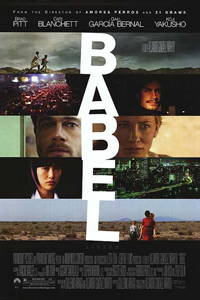
    Paramount Vantage\'s Babel“Babel” is the crowning achievement in the early careers of writer Guillermo Arriaga and director Alejandro González Iñárritu.  It will deservedly be seen as that defining moment which took them out of personal thematic expression -– the mark of a true artist -– and into the arena of global and human consciousness through artistic dexterity -– the mark of something much more.

    It is the most particular specimen, yet the most universal, in the long line of socially and/or politically inquisitive filmmaking we’ve experienced over the last two years.  And it goes without saying, “Babel” is the first real masterwork of 2006.

    As outlined in the eleventh chapter of the book of Genesis, the Tower of Babel was a creation built by the collaborative forces of a united humanity.  Having it in their hearts to emulate the Creator, the text reveals, “they said, Go to, let us build us a city and a tower, whose top may reach unto heaven.”   As the legend states, God halted the project by confusing the languages of the united, so that they could no longer communicate with one another.

    God then scattered the people throughout the land, forever disconnected, yet still of a similar and undeniable origin.

    The Tower of Babel is a narrative used to explain the diversity of languages and race throughout the world.  It is also a rather obvious warning that any who would attempt greater personal standing than that which God has outlined for them is doomed to failure.  However, at its core resides another illustrative failure begging thematic expansion: We as humans are furthermore doomed to eternal miscommunication, so long as we maintain the literal and figurative borders of our own design.  This thematic is the central focus of Arriaga’s and Iñárritu’s brilliant film.

    “Babel” tells four stories set in the lands of Morocco, Mexico and Japan.  Each of the stories, in typical Arriaga/Iñárritu fashion, shares common strands, continuing their trilogy of interconnectivity and fateful consequence (themes also found in 2000’s “Amores Perros” and 2003’s “21 Grams”).

    Two Moroccan brothers, testing the range of a firearm purchased for them by their father for the purposes of killing jackals, instigate the events of the film which will outline the filmmakers’ tale.  A single gunshot rings out in the Moroccan desert, spiraling the lives of Richard and Susan (Brad Pitt and Cate Blanchett, respectively) into a dizzying and confusing abyss of political turmoil, paranoia and, assuredly, dire straits.

    Adriana Barazza in BabelVacationing and searching in vain for themselves and their emotional connection once again, Richard and Susan have recently lost one of their children.  Neither has recovered, and neither has found the ability to forgive the other.

    Meanwhile, at the couple’s home in San Diego, their illegally employed Mexican nanny, Amelia (Adriana Barazza), is anxious to make it to her son’s wedding back home.  Against the advice of her nephew, Santiago (Gael García Bernal), she makes the fatal decision to bring Richard and Susan’s children –- whom she has raised for eleven years –- with her across the border.

    The more politically relevant of the three tales, Amelia’s journey is reflective of current foreign policy as it relates to border concerns, and the heartbreaking consequences potentially harsh edicts can manifest in that regard.

    Concurrently, in the communicative and technological Eden of Tokyo, Japan, Chieko (Rinko Kikuchi, the film’s unparalleled standout), is a deaf-mute girl exploring herself sexually as an adolescent, but ever lost in her own paralyzing world.  Chieko is the true heart of the film, lacking the ability to communicate, not merely emotionally, with her widowed father, Yasujiro (veteran Japanese thespian Kôji Yakusho), but quite literally, with the people who surround her in one of the most populated cities in the world.

    The performances in the film are all of an organic whole, but as undoubtedly diverse as the characters being portrayed.  As Richard, Brad Pitt finally puts forth a commendable and saturated performance to stand alongside his best work (“12 Monkeys,” “Seven,” “Seven Years in Tibet”), while Cate Blanchett, largely relegated to painful cries and disappointed outbursts, is ever-commanding as she continues her lineage of impressive portrayals.

    The actors cast as the two Moroccan brothers and their father (with whose names, I’m embarrassed to say, I am not familiar) offer performances that are fascinatingly tangible and, in many ways, the most reflective of human frailty.  Meanwhile, Gael García Bernal has a comfortable supporting opportunity to give the hint of depth, but still keep his cards close to the vest.

    Rinko Kikuchi in BabelThe most captivating and award-worthy performances in the film, however, come from Adriana Barraza and, most especially, Rinko Kikuchi.  Barraza’s conflict is so frightening, and eventually, so terribly desperate, that it could burden the shoulders of the most gifted of actresses.  She commands the role in such a way that we feel for her wholly, in ways both humanitarian and political in nature.

    Kikuchi, on the other side of the world, provides a venue for us to experience the film’s themes ourselves.  So much of her performance comes through her eyes and through her visual reaction to the events around her that the audience is forced to partake in her journey as well.  Seemingly we feel no such personal connection to any other character in the film.  It can be no coincidence that that character is the one so drastically isolated from the world six inches in front of her face.

    “Babel” pushes through the journeys of its inter-connected characters toward its own vibrant, certainly logical, but altogether ideal (if profound) conclusion.  Through their usual heart-wrenching tactics, Arriaga and Iñárritu paint the portrait of humanity scattered, just as in the days of Genesis, but not at all lacking the promise of rediscovery.

    Though not nearly as dark as their last two efforts, and certainly more accessible on the whole, “Babel” concludes in the most uplifting of fashions.  The film’s closing moment at once draws the sigh of hope and a tear of thankfulness that Pandora closed her box in time, another legend entirely, yet one as applicable to humanity as that of the tower which represented man’s original arrogance.