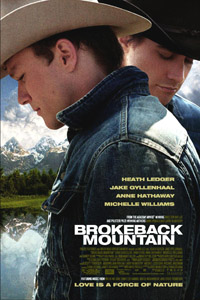
In Contention

Tag: Brokeback Mountain

  • In praise of the modern movie soundtrack

    I generally try to ignore film opinion pieces I think are fundamentally misguided — à chacun son goût and all that, plus the fact that fighting one mind is generally more trouble than it’s worth — but Ben Walsh’s idle article in The Independent today on the supposed demise of the movie soundtrack does such an absurd disservice to the current landscape of film music that it can’t pass without objection.

    Walsh’s standpoint is a dully nostalgic one: movie scores were so much more memorable in the old days, when greats like John Williams, Ennio Morricone and Danny Elfman (who are all dead, apparently) conjured whistle-ready themes by the dozen, while scores today “seem so completely unmemorable” by comparison.

    His pool of case studies for this assertion is a shallow one — he speaks mainly of the recent Oscar winners by Best Picture, Original Score and Original Song, oddly conflating the last two categories as if the two disciplines are somehow comparable — and even through that narrow prism, his preferences are hard to justify.

    (more…)

  • THE LONG SHOT: Don’t let ’em catch you caring

    (Updated Oscar predictions here. They’ll likely be tweaked once more before Tuesday.)

    Following the Academy Award season is a little like watching a particularly low-rent TV soap: just as the mindlessness and predictability of the enterprise escalates to a point where quitting seems the only credible option, some or other narrative curveball will lure you back in.

    So it was with me this week: after my column last week expressed a weary indifference to the race two weeks ahead of nomination day, along came the Academy to throw me a bone and re-pique my interest.

    The bone was, admittedly, a small one — a wishbone, if you will — but it did the job. By shortlisting Greece’s disturbing, tar-black adult fable “Dogtooth” for Best Foreign Language Film, the Academy sent out a reminder to bleary-eyed awards watchers not only that it is still capable of surprising us, but that good films can sometimes endure on their own merits — even if some of them do need an executive committee vote to help them along. (Hey, anyone else starting to think an executive committee for the Best Picture category would be a fine idea?)

    (more…)

  • THE LONG SHOT: Follow the leader

    [Updated Oscar predictions here.]

    Hey, have you heard of this movie called “The Social Network?” You should probably check it out. It’s about Facebook and stuff and it’s supposed to be really good. So good, in fact, that it’s managed to tame the single most argumentative species in the animal kigdom, The Lesser Spotted Film Critic, into silent agreement. Of the 12 American critics’ groups to dish out awards so far, 11 have given their top honor to the film. (“Winter’s Bone,” you say? Get with the program, San Diego.)

    The enthusiasm for the film, of course, extends beyond the sometimes soundproof critics’ chamber, as less distinguished media collectives like the HFPA and the BFCA have voiced their approval – while this morning, give or take a Supporting Actor snub, the film passed its first industry award test with two key Screen Actors’ Guild bids. Expect the Directors’, Producers’, Writers’ and Editors’ Guilds to follow suit in the New Year.

    So, we can basically tie a ribbon around Oscar’s neck and hand him over to Scott Rudin and David Fincher now, can’t we? After all, against all its on-paper disadvantages, “The Hurt Locker” was in a similar position this time last year, and it didn’t budge, did it? (Indeed, it didn’t even unite the critics’ groups to this extent – of the 12 awarding bodies I mentioned above, only five selected Kathryn Bigelow’s Iraq actioner last year.) Scarcely anyone has a word to say against the film, so let’s sit back and let the sweep wash over us, right?

    (more…)

  • Schnabel holds ‘Miral’ for Venice

    One of the more eyebrow-raising omissions from the Cannes official selection announced this morning was Julian Schnabel’s “Miral.” The New York artist’s biopic of Hind Husseini, with a cast including Hiam Abbass, Willem Dafoe and Freida Pinto, had been widely deemed a good bet for the competition lineup, given its lofty arthouse profile and the Cannes success of Schnabel’s last feature, “The Diving Bell and the Butterfly,” for which he won the Best Director award.

    Roger Friedman reports, however, that this year Schnabel was offered only an out-of-competition slot by festival organizers. The director declined the offer, choosing instead to unveil the film on the fall festival circuit: “Miral” will therefore premiere at the Venice Film Festival in September, before moving on to Toronto.Venice, of course, is where Schnabel premiered “Before Night Falls” in 2000 — he has form in both festivals.

    If the film turns out well, it won’t be the first time Venice has successfully fed off the bigger festival’s leftovers: both “Vera Drake” and “Brokeback Mountain” debuted on the Lido (and went on to win the Golden Lion) after being turned down by the Cannes selection committee.

  • LAFCA picks the top 10 films of the decade

    Laura Elena Harring in Mulholland DriveYou can never have too many of these, right?  Right?

    Right?

    1. “Mulholland Drive”
    2. “There Will Be Blood”
    3. “Eternal Sunshine of the Spotless Mind”
    4. “Brokeback Mountain”
    5. (tie) “No Country for Old Men” and “Zodiac”
    6. “Yi Yi”
    7. (tie) “4 Months, 3 Weeks and 2 Days” and “The Lord of the Rings”
    8. “Spirited Away”
    9. (tie) “United 93” and “Y Tu Mama Tambien”
    10. “Sideways”

  • Guy’s top 50 of the decade: #21-30

    Maggie Cheung in In the Mood for LoveA little late, but we’re at the halfway mark now, and I must say I couldn’t be more delighted and flattered by your warm response to the list so far.

    I mentioned in my intro to the first installment that I’d prefer you to view this as a loose playlist than as a rigid ordered assessment, and I’m thrilled that some of you have already taken me at my word, seeking out less-seen titles like “Last Resort” on Netflix and the like. On behalf of the movies, I thank you.

    With that said, today’s bracket of ten perhaps offers less buried treasure than yesterday’s, even turning up a pair of Best Picture Oscar winners. Hey, sometimes films get popular for a reason — I’m not such a snob, after all.

    That said, I suspect at least one of the following inclusions might prompt some healthy disagreement. The list continues after the cut.

    (more…)

  • THE LONG SHOT: Don’t look back in anger

    Jake Gyllenhaal in Brokeback MountainFor all the movement in the awards game this week – Jeff Bridges leap-frogging into contention, the animation race swelling to five nominees, “Precious” continuing to gather momentum – my head hasn’t really been in it this week.

    That’s partly because we’re all still making blind prognoses until four unseen juggernauts – “Nine,” “Avatar,” “The Lovely Bones,” and “Invictus” – finally deign to show their faces. And partly because I’m only looking forward to one of those titles with sincere movie-fan enthusiasm, as opposed to professional curiosity. Sometimes you just get the wholly subjective feeling that it isn’t going to be ‘your’ Oscar season – and while I’m not there yet, the fear is setting in.

    So, with no current awards developments getting me particularly enthralled or incensed, I’ve spent most of my time lately in a reflective state. With ‘best of the 2000s’ lists already coming thick and fast, and my DVD trawl through the decade’s leftovers for my own list in full swing, Oscar’s own performance over the last 10 years has been on my mind.

    As I discussed in this space a few weeks ago, it’s been a slightly schizophrenic decade of Oscar winners, one that has blurred long-held definitions of “Oscar-bait.” One does have to wonder about the identity or cultural relevance of any group that can alternately celebrate such disparate achievements as “Slumdog Millionaire,” “Gladiator” and “No Country for Old Men.” Who are these people, and what do they know?

    (more…)

  • THE LONG SHOT: Minority report

    PreciousWhen the Academy Awards roll around in March, it will have been precisely two decades since the unlikely figure of Kim Basinger blasted Academy voters’ conservatism on air at the 1989 ceremony, with specific regard to their sidelining of “Do the Right Thing,” Spike Lee’s groundbreaking study of urban interracial tension.

    “We’ve got five great films here, and they’re great for one reason – they tell the truth,” the star opined before presenting a clip from one of that year’s Best Picture nominees. “But there is one film missing from this list that deserves to be on it because, ironically, it might tell the biggest truth of all.”

    As if in response, later that evening, the Academy handed their top prize to “Driving Miss Daisy,” as quiet and uncontroversial a portrait of the American racial divide as you could ask for. Let it never be said that the Oscars have no sense of irony.

    20 years on, much has changed. (Basinger has become an Oscar-winning actress, for starters. No one saw that coming.) More to the point, the amount of black Oscar winners in acting categories has trebled. And just two years after Basinger’s outburst, the Academy named 23 year-old John Singleton their first black Best Director nominee.

    (more…)

  • The new millennium Oscars?

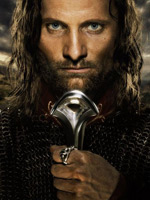
    Viggo Mortensen in The Lord of the Rings: The Return of the KingLooking back over the previous Oscar winners for Best Picture since 2000, the start of a new century (and a new millennium), I find myself wondering sometimes what the hell the Academy was thinking.  It’s no secret I disagree with the Academy a lot, but I can also admit that when they get it right, they get it right.

    But since 2000, their Best Pic choices have run the gamut from incredibly ridiculous, “Gladiator” and “A Beautiful Mind” being just goofy, to bang on, with “The Departed” and “The Lord of the Rings: The Return of the King.”  I am told the Academy is moving in a more progressive direction, willing to take more risks, and I suppose some of these winners do just that.  But they could have gone further.

    Year by year, here’s a quick look, with some thoughts about who might have won, and who should have at least been nominated…

    (more…)

  • Why does the Academy fear controversy?

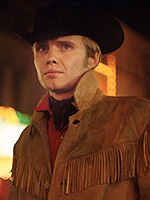
    Jon Voight in Midnight CowboyIn 1969, the Academy saw fit to give “Midnight Cowboy” the award for Best Picture — a first ever for an X-rated film.  Some saw the moment as a bellwether signaling a new dawn for the group, that they were developing a growing acceptance for the films that would start coming at them around this time of creative invigoration in the cinema.  But was it really?

    I remember somewhere that a high-ranking Academy official stated that if “A Clockwork Orange” won the Oscar for Best Picture they would resign their membership! The film had already won top honors from the New York Film Critics Circle and was nominated for four Academy Awards, among them Best Picture and Best Director. A ground-breaking work, the best of Kubrick’s career, still looking futuristic 37 years later, the film is an obvious masterpiece.  But it frightened the Academy for whatever reason.

    A year later Bernardo Bertolucci’s “Last Tango in Paris” came along with a galvanizing performance from Marlon Brando and was certainly a better film than at least two of the pictures nomination int he top race, “The Sting” and “A Touch of Class,” yet as expected, the Academy backed away from the film, nominating only Brando and Bertolucci.

    What is it in the makeup of this esteemed organization of artists that makes them steer clear controversial films, films that push the envelope, that go further out on a limb than most in exploring dark and sometimes daring subject matter?

    (more…)

  • EW’s Oscar revote

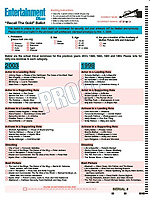
    Entertainment Weekly Oscar revoteFrom Thompson on Hollywood:

    Entertainment Weekly wants Hollywood to rewrite Oscar history by giving the film industry a chance to revise the Oscar history books. It’s called “Recall the Gold.”

    On October 6, EW is inviting more than 7,000 Hollywood insiders to participate in an extensive survey to re-vote on past Oscar races. EW wants to test which movies truly stand the test of time. With the benefit of hindsight, did the right films and performances win over the past 25 years? To look at 2003, will Robert Begnini still beat Tom Hanks? Will Shakespeare in Love still beat Saving Private Ryan? Will Gwenyth Paltrow still beat Cate Blanchett?

    Alright, let me stop it right here and get this out of the way: a nice diversion, nothing else.  Not to poo-poo the experiment, because it’s a fun idea, but the buzz and manipulation of a given Oscar season is in the same league as the manipulation that comes from loud fans and film-goers who think this film deserved to win over that and scream about it for years after the fact.  Nothing like this can happen in a vacuum, so let’s not consider an “Oscar revote” anything more than it actually is.

    And when you see that EW editor Sean Smith’s idea was inspired by the “Brokeback Mountain” loss to “Crash,” it becomes a little more irritating, in my book.  Let it go, folks.

    More:

    Monday EW is mailing out their official “Recall The Gold” ballot inviting the industry to vote in six major categories for five given years spaced five years apart–2003, 1998, 1993, 1988, and 1983–five, ten, fifteen, twenty and twenty-five years ago…

    “We built it from scratch,” says Smith. EW reporters and editors scrolled through their rollidexes. They added everyone who had ever been nominated or won an Oscar, and crew members of films that grossed over $100 million. They looked at the news reports of Hollywood people who had been added to the Oscar ranks in recent years. They culled creative directories for execs, producers, publicists, editors, costume designers, art directors, directors, cinematographers, writers, animators, sound mixers, composers–all the categories covered by the Academy.

    EW made one HUGE change. They invited top film (not TV) agents, who are not permitted to belong to the Academy, to join the list of Oscar revoters. And Smith thinks his list may skew slightly younger than the Academy’s. “We’re not trying to duplicate the Academy,” he says. “What do people working in the film industry think about these Oscar-winning movies now?”

    So, they added more people with agendas to the voting pool.  Nice.  Click the ballot image above for a larger image.  And read the rest of Thompson’s story here.

  • What does early (and excessive) Oscar hype do to a film’s chances?

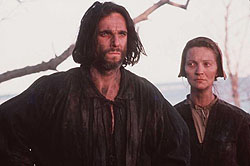
    Cover of Entertainment Weekly featuring The CrucibleIn 1996, a fall movie preview of Entertainment Weekly arrived in my mailbox, the cast of “The Crucible” staring back at me on the cover, making clear to me this was going to be THE film of the fall. There were rumors floating within the industry that the film, based on the Arthur Miller play, could conceivably be nominated for 12 or 13 Academy Awards, and it seemed a cinch for at least a Best Picture nod.

    Having directed the play twice, studied it at length in university and being a huge Arthur Miller fan, I was thrilled that the film was finally going to get the intense big screen version it deserve. The 1959 French adaptation was okay, but not enough people had actually seen it. Here was a chance for one of the greatest dramas of the 20th century to make the transition to film with a superb cast, including Daniel Day-Lewis, Joan Allen, Paul Schofield and Winona Ryder.

    Somewhere along the way Fox panicked and released the film late in December, and though Day-Lewis finished second in balloting for the New York Film Critics Awards, the picture never caught fire as it had been predicted to do. Instead it was a dismal box office failure, nabbing only a supporting actress nomination for Joan Allen and an adapted screenplay nod for Miller.

    “The Crucible” is a great film, with powerhouse performances from Day-Lewis, Allen and Ryder, though many critics attacked the latter. But was the film a victim of over hype, or were audiences simply too familiar with the story? What happened?

    The same sort of thing almost happened to Steven Spielberg’s “Munich,” which at this time in 2005 was being touted as not just an Oscar nominee, but the likely winner for Best Picture and Best Director, sight unseen. It opened and was very good, but it wasn’t the searing masterpiece everyone had been hoping for.  And somehow “Crash” won the Best Picture prize.

    (more…)

  • ‘Wrestler’: Is Golden Lion just the beginning?

    As Kris just reported, Darren Aronosky’s “The Wrestler” has won the Golden Lion at the Venice Film Festival. No surprise there — in what was widely deemed a lukewarm festival, Aronofsky’s film, which only screened yesterday on the Lido, was one of the few outright critical sensations.

    What is surprising is that Mickey Rourke, whose lauded comeback performance is the predominant source of the film’s buzz, missed out on the Best Actor prize, which went to Italy’s Silvio Orlando for “Giovanna’s Father.”

    Perhaps the jury wanted to spread the love. Perhaps after wins for David Strathairn, Ben Affleck and Brad Pitt in the last three years, they felt American actors had been sufficiently rewarded for a while. Prize or no prize, however, this recognition for the film — to which his performance is so integral — makes it quite clear that Rourke is on the awards trail.

    But what of the film itself? In years past, the Golden Lion has been the start of a healthy awards-season run for a couple of films — examples include “Atlantic City,” “Vera Drake,” and most notably, “Brokeback Mountain.”

    It’s no guarantee of future glory, though. In 1996, Neil Jordan’s lavishly mounted biopic “Michael Collins” seemed poised for an awards sweep after it took the Golden Lion and its star, Liam Neeson, nabbed the Best Actor prize. But the film never quite clicked with other awards bodies — and on Oscar nomination morning, all that awaited it was a pair of technical nods.

    (more…)

  • Ang Lee takes Woodstock

    Here’s what I love about Ang Lee: there is simply no way of anticipating what his next project is going to be. So far, the decade has seen him bounce from “Crouching Tiger, Hidden Dragon” to “Hulk” to “Brokeback Mountain” to “Lust, Caution” – a group arguably linked by thematic concerns of outsider identity, but with precious little in common besides. If there’s a more adventurous filmmaker at work these days, I don’t know his name.

    Now Variety confirms that his next project sees him revisiting Nixon-era America, the period having served him well in “Brokeback” (part of it, at least) and what I believe to be his finest work, “The Ice Storm.” Not that “Taking Woodstock” – Lee’s third film in a row for Focus Features – sounds like anything he’s done before either.

    The project, which enters production this month, has been adapted by James Schamus, Lee’s regular cohort, from the memoir of Elliot Tiber, a Greenwich Village interior designer who wound up in the creation of the biggest rock concert of all time when he lent his family’s motel to the event organisers.

    In an inspired piece of casting, Tiber will be played by “The Daily Show”‘s Demetri Martin, while other members of an interesting, and evidently complex, ensemble include Imelda Staunton as Tiber’s mother, Jeffrey Dean Morgan as Tiber’s closeted lover, Emile Hirsch as a Vietnam vet, Paul Dano as a hippie concertgoer, Liev Schreiber as a transvestite, and Eugene Levy as Max Yasgur, the owner of the farm where it all took place.

    Sounds like a suitably broad canvas for Lee to paint on – this should afford him plenty of room for a typically nuanced investigation of class, sexuality and popular culture, while offering him another completely new story world to explore. I can’t wait.

  • Tom-O ‘can’t quit’ the Academy’s insults

    (from left) Heath Ledger and Jake Gyllenhaal in Brokeback MountainI have to admit, I got a chuckle out of Tom O’Neil’s latest diatribe against the AMPAS.  Mainly, I just like to see him riled up, but he does have a point here.  Regarding the recent press release for the Academy’s upcoming screening of “Brokeback Mountain,” Tom had this to say:

    Am I the only person who finds the headline of a recent Oscars news release outrageous? While announcing the latest film to be screened in its “Great to Be Nominated” series at the AMPAS headquarters in Beverly Hills, the news release proclaims “Academy Can’t Quit ‘Brokeback Mountain.’” That’s a pathetic attempt of someone in the academy’s media office to be cutesy-pootsy and it’s offensive considering how cruelly academy members roughed up the gay cowboys two years ago.

    To begin with, I don’t think now, nor did I think nearly three years ago that the Academy “roughed up” the Ang Lee film that is clearly so beloved (I loved it too, so no hater-haters, please).  They certainly weren’t beholden to honoring the film with their top prize just because of its impressive precursor streak, and indeed, more often than not, the AMPAS shows that it will not be told what to do on Oscar night.

    I also am a supporter of the unfairly maligned “Crash, but I don’t feel like going there.

    That said, Tom has a point.  Let’s face it, the “Great to Be Nominated” series is an insult on its face no matter what film is screening.  I know the Academy thinks it is doing a service to the films it ignored throughout the years, but mostly it’s just digging away at wounds, some of them fresh, some of them scabbed over.

    Anyway, more from Tom:

    Now the academy says it “can’t quit” “Brokeback Mountain.” Oh, yeah? “Can’t quit” is an intense romantic phrase from the film professing undying gay love. What the academy really gave “Brokeback Mountain” two years ago was the equivalent to a gay-bashing. After the “Crash” upset, scores of academy members confessed to me that they “just couldn’t” vote for the gay film. Most of the academy members I spoke to admitted they didn’t even watch their DVD screener….

    Now if the academy really “can’t quit” “Brokeback Mountain,” why doesn’t it go back and give it the top prize it deserved in 2005? By invoking that phrase, AMPAS only insults the film further while proving how really clueless it can be sometimes.

    You can check out his full rant here.

  • Who joins the great Best Picture snubs this year?

    It happens every year, a great film, in some cases destined to be remembered more than the eventual Oscar winner is snubbed for a Best Picture nod, or gets nominated and loses to an inferior film that happened to capture the public’s attention at that particular point in history.

    Some of the greatest films of all time lost the top award, “Citizen Kane” among them, arguably the greatest of all time (though I disagree). “The Treasure of the Sierra Madre”, easily John Huston’s best work, joins the list, as does “The Searchers,” which is in my opinion the finest western ever made and contains the greatest John Wayne performance of all time.

    Remember “Rocky” winning over “All the President’s Men,” “Network” and “Taxi Driver?” Or “Kramer vs. Kramer” over “Apocalypse Now?” In the last twenty years, Oscar has pulled some howlers, some choices that left me nearly putting my foot through the television upon the announcement. The first time I remember being really, truly angry at a lame decision was in 1981 when “Chariots of Fire” bested Warren Beatty’s “Reds,” which I believe to be among the best films of the 80s.

    (more…)

  • Best actor contenders join an eclectic list of recent winners

    Sean Penn, Benicio Del Toro and Frank Langella seem to be the names bandied about for Oscar consideration this year, which would place them in some impressive company of nominees and winners these last 20 years. Of course, that said, there have also been some bizarre choices for the Best Actor award, which has often left me shaking my head in disgust and wondering what these voters were actually seeing.

    Since 1988, there have been 10 winners that perhaps should not have been, the award arguably deserved by another of the nominees, or worse, an actor not nominated! Consider Dustin Hoffman in “Rain Man,” a widely acclaimed performance that asked that he not connect with anyone in the film, never make eye contact, rock back and forth and speak in a nasally voice.

    Stop what you are doing right now and try what he did in the film, and trust me it is very easy to do. Now do you deserve an Oscar for doing what Hoffman did in that film? The real perfortmance in “Rain Man” was that of Tom Cruise, who we watched evolve over the course of the film, and of course the best performance of that year was Gene Hackman as the tough investigator in “Mississippi Burning.” Hackman was nominated, but he stood no chance in the wake of the juggernaut of support for Hoffman, who in fact should have won years before for his miraculous work in “Tootsie!”

    (more…)

  • REVIEW: “Brokeback Mountain” (***1/2)

    Focus Features' Brokeback MountainIt is the true mark of artistry that guides a hand away from the simplistic and into the complex.

    “Brokeback Mountain” is and has been poised to merely be considered “the gay cowboy movie,” a label I’ve defended it against ever since I first read E. Annie Proulx’s short story (which originally appeared in The New Yorker).

    In the final analysis, however, director Ang Lee strikes so many right chords in the film, which took eight years to find its way to the screen, that one comes to forgive moments of melodrama that creep into an otherwise emotionally raw narrative.

    The story revolves around two ranch hands, Ennis Del Mar (Heath Ledger) and Jack Twist (Jake Gyllenhaal), who come to form a close bond while sheepherding for extra income over the summer of 1963.

    A chance moment of absolute comfort overtakes the two men one night, and that bond becomes a sexual one, but more appropriately, a sensual one. Their lives soon part ways, and years go by before they reunite for the first of a number of getaways to the mountains of Wyoming, both with wife and child at their respective homesteads.

    The story would be a tightrope walk for any seasoned filmmaker. Indeed, as Del Mar notes of the forbidden passion he and Twist share, “there ain’t no reins on this one.” It is an applicable statement to the tale itself, and like Twist’s rodeo cowboy, Lee takes the thunderous implications and bucking ferocity of the story in stride, riding the beast the full eight seconds. In so doing he elevates the chronicle above the physicality which can unfairly precede it.

    What struck this viewer most is that Lee reveals the thin line between love and hate with absolute expertise. Pain is a natural byproduct of intense passion. When Ennis punches the wooden walls of a façade –- after what he presumes to be the last time he’ll ever see Jack –- the reaction is both to the pain of loss and the anger he feels toward something clutching his heart so authoritatively. Let alone any thoughts that he may feel disgust for the act he has committed, surely the last thing he’d expect to have happened. This is quite apparently the first time Ennis Del Mar has ever fallen in love.
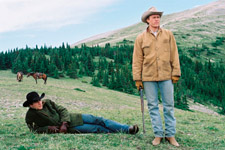
    (from left) Jake Gyllenhaal and Heath Ledger in Brokeback MountainThe performances largely represent the correct emotional cachet across the board.  Ledger’s seedy, love-struck cowboy is the standout. He lurks between his own surface, a character inside an entirely different persona. At once guarded and intense, this has to be seen as the actor’s finest work to date.

    The moment he claims “I’m nothing, I’m nowhere,” it becomes one of the truest depictions of the trappings of desire and ardency we’ve seen on screen.

    Much credit is due to a well-assembled and emotionally investigated screenplay from Diana Ossana and Larry McMurtry, but Ledger’s task was a challenging one regardless of the words provided.

    Suitably boring is Ennis’ wife Alma, played rather succinctly by Ledger’s real-life sweetheart Michelle Williams. The performance gives us another level of understanding when Ennis flees away to the mountains with Jack, as his “real” life becomes a slow, uneventful process lacking any real passion or excitement. Alma’s distress and shock at the knowledge of her predicament plays well through pained eyes.  The difficulty, however, lies on the other side of things.

    Jake Gyllenhaal slips over the top a bit too often as Jack Twist, both in times of joviality and in times of sincerity. He really hits his stride, however, once the character begins to age over the course of the narrative’s 15 or 20 years, as we see the toll longing and idolatry have taken on him.
    Michelle Williams and Heath Ledger in Brokeback MountainIt has to at least be said that Gyllenhaal has come into his own this year, both through this performance as well as through his controlled portrayal of an equally emotionally secluded young man in the underwhelming “Jarhead.”

    Anne Hathaway has a presence as Twist’s wife, Lureen, which overrides the function of the character. Her face is so bold and her performance so over-baked that it really clashes with the intent of the role.

    The relationship between Jack and Lureen just isn’t as thematically potent as the relationship between Ennis and Alma, due largely to this, and if there is a weak link in the case, I’d consider Hathaway as such.

    Regardless of imperfection, what we have in Brokeback Mountain is a brutal account of tragic love. It’s one of the oldest stories in the book, but Lee’s conviction and dedication to the core of Proulx’s wonderful story, in every waking aspect of the film’s creation, is what assists it in vaulting quite capably beyond simple-minded nonsense.

    Such a perception could easily have been detrimental to understanding the affecting symphony being composed here.