In Contention

Tag: Forrest Gump

  • THE LONG SHOT: A toast to the douchebags

    (Not-quite-final predictions here.)

    176 days from the unofficial opening of my Oscar season — a breakfast-hour press screening of “Black Swan” on the first day of the Venice Film Festival — it’s fair to say I’m ready for the endgame.

    Aren’t we all? Whether you’re delighted or disappointed by where the awards trail has led us thus far, it’s fair to say it offers little further room for discovery. Back in the golden days of September, pundits whittled the race down to “The King’s Speech” versus “The Social Network,” past versus present, comfort versus cred, That Was Then versus This Is My Now. And as much as I clung to the idea that it couldn’t be that simple, they were right.

    The axis may have swung in this narrative across the season, and the side-taking may have become more heated in the post-nomination phase, but the fact remains that the increasingly small world of Oscar blogging has largely revolved around two films for the better part of six months. If you want to know what this looped conversation has done to our collective brains, look no further than the fact that I just quoted Jordin Sparks lyrics in the paragraph above.
    (more…)

  • LIFE WITHOUT OSCAR: 1993 and 1994

    Catch up with the idea behind this series here.

    1993 was the year I first became interested in making movies and tracking box office. There are two words responsible for both and they rhyme with Yourassic Lark. The director of that beast would also helm our Best Picture winner that year, finally earning the Academy’s respect. I’m talking about Steven Spielberg and “Schindler’s List” of course, but if you ask me, “Jurassic Park” is the better film.

    Tom Hanks won Best Actor in both 1993 and 1994, becoming the first person since Spencer Tracy to take the prize two years in a row. I’d begrudge him the honor, but he’s just so darn likable. Honestly though, Denzel Washington should have gotten some love for “Philadelphia” too. This win marks the only time an acceptance speech was adapted into a movie (“In & Out”).

    1993 is also personally notable as the first time I had seen one of the Best Picture nominees by the time of the ceremony (“The Fugitive”).

    1994 was easily won by “Forrest Gump,” despite the presence of what IMDb users consider the greatest movie of all-time being in the mix. Really, IMDb users? “The Shawhsank Redemption?” It was also David Letterman’s one and only shot at hosting, which has been much-maligned but remains one of my favorite turns at the gig. Infinitely better than Whoopi Goldberg in 1993.

    Uma. Oprah.

    (more…)

  • Quote unquote

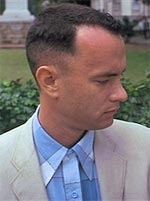
    Tom Hanks in Forrest GumpIn one of yesterday’s comment threads, a bit of a discussion built up concerning the quotability (or otherwise) of “Avatar,” and how this factored into its potential pop-culture significance.

    It’s a subject that was also brought up a while back by Cinematical’s Erik Davis, who wondered whether the film’s oft-repeated refrain of “I see you” was a calculated attempt to enter popular conversation. I agree with him that the line seems tooled for that specific purpose, which is precisely why I have a hard time seeing it catch on in a lasting way. (That, and the fact that any sensible person know that “I see you” can only be preceded by a cry of “Peekaboo!”)

    Cinema’s most quotable quotes are rarely designed to be as such. This is also the conclusion of a handily-timed LA Times article, which details the backstory behind now-classic lines from “Cool Hand Luke,” “Forrest Gump,” “Sudden Impact” and, uh, “A League of Their Own.” (Must be an American thing.)

    (more…)

  • Gumption

    If you’re an awards geek and you haven’t yet discovered Nathaniel Rogers and friends’ series of “Best Pictures from the Outside In” discussions, you have a treat in store.
    The premise is both eccentric and beautifully simple: word from both ends of the Oscar timeline, each episode pits two Best Picture winners against other for discussion, re-evaluation and occasional ridicule, with the comparison of two often wholly disparate films bringing out interesting elements in each other.

    In the ring for the latest instalment are “How Green Was My Valley” and “Forrest Gump” — an appropriate match-up in that they are both sentimental pieces that beat out more daring, enduring works in their respective years, and have retrospectively become less popular choices for it.

    I’m pleased to see Rogers, together with his two fellow bloggers Nick Davis and Mike ‘Goatdog’ Phillips, giving “How Green Was My Valley” more respectful attention than most people, who routinely dismiss it as “That Movie That Beat ‘Citizen Kane’” and little more.

    It’s still a John Ford film, after all, and one of his most intimate, visually lyrical works, even if it succumbs to hokum on more than one occasion. As Davis so aptly puts it, it’s a film wherein “you really feel the cycles of the day and the season, sometimes within a single shot.”

    They don’t, however, hold back on their mutual loathing for “Gump,” which I have to agree is one of the most artistically and ideologically objectionable films ever to wins Best Picture. (“Gump” and “Braveheart” back-to-back represent the Academy’s all-time nadir, as far as I’m concerned.)

    (more…)

  • Separated at birth

    Thanks to Hollywood Elsewhere for pointing out this amusing video, which … well, it speaks for itself, really:

  • 1/2 Oscarweb Round-up

    David Fincher• David Poland looks at the race nine weeks out from the angle of release marketing and strategy. [Movie City News]

    • Nathaniel Rogers is knee deep in his annual (extensive) year in review features.  Read it.  Now. [The Film Exerience]

    • Jeffrey Wells passes on some notes from a friend making some dubious comparisons between “Milk” and “Braveheart.” [Hollywood Elsewhere]

    • Old news you’ve probably read by now, but Tina Brown’s latest foray into the world of journalism proves just how much of a disreputable rag it can be. [The Daily Beast]

    • David Usborne is quick to dive in the mud with the hacks and bring a respectable UK outlet down there with him. [The Independent]

    • Joe Queenan chats with Mickey Rourke across the pond. [The Guardian]

    • Anne Thompson seems to think a Christmas release hurt “Revolutionary Road”‘s Oscar chances. [Thompson on Hollywood]

    Dave Karger takes a stand with some late-December Oscar predictions. [Entertainment Weekly]

    • David Carr speaks up for “Iron Man” over “The Dark Knight,” calls the latter’s third act a “mess.”  Oy. [The Carpetbagger]

    • Tom Roston sits down with “Defiance” and “X-Men Origins: Wolverine” star Liev Schreiber. [Los Angeles Times]

    • As a David Fincher retrospective cranks up in the Big Apple, Dennis Lim looks back over the director’s career to date. [New York Times]

    • Patty Rhuke spotlights the similarities between “Forrest Gump” and “The Curious Case of Benjamin Button,” comparisons certain parties involved would probably rather go away. [USA Today]

  • Could Woody Allen be a surprise Best Director nominee?

    Woody Allen at the 2002 Academy AwardsIn 1994, Woody Allen’s masterful “Bullets Over Broadway” was not really on anyone’s charts as a potential Oscar nominee. A very funny film about a playwright who enlists a gangster to help him bring life and reality to his play, it was one of Allen’s best works with hysterically funny performances from John Cusack, the great Dianne Wiest (who won an Oscar), Chazz Palminteri, Jennifer Tilly, Jack Warden, Mary Louise Parker, Rob Reiner, Jim Broadbent, and Tracey Ullman. The film premiered here at the Toronto International Film Festival with excellent reviews, but it seemed overshadowed that season by Quentin Tarantino’s “Pulp Fiction,” without question the movie of the year.
    The day the Academy Award nominations were announced, as expected, “Forrest Gump” and “Pulp Fiction” dominated, but in a huge surprise, Allen’s film was up in seven categories including Best Director, Best Screenplay, Best Supporting Actor (Palminteri), Best Supporting Actress (Weist and Tilly) and a couple of technical awards.

    I have always believed the film to be one of Allen’s funniest and finest films, with beautifully created characters and knockout performances throughout. Wiest is miraculous as a manipulative diva seducing the director/writer portrayed by Cusack because she knows it to be the only way to create a better character for herself. Her “don’t speak” becomes more and more insane throughout the film.

    I have always felt the film was robbed of a Best Picture nomination, likely edged out by “Four Weddings and a Funeral,” but it really did not matter as “Forrest Gump would dominate the ceremony.

    This year, Allen has directed and written a critically acclaimed film in “Vicky Christina Barcelona,” with a powerhouse performance from Penélope Cruz (the Oscar frontrunner), and solid work from Javier Bardem, Rebecca Hall, and Scarlett Johansson (two of them Golden Globe nominees). The film is funny, sexy and dangerous, both vintage Allen, but also a newer, darker Allen, a director evolving.

    (more…)

  • 12/8 Oscarweb Round-up

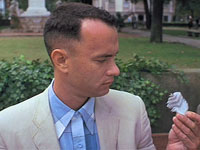
    Tom Hanks in Forrest Gump• Lou Lumenick runs down his 10-best list… [Lumenick on Film]

    • …and calls “Mamma Mia!” the guilty pleasure of the year. [Lumenick on Film]

    • Peter Sciretta gets a juicy tid-bit on the “Forrest Gump” sequel “Gump & Co.” from screenwriter Eric Roth: 9/11 killed the idea and all the principles decided it wasn’t relevant anymore.  Interesting. [/Film]

    • Christopher Nolan elaborates on his four favorite scenes from “The Dark Knight.” [USA Today]

    • Anne Thompson goes deep on why “Australia” misses the mark. [Thompson on Hollywood]

    • Mick Brown sits down with “Doubt” star Meryl Streep. [Daily Telegraph]

    • As the ship sinks around him, Gregg Kilday reports on the box office muscle of this weekend’s Oscar contenders. [Hollywood Reporter]

    • Ariel Kaminer tracks the road to the big screen for Bernhard Schlink’s “The Reader.” [New York Times]

    • Eleanor Clift talks the parallels of “Frost/Nixon” to the current administration, parallels writer Peter Morgan certainly didn’t have in mind. [Newsweek]

    • A refreshing list of the year’s superlatives. [New York Magazine]

  • And often, the Academy gets it right…

    United Artists' Midnight CowboyAs much as I rant about some of the bizarre choices made by the Academy, let’s be fair…there are times when they are right on the money.

    The AMPAS allowed for an embracing of the New American cinema with their awards for Best Picture and Best Director for “Midnight Cowboy” in 1969, and only they had the courage (and the smarts) to recognize that “The Godfather Part II” was a superior film to the first in handing it the same two trophies. They had awarded “The Godfather” Best Picture two years earlier, but much of the precursor circuit (and all of the critics groups) largely ignored the sequel, opting instead for films such as “Alice Doesn’t Live Here Anymore” and “Chinatown,” among others.

    The five awards betsowed on “One Flew Over the Cuckoo’s Nest” in 1975 are among the group’s best choices ever, in particular the honors for actor Jack Nicholson and director Milos Forman.

    Though far too often dismissed as a chick flick, “Terms of Endearment” was a marvelous slice of life that the Academy embraced with five Oscars, including Best Picture, Best Actress, Best Supporting Actor and Best Director. By the way, is it not odd that first time winner James L. Brooks has never again been nominated in the directing category again, despite two Best Picture nominees in “Broadcast News” and “As Good As It Gets?”

    I remember cheering loudly the many wins for “Amadeus,” “Out of Africa” and “Platoon” three years in a row, and though I believe “Goodfellas” is a better film, I was pleased to see a western, “Dances with Wolves,” win seven Oscars.

    No arguments from me between 1991 and 1993, with “The Silence of the Lambs,” “Unforgiven,” and “Schindler’s List” all most deserving winners. And though I prefer “Pulp Fiction,” I understand why “Forrest Gump” took the top prize in 1994.

    Bravo, too, to the Academy for honoring “The Lord of the Rings: The Return of the King,” a bonafide movie masterpiece, and again the following year for “Million Dollar Baby.”

    So you see, for all my bitching (and we all do it…come on), I concede that the Academy does, from time to time, nail the best.