In Contention

Tag: Shakespeare in Love

  • LIFE WITHOUT OSCAR: 1997 and 1998

    Catch up with the idea behind this series here.

    Before James Cameron was making $3 billion grossing movies, he was stuck directing $2 billion grossing art films that won tons of Oscars. I remember seeing “Titanic” three times in the theater at the age of 15, trying to get Kelly Adams to make out with me. I loved that movie yet still I remember being disappointed that “Good Will Hunting” didn’t take the top prize and that Burt Reynolds came away empty handed as well. We’re never satisfied, are we?

    Billy Crystal hosted and the result was the most watched telecast ever. And if you remember this show, you remember watching an endless segment introducing 70 previous winners. It was the worst.

    1998 gave us the second biggest upset in the last twenty years, when “Shakespeare in Love” took the top prize from “Saving Private Ryan.” At the time, I was outraged, but now I’m more than happy to throw my weight behind the former as a better film. Of course, we all know “The Thin Red Line” is where it’s really at.

    Roberto Benigni may go down in history as the only winner to stand on Spielberg’s chair after hearing his name. Say what you want about his performance, but he remains the only Best Actor winner in a foreign language film and that’s a fantastic achievement.

    So what failed to excite the Academy?

    (more…)

  • THE LONG SHOT: British reserve

    “The British are coming!” crowed screenwriter Colin Welland from the Oscar stage in 1982, hoisting aloft his just-awarded awarded statuette for “Chariots of Fire” – and anticipating one of the bigger upsets in the history of the Best Picture race, as the modest British sports drama upended Warren Beatty’s grand political epic “Reds.”
    His rallying cry was both premature and behind the beat. Welland may or may not have been aware that the Brits had crashed this particular party several decades previously. In 1948, Laurence Olivier’s “Hamlet” became the first non-US production to land the Academy’s top prize, while the 1960s were something of a golden period for England at the Oscars: while films like “Lawrence of Arabia,” “Tom Jones” and “Oliver!” emerged triumphant, so many Brits vacuumed up the acting prizes that Hollywood industry gossips – the bloggers of yore – began to complain. “It’s not fair,” whined Hedda Hopper. “The weather’s so foul on that tight little isle of theirs, that to get in out of the rain, they gather in halls and practise ‘Hamlet’ on each other.”

    But Welland’s promise of a similar period of ubiquitous Brititude was kept only in fits and starts: Richard Attenborough, Ben Kingsley and “Gandhi” may have ruled the roost the following year, but it would be a whole quarter-century before another predominantly UK production (and coincidentally, also one with an Indian bent) took the top prize. In the early 1990s, Limey actors enjoyed a four-year run of wins in the lead acting races – from Daniel Day-Lewis through to Emma Thompson – only for their luck to dry up until Helen Mirren initiated another mini-streak 14 years later. “The British are coming… for occasional visits,” might have been a more accurate boast, if not quite as rousing.

    (more…)

  • THE LONG SHOT: Bait, switch

    Whether you choose to believe them or not – and speaking for myself, I don’t quite – the media powers that be have currently reduced the 2010 Best Picture race to just two titles: “The Social Network” and “The King’s Speech.” That’s entirely (and hopefully, lest things get too dull too soon) subject to change over the next four months, but given what we’ve seen at this point, it’s difficult to devise a could-win theory for many of the films most fancied for the remaining eight slots, be it “Inception” or “Another Year.”
    I don’t really blame those in the blogosphere who are narrowing things down to this pair of films: after a lackluster Toronto fest failed to turn up a hidden dragon along the lines of “Slumdog Millionaire,” the slate of contenders looks much as it did before the fall festival season began. With expectations for “Network” and “Speech” pegged high all along, meeting them was enough to seal frontrunner status.

    Moreover, the temptation to pit David Fincher’s modish Facebook story and Tom Hooper’s tony royalty porn against each other is hard to resist, given how conveniently the films are opposed: both acclaimed biopics after a fashion, but one concerned with present-day American youth, the other with British aristocracy of yore. “It’s the time-capsule piece versus the time-warp piece,” snarked one friend of mine recently, anticipating a narrative that will likely run all season, even if other frontrunners enter the fray.

    (more…)

  • “It’s a shame ‘Slumdog’ is going to come in second.”

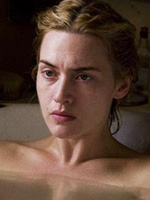
    Kate Winslet in The ReaderYep, those would be Harvey Weinstein’s words right there. EW has an interesting piece positing the theory that “The Reader” is really the film most likely to spoil the party for “Slumdog” on Oscar night — even if the writers admit that it’s unlikely to happen. (I agree on both counts.)

    It’s a handy precis of the comeback narrative that Weinstein has forged this year — both for himself as a major Oscar campaigning force, and for the movie, which some months ago looked like an awards-season casualty after suffering tepid reviews and unwelcome behind-the-scenes controversy.

    How did he do it, given a campaigning budget that’s a mere fraction of the millions he spent back in the “Shakespeare in Love” days? The answer, the article says, lies in Weinstein’s self-professed new “low-key” strategy with an emphasis on simply screening the film, especially in certain well-targeted areas:

    Weinstein’s first salvo was to home in on the Academy’s aging Jewish population. Although he’s been trying to get all voters to see the movie, it’s no coincidence that he has screened The Reader at such Jewish cultural hot spots as the Skirball Center in Los Angeles and the 92nd Street Y in Manhattan, places where one is likely to find older voters with a deep connection to films about the Holocaust. ”When I went to a screening, I was one of about four people who didn’t have blue hair,” says one Academy member and former campaign engineer. ”And I was the only WASP.”

    Weinstein also invited Nobel laureate and Holocaust survivor Elie Wiesel to The Reader‘s New York premiere, and courted an endorsement from the Anti-Defamation League, a group whose mission is to call attention to anti-Semitism … Weinstein says, ”It must have been the hand of Anthony Minghella and Sydney Pollack, because Elie Wiesel asked to see me after the screening and he hugged me and said how much he loved the movie.” (Wiesel, through his agent, declined to comment.)

    Ahem. While there may be a lot of people (Roger Ebert among them) protesting that “The Reader” isn’t a “Holocaust movie” — and beneath the surface, it isn’t really — it doesn’t appear that Weinstein has got that particular memo. The point is that he’s marketing it as a Holocaust movie, and it seems to be working.

    (more…)

  • Define ‘upset’

    Let’s get this straight: an upset and an injustice are two very different things. When a nominee that isn’t widely expected to win beats one that is, that’s an upset. When a highly deserving underdog loses to a less deserving favourite, that’s an injustice. The latter arguably happens more frequently in Oscar history than the former, but that’s no reason to blur the line.

    I mention this in connection with a poll that Sasha Stone spotted yesterday, in which the following were named the biggest Oscar upsets of all time in the Best Picture category:

    1. “Shakespeare in Love” over “Saving Private Ryan” (1998)
    2. “Crash” over “Brokeback Mountain” (2005)
    3. “Dances With Wolves” over “GoodFellas” (1990)
    4. “Rocky” over “Taxi Driver” (1976)
    5. “How Green Was My Valley” over “Citizen Kane” (1941)

    Now I remember the 1990 awards clearly — I was 8 years old, and it was the first Oscar season that I followed keenly from beginning to end. And even I, at that tender age, knew that “Dances With Wolves” was a gimme, a slam-dunk, a no-brainer. However critically acclaimed Scorsese’s masterpiece was, it hadn’t a prayer against the film that swept the Guilds and the Globes — Kevin Costner enjoyed as great a stranglehold on the Oscar as Danny Boyle does today. “GoodFellas” winning would’ve been the upset, not the other way round.

    (more…)

  • In it together

    Today is my birthday. I’m 24 years old.

    I’ve been following the Oscar race with some notable level of attention for 8 years. It is by no means a lengthy tenure, as there are others in the game who have been observing this outlandish span of time much longer than that. Even still, in these recent years – the height of the race’s popularity amongst the film-going community – I’ve noticed a number of intriguing things as a witness to its modern evolution.

    My first season was the 1997 season. The big films in play were James Cameron’s Titanic, Curtis Hanson’s L.A. Confidential and Gus Van Sant’s Good Will Hunting. It would be a rather poignant introductory year into the process for me.

    I knew my favorite films of the year were As Good As It Gets (from director James L. Brooks) and L.A. Confidential. The former struck the right chord at a time in my life where I was truly head-over-hills in love, while the latter was part of a brief progression of cinema – along with Michael Mann’s Heat and Bryan Singer’s The Usual Suspects – that was greatly sparking my interest and leaning me toward a profession chosen in the filmmaking arena.

    (more…)