In Contention

Tag: The Queen

  • ‘King’s Speech’ rules UK box office

    “Tailored largely for the international audience for whom the internal politics of the Royal Family seem never to lose their mystique or fascination,” I wrote in my October review of “The King’s Speech.”

    I guess I have to take that back, since the film — which only opened on Friday in its home country — has become a genuine UK box-office phenomenon, as opposed to the specialized success it’s been across the pond.

    The film handily knocked “Gulliver’s Travels” off the #1 spot (bleak times, these) with a weekend gross of £3.52 million. (That’s about $5.5 million, if you like your figures translated, though it goes with saying that UK and US numbers are not comparable.) To put that in context, that’s over four times what another royal-themed prestige drama, “The Queen,” made on only slightly fewer screens back in the autumn of 2006.

    (more…)

  • THE LONG SHOT: British reserve

    “The British are coming!” crowed screenwriter Colin Welland from the Oscar stage in 1982, hoisting aloft his just-awarded awarded statuette for “Chariots of Fire” – and anticipating one of the bigger upsets in the history of the Best Picture race, as the modest British sports drama upended Warren Beatty’s grand political epic “Reds.”

    His rallying cry was both premature and behind the beat. Welland may or may not have been aware that the Brits had crashed this particular party several decades previously. In 1948, Laurence Olivier’s “Hamlet” became the first non-US production to land the Academy’s top prize, while the 1960s were something of a golden period for England at the Oscars: while films like “Lawrence of Arabia,” “Tom Jones” and “Oliver!” emerged triumphant, so many Brits vacuumed up the acting prizes that Hollywood industry gossips – the bloggers of yore – began to complain. “It’s not fair,” whined Hedda Hopper. “The weather’s so foul on that tight little isle of theirs, that to get in out of the rain, they gather in halls and practise ‘Hamlet’ on each other.”

    But Welland’s promise of a similar period of ubiquitous Brititude was kept only in fits and starts: Richard Attenborough, Ben Kingsley and “Gandhi” may have ruled the roost the following year, but it would be a whole quarter-century before another predominantly UK production (and coincidentally, also one with an Indian bent) took the top prize. In the early 1990s, Limey actors enjoyed a four-year run of wins in the lead acting races – from Daniel Day-Lewis through to Emma Thompson – only for their luck to dry up until Helen Mirren initiated another mini-streak 14 years later. “The British are coming… for occasional visits,” might have been a more accurate boast, if not quite as rousing.

    (more…)

  • Step away from the Blair

    Regular readers (or Twitter followers) may have gathered by now that Peter Morgan isn’t my favorite high-end screenwriter on the scene — I’ve found his recent run of factional biopics, resulting in a pair of Oscar nods for “The Queen” and “Frost/Nixon,” increasingly smug and samey, and was pleased to see him attempting something a little different in Clint Eastwood’s “Hereafter.”

    Going on the mixed Toronto reception for the latter film, the jury is still out on whether Morgan’s flirtation with fiction — spiritually-tinged fiction, no less — has actually been successful. Either way, it would appear that Morgan is quite ready to return to his comfort zone, and more specifically, to his longstanding hobby-horse, Tony Blair.

    Morgan has now dramatized the career of the former British prime minister in three separate projects — with “The Queen” sandwiched by TV films “The Deal” and “The Special Relationship” — each of them giving actor Michael Sheen an opportunity to fine-tune his Blair impersonation.

    (more…)

  • THE LONG SHOT: A little bit of English

    Rosamund Pike in An EducationYesterday, while talking with one of my sane friends whose thoughts drift to film awards perhaps one day a year, the conversation turned to the BAFTAs, which announce the nominations for their 2009 film awards tomorrow.

    “The BAFTAs, they’re like the Oscars for British films, right?” she asked.

    “Not quite,” I replied. “They’re open to all films.”

    “But the British films always win, right?”

    “No, not always.” I stared into my pint. “Well, a lot of the time, yeah.”

    “Why not just make them for British films, then?”

    “Because they want to be like the Oscars.”

    “So why do they keep rewarding the Brits?”

    The conversation could have circled this way for some time, but fortunately, it was time for another round – and by the time I returned from the bar, the topic had shifted to Pat Robertson.

    My friend’s innocent but pertinent questions only grazed the surface of the peculiar identity crisis suffered by the BAFTA Awards, a longstanding institution, kindly regarded by many, that only joined the pack of Oscar precursors nine years ago. Since they did so, it’s become increasingly difficult to ascertain who they are, what they stand for in awards season.

    (more…)

  • The Times names Haneke’s ‘Caché’ the decade’s best

    Cache (Hidden)I’m not sure why the British broadsheets are all falling over themselves to publish their ‘best of the 2000s’ lists in early November, but mere days after The Telegraph critics declared Michael Moore’s “Fahrenheit 9/11” the film of the decade, The Times has weighed in with their own Top 100.

    In their list, a different Michael comes out on top: Haneke’s cryptic and rather brilliant 2005 thriller “Caché” (or “Hidden,” if you prefer), which only came in at #44 on the Telegraph list, is their pick of the last 10 years. (Has that threat of a Ron Howard remake gone away yet?) I must say, I’m happier with that choice than the Moore film, which doesn’t even feature on The Times list.

    That said, the lists’ objectives are different: The Telegraph aimed to gather the most significant films of the decade, disregarding aesthetic worth in some cases, while The Times has gone for a blunter ‘best films’ claim. Both lists are equally contentious and sometimes silly, as such group-think collectives tend to be. (“Team America” in the top 10 is an obvious attention-seeking ploy, but what of the British bias that places “Casino Royale” and “The Queen” similarly high?)

    (More, and the Times Top 20, after the cut.)

    (more…)

  • A new, diminished Miramax era

    MiramaxI’ll have to just say it: this is sad.  Just from a movie-goer, awards-watcher standpoint.  Miramax has indeed been “folded-in” at Disney for about a year, as David Poland notes in his characteristic “nothing surprises me” fashion.  And Greg Ellwood has put together a nice analysis of the event over at his Awards Campaign blog at HitFix.  But beyond all that, it’s just…a bummer.

    After all, it’s something of an end of an era for awards obsessives.  Miramax dominated the 1990s under the Weinstein brothers who founded the company, acquired by Disney in 1993.  The run is legendary, of course, and changed the way awards campaigns would be structured for years to come.  But even with the brothers’ departure in 2005, it seemed there could be a spark of renewal in the brand.

    2006 saw the first post-Weinstein Best Picture nomination in Stephen Frears’s “The Queen,” and a year later, “No Country for Old Men” took the Oscar, the first Miramax win since 2002’s “Chicago.”  But the slate of upcoming releases was increasingly thin, and now, the company has been downsized considerably.  Anne Thompson also has more details.  In a nutshell, though, Miramax, as we’ve known it for two decades, is no more.

    And like I said, it’s sad.  The changing face of the industry right now was both inevitable and necessary, but it’s going to be a bit weird to see this former awards giant virtually (if not completely) absent from the Oscar landscape.

  • 5/14 Web Round-up

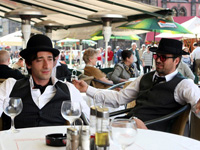
    (from left) Adrian Brody and Mark Ruffalo in The Brothers Bloom• A little news from my homeland: Michael Cieply reports on Durham, North Carolina finally getting its Hollywood day in the sun. [The Carpetbagger]

    • Revisiting Stephen Frears’s “The Queen” on the basis of entertainment and history. [The Guardian]

    • Rachel Abramowitz profiles new “Angels & Demons” starlet Ayelet Zurer. [Los Angeles Times]

    • Director Frank Darabont’s 223 favorite movies. [Empire]

    • Kim Voynar wonders where the muscle-bound estrogen is at the multiplexes this summer. [Movie City News]

    • Brooks Barnes reports on “Kung Fu Panda”‘s transition from animated film to Nickelodeon TV series. [New York Times]

    • Maria Puente on the many visions of Salvador Dali on film. [USA Today]

    • The home of “Slumdog Millionaire” star Azharuddin Mohammed Ismail has been demolished. [Wall Street Journal]

    • In honor of the “unbearable start” of “The Brothers Bloom,” Christopher Campbell writes up a list of 10 films ruined by voice-over narration. [Spout Blog]

  • Enough already

    Right, so Michael Sheen obviously ignored my career advice to lay off the biopics for a while. That’s okay. He’s a lot more famous and successful than I am, so I guess he probably knows best.

    But seriously, a third go-round playing Tony Blair in yet another factional Peter Morgan-scripted project? If you haven’t heard already, “The Special Relationship” is a planned BBC/HBO collaboration covering the political allegiance between Blair and Bill Clinton at the tail-end of the century. From the Guardian:

    Michael Sheen is due to return as the former prime minister for the third time, alongside Helen McCrory, reprising her Cherie Blair from The Queen. Dennis Quaid is attached to play the ex-US president, reportedly beating Russell Crowe, Philip Seymour Hoffman, Alec Baldwin and Tim Robbins to the role. Julianne Moore is lined up to play Hillary Clinton. Morgan intends to sidestep casting of Monica Lewinsky by showing the former intern solely in archive footage, including video of her closed-door testimony to Congress.

    Sure, Sheen has that particular impression nailed, but what does he (or we, for that matter) stand to gain from reprising it once more? He’s a gifted actor, no doubt — but I can’t be the only one who’d like to see him expand his range a little. (In any case, wouldn’t it be interesting to see another actor’s interpretation of the role?)

    Much the same, in my opinion, goes for Peter Morgan, who is apparently set to make his directorial debut with this. I’d love to see his evident grace and wit as a dramatist put to work on something loose and fictitious — perhaps even more genre-based. Anyway, kvetching aside, I’m sure this will be a typically classy, intelligent effort. Just wake me when it’s over.

  • Well, it sure sounds pretty

    If, like me, you’re writhing in frustration at not having seen “The Curious Case of Benjamin Button” yet, here’s some minor compensation — you can listen to it instead. The score, that is.

    As you’re surely aware, it’s by Alexandre Desplat, who happens to be my favourite modern composer. That his only Oscar nomination thus far has come for his comparatively unadventurous work on “The Queen” is a shamefully inadequate testament to the creative breadth of his oeuvre.

    His balancing of romanticism and minimalism in “Birth” made for the greatest score of the decade, in my opinion, while the snubbing of his lush, culturally expansive score for “Lust, Caution” was just one of numerous ways in which the Academy’s music branch proved themselves unfit for purpose last year. I could go into his equally gorgeous work on “The Beat That My Heart Skipped,” or “Girl With a Pearl Earring,” or “A Self-Made Hero,” or several other titles, but time is of the essence.

    Anyway, suffice to say that his “Button” score sounds as layered, intelligent and seductive as you’d expect from Desplat — I can’t imagine the music branch turning a blind eye (or ear) to him this time. I only listened to a little, as I want to experience it in its entirety for the first time in the context of the film… I’m pedantic that way. But if you’re so inclined, check it out on the film’s BAFTA For Your Consideration site.

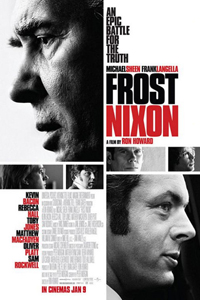
  • REVIEW: “Frost/Nixon” (**)

    Universal Pictures\' Frost/NixonLondon Film Festival

    For director Ron Howard and screenwriter Peter Morgan, “Frost/Nixon” was always going to be a tricky beast to handle. A film adaptation of Morgan’s own stage play that was itself very much about the powers of television, the relationship between text, medium and audience has shifted in ways I’m not sure the film’s makers have fully accounted for.

    It is one thing to portray a momentous televisual event on the stage, where the intimacy and crackle of live human interaction allows for a very different, and rather more immediate, experience of the proceedings. It is quite another to recreate said event for  television’s closer cousin — with the legendary interviews between David Frost and Richard Nixon that form the spine of the narrative widely available, the film has to recreate the spontaneous feel of history in progress, and in doing so, reveal something in a 30-year-old document that we haven’t already seen.

    It’s a tall order, and with Morgan’s script hewing closely to its source, Howard responds to it in the manner he knows best: with the most prosaic of visual aesthetics to hand, a doggedly linear approach to storytelling and the spotlight thrust squarely on a reliable pair of actors. The approach only gets him so far.  Howard’s hands-off direction makes for an oddly bloodless viewing experience, with a lot of talk standing in for any fresh perspective (or frankly, much of a perspective at all) on the events.

    To be honest, we could have seen this coming. It’s difficult to think of a director less-suited to take on the intricate, minutiae-obsessed writing of Peter Morgan than Howard — a director who, even in his finest films, has always been interested in the big picture first, with characters serving history rather than the other way round.

    (more…)

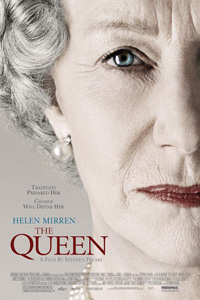
  • REVIEW: “The Queen” (***1/2)

    Miramax Films\' The QueenStephen Frears is one of the most versatile working directors in the industry.  With that versatility comes the inevitable misstep from time to time, sure.  But also with it comes a high order of professionalism and a certain amount of confidence that can manifest the most precise of cinematic creations.

    “The Queen” is just such a film.  Carefully calibrated and wound to a specific 103 minutes, it is a modest and fine hour for a director who has been cranking out work of the highest quality for over two decades.

    “The Queen” tells the behind-the-veil story of the days following Princess Diana’s tragic death in August of 1997.  As the world mourned the passing of one of the most important political figures of the 20th century, Queen Elizabeth II (Helen Mirren) and her family holed up in their Scotland compound, choosing to handle matters with restraint, dignity and in privacy.

    Newly appointed Prime Minister Tony Blair (Michael Sheen), with his sites set on modernizing the outdated government and bringing it back in touch with the people of the land, felt the decision to refrain from public access was detrimental to a country that desperately needed guidance and to share in the grief.

    The “black sheep” opinion the family had of Diana was an unpopular stance to say the least.  While they always saw her as a blight on the crown, the citizens of England saw her as the people’s princess, one of their own, and a woman unwavering in her desire to make the world a better place.

    Only a year divorced from Prince Charles (portrayed in the film by dead ringer Alex Jennings) when she died, Diana had endured public embarrassment after Charles’s well-publicized, long-term affair with Camilla Parker-Bowles.  Diana herself admitted to her own extra-marital affair as well, but it goes without saying, the marriage was an unhappy one.

    Hounded by the media and ultimately the most photographed person ever, Diana’s life was never her own.  That turbulent year was perhaps the most difficult for her in that regard and it might be too easy to say the media killed her in the end.  It may be more applicable to say the very nature of celebrity killed her, but regardless, even in death, she would rally the attention of a billion people who tuned in to view her public funeral (a festivity proposed by Tony Blair and fought against by the Royal Family).
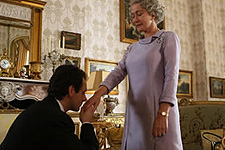
    Michael Sheen and Helen Mirren in The QueenThe relationship established between Elizabeth and Blair is a delicate one, and certainly a dramatic one.  It might be the oldest story in the book, but it is still one of the most relevant.  The clashing of policies is something the world will struggle with until we are no longer the dominant species.

    Blair’s progressive ideas about leading with the people, not ahead of them, was outlandish to the Queen and, most especially, to Prince Phillip (James Cromwell).  Those disagreements truly came to a head that week, and their focus was rightly on the well-being of William and Henry, two boys who lost their mother and should be shielded from the poisoning words of the media.  But as they retreated, their country grew impatient and, ultimately, aggressively disappointed.

    Dame Helen Mirren is absolutely irresistible in the role of Queen Elizabeth II (she ironically just won an Emmy for portraying Elizabeth I).  Though it is not the powerhouse, Oscar-lock performance that shatters perceptions and announces itself with determination, it is nevertheless a collected and well-maintained turn.

    The stiff upper lip of the Royal Family really is carried across well in this regard.  James Cromwell’s Prince Phillip is specific in his conservatism, while the humor of Charles’s paranoia provides a nice balance.

    As Prime Minister Tony Blair, Michael Sheen does a capable job of conveying a political figure who would become increasingly controversial himself.  Frears’s film hits a thunderous note in that light during a coda in which Elizabeth looks Blair square in the eye and tells him his country will turn on him, too, one day, “Quite suddenly, and without warning.”

    These are the delicate touches of meaning that go toward crafting an exemplary film.  The screenplay was penned by Peter Morgan, who also co-wrote the amazing adaptation of Kevin Macdonald’s “The Last King of Scotland.”  His work comes as a result of extensive interviews and information from discreet, informed sources inside the momentous event.
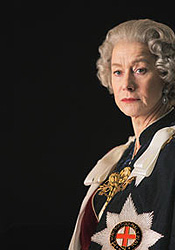
    Helen Mirren in The QueenStephen Frears does what he is best at in “The Queen.”  He steps aside and lets the story tell it self.  He has always been what I consider a “screenwriter’s director,” as he seems ever capable of letting the writer’s words play on the screen as they should.  He never leaves a fingerprint, other than the strong scent of competence that can be found even in his lesser efforts.

    He also handles the material without fuss, getting out of dodge when the work is complete.  You’ll never find a Frears film meandering or losing itself, and that’s a trait most directors never exhibit with such consistency.

    Though it revolves around an event that occurred nine years ago, and prior to the post-9/11 environment we endure today, “The Queen” is very much a current piece of filmmaking.  It is about the necessity for a leader to be in touch with his or her people.  It is about respecting tradition while understanding the need to extinguish it all the same.  It is about finding a balance and, if not maintaining that balance, at the very least striving for it at all costs.

    “The Queen” could be seen as quite applicable to our current domestic political environment, or it could simply be enjoyed as an airy, pleasant endeavor with no frills.  But isn’t it the best of cinema that finds <em>that</em> balance?